

There are questions that humanity has been dragging behind for centuries. Are we alone in the universe? Is there free will? Was egg or chicken born first? Team Lazerbeam decided to focus on something much more important: What would happen if Slay the Spire was a first-person dungeon crawler populated by psychedelic fungi and allowed us to eat our enemies to recover health?
Finally, someone had the courage to ask.
Published by Devolver Digital and landed in Anticipated Access on Steam,Shroom and Gloom is a roguelike deckbuilder that takes very little time to make you understand that you have something different to tell. Not necessarily because it revolutionizes the foundations of the genus, who has a few hundred hours between Slay the Spire, Inscryption and company will immediately recognize several familiar elements, but because Team Lazerbeam takes those foundations, the mold covers, draws them by hand, passes us over some substance probably illegal and finally builds us around a system adouble deck That works damn well. The result is one of those games able to initially draw attention with an artistic direction out of mind, and then hold it back thanks to something much more important: the gameplay
This content is provided by YouTube. To view it, you must allow external content. Activation may result in data being shared with the third party.
Two bouquets is megl
The concept around which everything revolves around Shroom and Gloom is as simple as smart: instead of using a single deck for any activity, we manage two completely different. The first is dedicated to combat and contains all that is needed to massacre the local mycological population. Attacks, effects, combos and various amenities with which to transform a nice walk in the woods into a fungal genocide. The second deck is used during exploration.
Shroom and Gloom does not leave us in front of the classic two-dimensional map consisting of icons to be selected. The dungeons are crossed in the first person long routes, moving physically through corridors and rooms designed by hand. During these moments, cards can open doors, dissor rewards, change other cards or interact with what we encounter along the way.

You see an X suspect on the ground? Pala.
A closed box? Key.
A frog? Well, of course you lick it. Don't ask questions.
It is precisely the separation between Fight deck and exploration deck to give the structure its own personality. We are not simply choosing which room to face after, but deciding how to use resources that could profoundly affect the rest of the run. Exploring more for a long time can allow us to further improve the deck, but each deviation has a cost and inevitably comes the moment when you have to wonder if another strengthening really is worth the risk.
The answer, of course, is almost always yes.
And that's how you die.
Today a card, tomorrow an abomination
If the double deck is the most immediately recognizable idea, it is card growth to turn Shroom and Gloom from “deckbuilder very cute” to something that seriously risks eating different hours of your life. Team Lazerbeam wants the cards to grow, not metaphorically. A poor initial card can be upgraded, modified and evolved to become a statistical abomination completely disproportionate to the piece of virtual cardboard from which we started. The effects begin to concatenate, the multipliers rise, a card activates another and suddenly what five minutes before inflicted a vaguely offensive damage to the opponent is erasing half the ecosystem. It is that particular form of satisfaction that the best deckbuilders know very well.
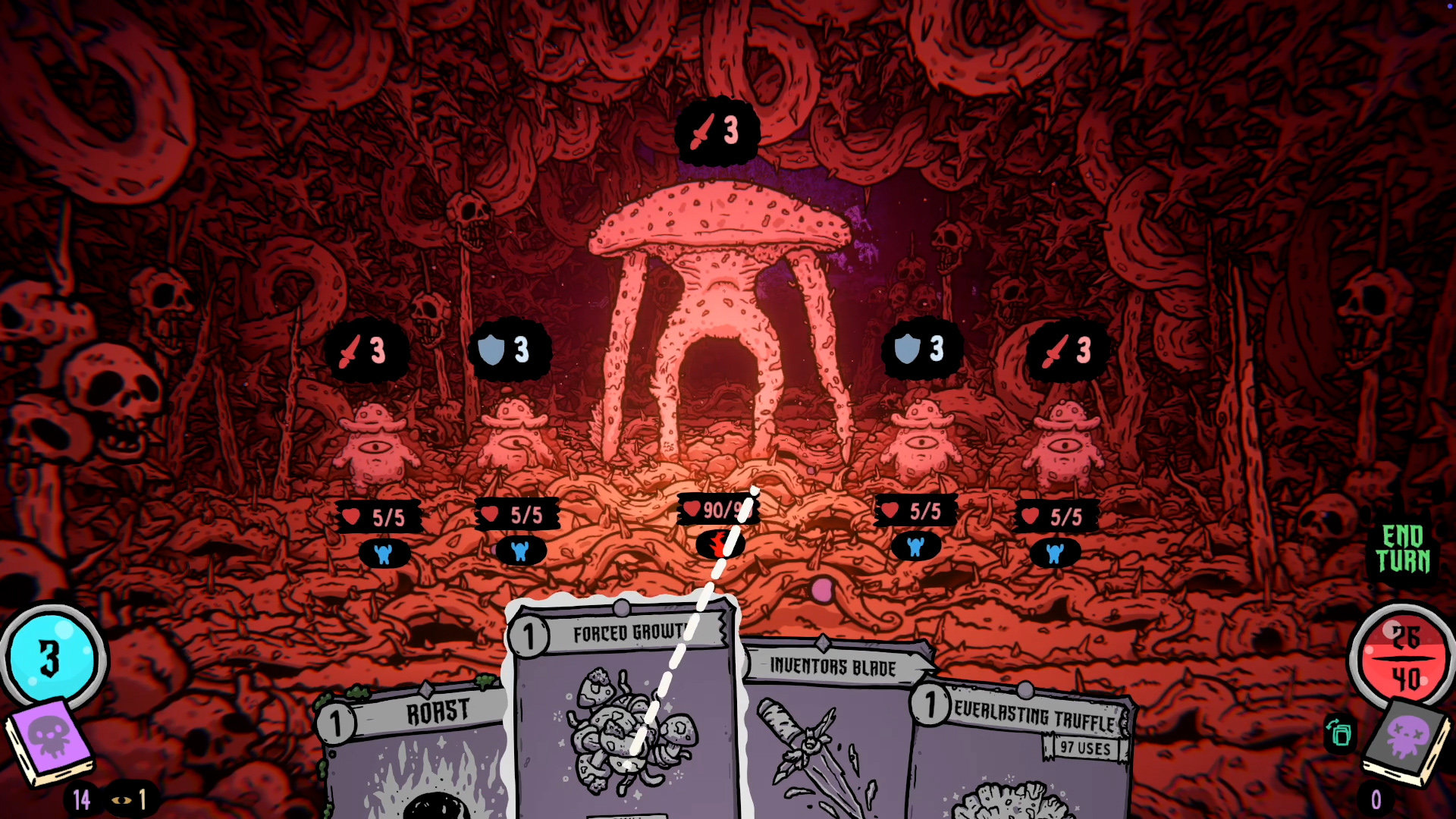
Small number becomes large number. Happy Neuron.
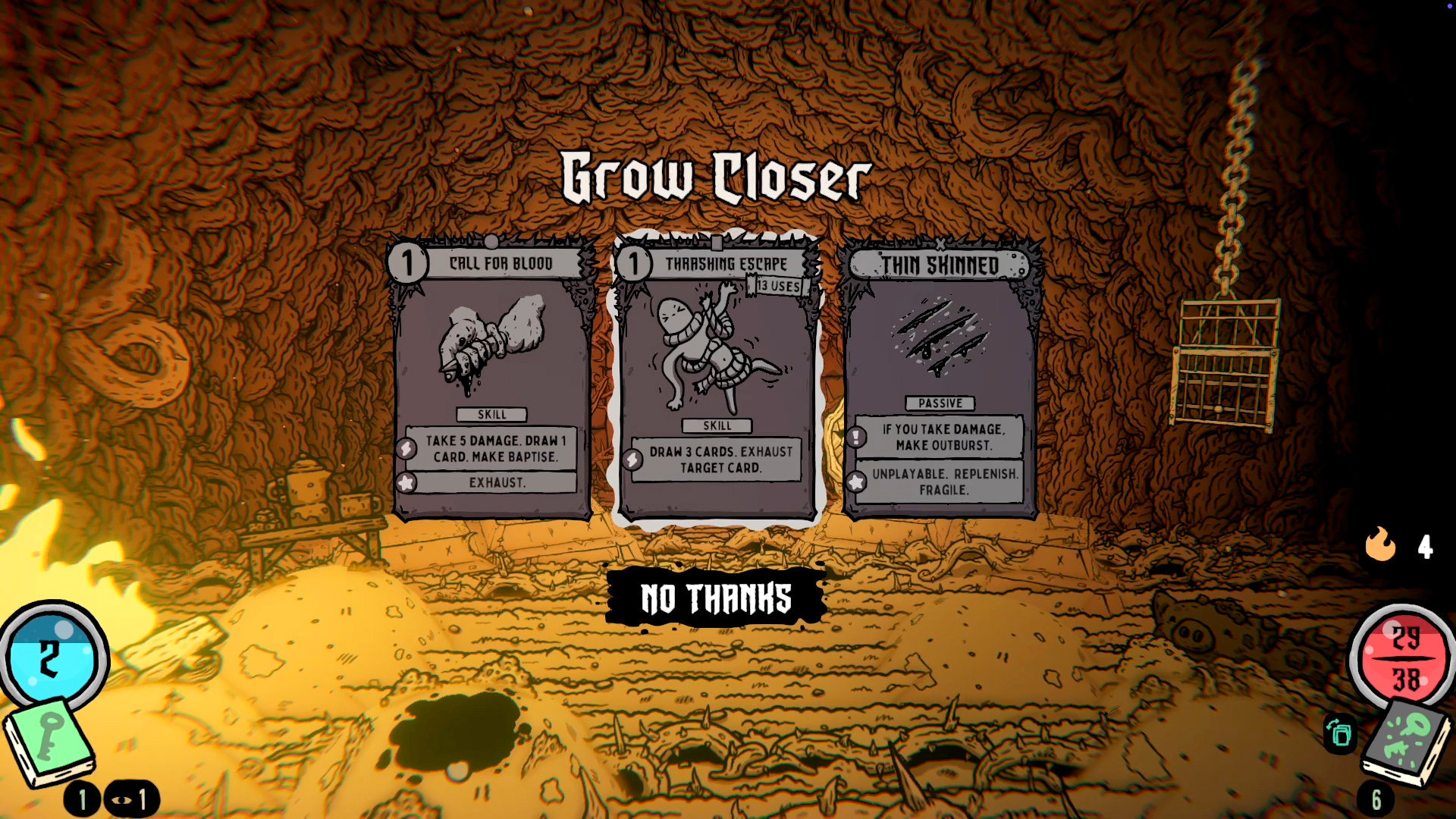
Yet Shroom and Gloom is able to avoid, at least for now, one of the most frequent traps like this: to make everything unnecessarily cryptic. Synergies require attention, of course, and in the first games you must inevitably learn the language of the game, but the functioning of the cards remains generally understandable and above all legible. The true depth arrives when you stop taking any card is kindly offered. Why not? more cards does not necessarily mean better deck. In fact. Eliminating less interesting initial options quickly becomes as important as adding new ones and building an efficient deck means learning to say no even in front of the perspective of a seemingly interesting toy.
How do you delete cards? Licking a frog, of course. I told you not to ask questions.
The most dangerous fungus is what you didn't plan
The strategic component works mainly because Shroom and Gloom does not seem particularly interested in giving us victory. The meta-progression exists, but does not follow that philosophy typical of many roguelites that, after enough attempts, statistics and permanent upgrades inevitably end up transforming even the most distracted player into a war machine. Here you unlock cards, characters and above all information.
The world remains progressively more readable and knowledge acquired in previous runes allows to better plan the next one, but an exceptional build can still be demolished by a wrong decision sequence. And it's a feature we enjoyed a lot. Shroom and Gloom wants you to think not only about the card we are about to play, but potentially about what will happen five, ten or twenty moves later. The reward does not simply come from possessing a powerful combo: it comes from having voluntarily built the conditions so that the combo could exist.
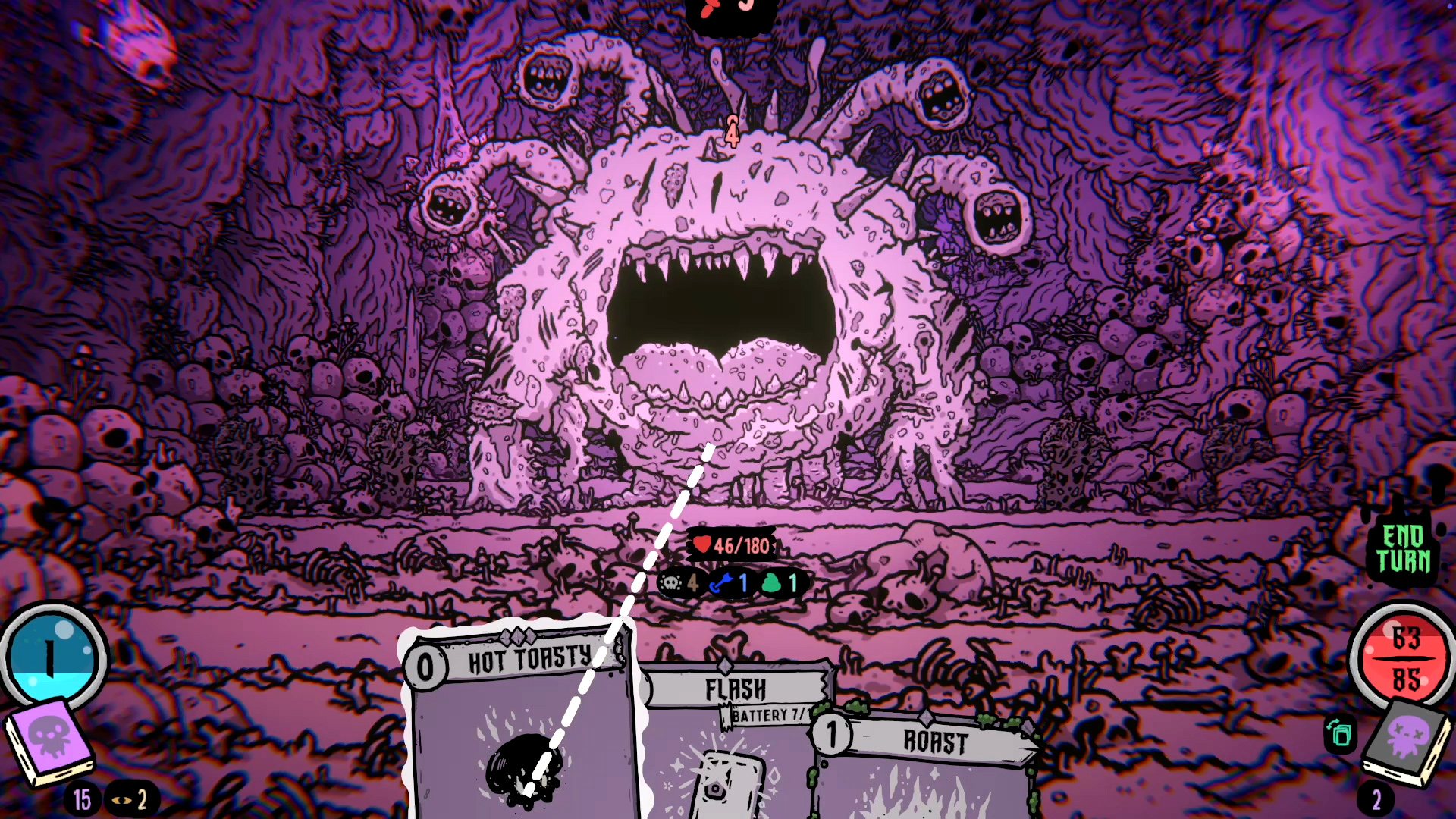
The characters also contribute to progressively expanding this complexity. The first approach is relatively simple and perfect to learn the rules, while the next ones introduce more and more specific gimmick. The LadyFor example, it builds a large part of its identity around food and can exploit it to fuel a progressive growth of its power. The Janitor, instead, plays with cards progressively dirty by negative effects and then clean them up and exploit this cycle as part of its strategy.
They are not simply skins with a couple of different statistics: change the way you interpret a run.
And that's exactly what we want to see from a deckbuilder.
Don't eat that mushroom. Or maybe.
Then we get to the care system. Normally, in a card game, we would expect blocks, shields, potions or some other very trivial invention developed by mentally stable people.
Shroom and Gloom prefers another approachKill the enemy. Cook it. Eat it. Problem solved. Several effects allow roasting, infiltration or transforming poor malcapitates into usable food to recover health. Some can even end up in a pot to create soups with particularly powerful effects. It is perfectly consistent with the rest of the game. In fact, food is not just a red button written “care”. It can become offensive resource, survival tool, build component and even integral part of the identity of some characters. Here again is the feeling that every system has been inserted not only because it made someone laugh at a development meeting (although we imagine it has happened) but that it could actually dialogue with everything else.
The difficulty, at least in the present state, seems to us challenging but rarely unfair. When you lose, very often you can also identify the decision that started the slow down to disaster.
Of course this does not prevent insulting the monitor. We're still human.
Inscryption after a bad food poisoning
And then she is. The artistic direction.
It's probably enough for ten seconds of Shroom and Gloom to see if it's aesthetically good for you. Hand-drawn illustrations and animations are inserted within three-dimensional environments, generating a strange contrast that seems to be somewhere between an illustrated book for children, Inscryption and a 40-fever after eating something found under a trunk. It works beautifully.
Each card seems designed with its own personality, the fungi can be both funny and vaguely disturbing, and the rooms have that psychedelic tone that can be surreal without becoming visually incomprehensible. It's a style dirty, colorful, grotesque and immediately recognizable. Especially, it does not seem to have been built simply to produce interesting screenshots on Steam.
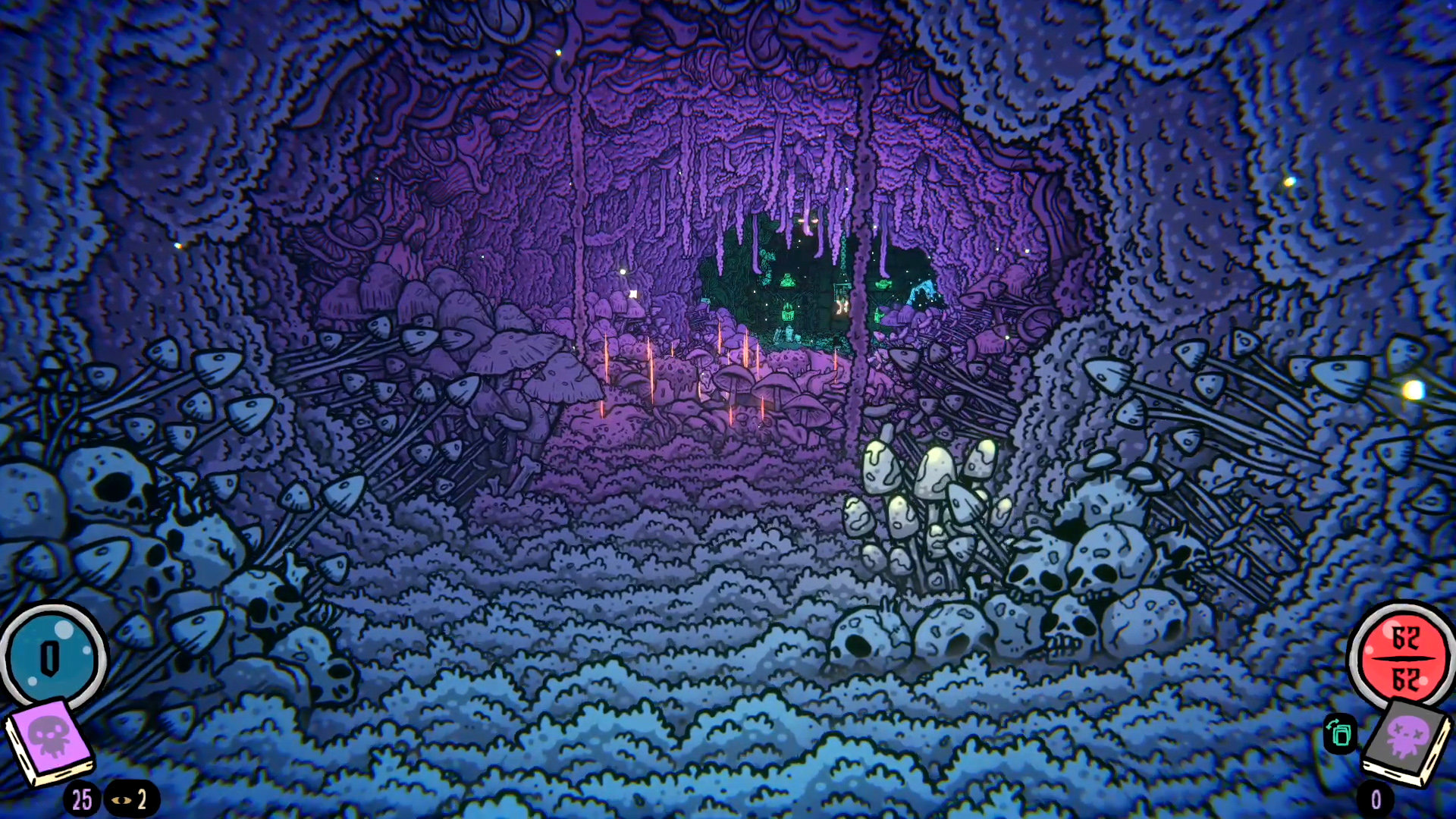
The passage between exploration and combat is natural and the perspective in the first person manages to give physicality to what, structurally, still remains a card game. To really enter the rooms, see the opponents in front of us and move between corridors built as gigantic illustrations makes exploration much more engaging than the classic succession of knots on a map.
And considering how difficult it is today the new deckbuilder roguelike without immediately appearing the new deckbuilder roguelike, it is not a result recently.
Technically speaking
On our system equipped with NVIDIA GeForce RTX 5080, AMD Ryzen 7 9800X3D and 32 GB of DDR5 RAM, Shroom and Gloom does not clearly represent a particularly challenging test bench and the experience has been smooth. Moreover, despite the use of three-dimensional environments, the bulk of the visual impact comes from art direction and illustrations rather than from the desire to fire the GPU. The more interesting is the speech related to controls. Mouse and keyboard represent the best solution at the moment. The support to the controller exists and you can already face the game almost entirely in this way, but the Anticipated Access still makes you feel in some interactions and in the consultation of certain contextual information.
Curious situation also on Steam Deck. Despite the title can be reported as unsupported, in practice it is already possible to play discreetly and, by structure, Shroom and Gloom lends itself magnificently to a portable device.
The problem is not so much to turn it, but to ensure that the interface and control system are completely comfortable without mouse and keyboard. And it is probably one of the aspects on which Team Lazerbeam should intervene with greater priority during the Early Access, because a deckbuilder like that on Steam Deck is practically legalized digital cocaine.
In conclusion
Shroom and Gloom arrives in Anticipated Access with something that many titles manage to build only after years of updates: a clear identity. Do not reinvent the deckbuilder roguelike and, frankly, does not need any. It takes familiar ideas, recombines them through a really significant double deck system and builds around card growth, exploration and resource management an extremely rewarding loop. The possibility of progressively transforming insignificant cards into monsters capable of food combo increasingly absurd works beautifully. The double deck prevents the exploratory phase from shrinking to a simple walk between a fight and the other, while the culinary system is so absurd that it initially seems a little more than a gag, except to be an important part of the build construction. Above all, Shroom and Gloom does not forget that a good roguelike must be able to make us feel smart when things work and perfectly responsible for our death when they do not work. It is precisely this feeling of control, combined with the possibility of planning more and more elaborate combos and interactions, to make each run sufficiently different to justify the next one. Of course we are still in front of a Early Access. The support to the controller needs further work, the variety available today will have to continue to grow and, after many runes, some elements inevitably begin to lose part of the surprise effect. The foundations, however, are there and are damn solid. Team Lazerbeam managed to build one of those games where “I make only another run” quickly becomes a sentence without any relationship with reality. This is how we find ourselves, without realizing it, at night after having licked three frogs, eaten fourteen sentient mushrooms and spent the last ten minutes studying a card in an attempt to understand how to increase a multiplier of 600%.
Devolver Digital, once again, seems to have found exactly the kind of weirdo we expected to publish Devolver Digital.
About the Author

Biography
- Staff di KotaWorld.itRecent Articles
- The Walking Dead: Streets Of Survival – The real monsters are still humans (Review)
- EVE Vanguard opens its Alpha 24/7 in November, Steam Early Access postponed to 2027
- Astrae Oratio shows itself at the Tokyo Game Show: first playable demo and mobile launch in 2027
- Princess of the Water Lilies: Definitive Edition comes to PS5 with a completely renewed version
- MONOWAVE is available on PC e Nintendo Switch