With a long past behind me as a 90s "darkettone", if there is one thing that I have always liked even when it was not yet cool it is the vampire fantasy that ranges from classic films such as "Dracula" to the games of "Vampire: The Masquerade" (which I even juggled live for a period) passing through comics ("Hellsing" mon amour!) and so on. Let's be clear, the Vampires with a capital V and not the ones that sparkle. However, to have assisted me in this review that seemed tailor-made for Noldor there were another pair of hands: those of Akeno, to whom I send a dutiful thanks, a warm hug and a pacifier of the neck.
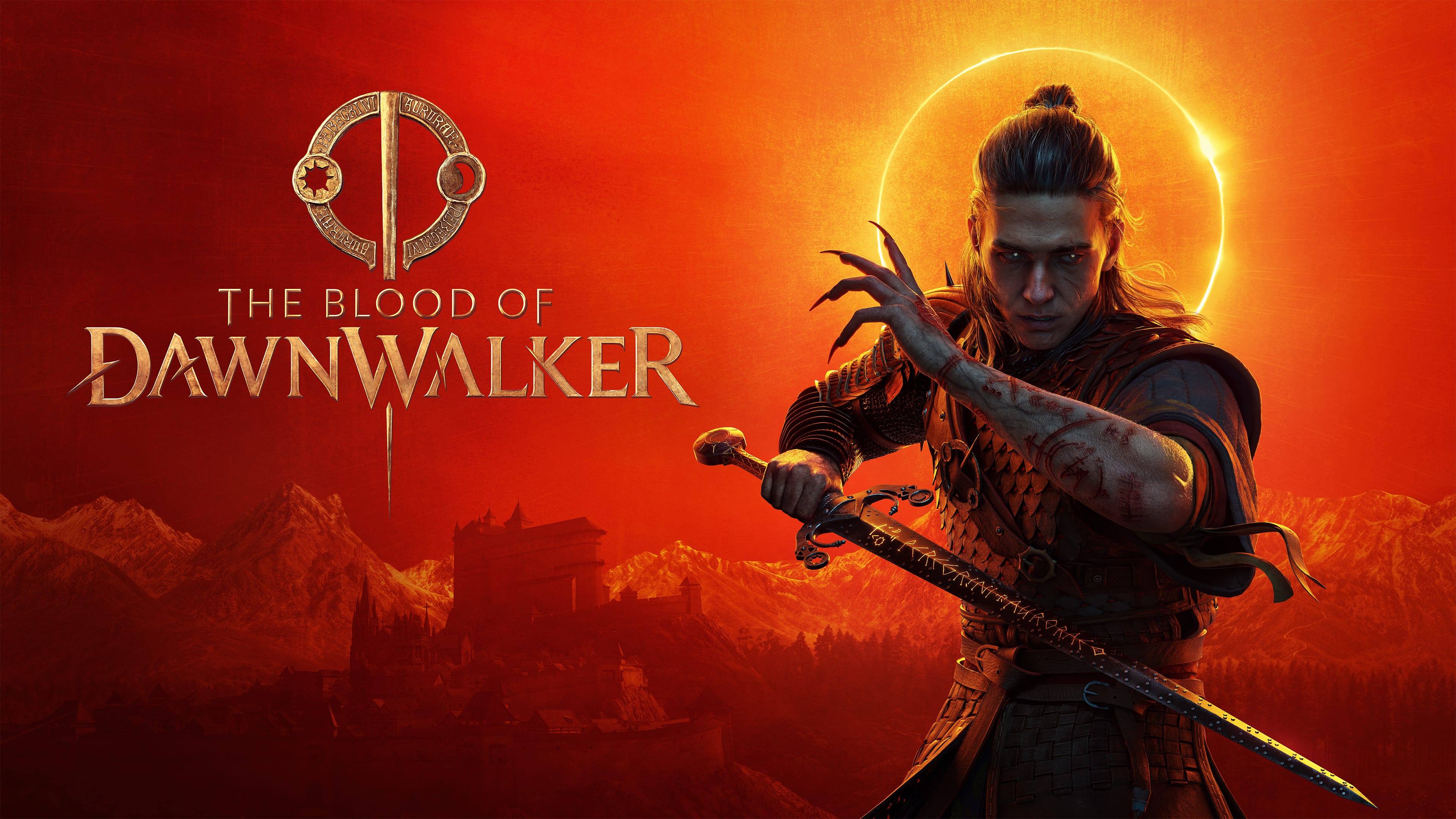
First of all, what is The Blood of Dawnwalker (which I'll abbreviate with TBOD from now on so as not to tire my old fingers)? Can you say "The Witcher" by day, "Vampire" by night, flavored with "Zelda: Majora's Mask" and with a je ne sais quoi of "Dragon Dogma II"? Ah, you can't? (Editor's note: to be read by quoting a famous meme).
There is a lot to say about TBOD, so make yourself comfortable, stay hydrated and get ready to read a long review, because if there is one thing that is clear from the first minutes of the game it is that TBOD is full of ideas. Not necessarily all perfect, not necessarily all developed to the end, but ideas ... And in a genre like that of open world action RPGs, where it is now very easy to take a gigantic map, fill it with question marks and exclamation marks and call it freedom, it is by no means a trivial thing.
… And instead Rebel Wolves (among others a studio founded by veterans of CD Projekt RED), decided to build its first game (published by Bandai Namco) around a rather simple and at the same time surprisingly brave concept: you don't have freedom. And it works damn well.
Keep time
Thirty days and thirty nights. After the prologue, the quest through which the entire game will develop (that is: save your family from a horrible death) will give you a time limit to be completed and every important activity we decide to tackle (including leveling!!) will take away a part of it.
It almost seems like a trivial thing, but it changes a lot the way you look at an open world, because if in "The Witcher 3" we could easily spend a virtual week playing Gwent while Ciri patiently waited for our arrival, here every side quest begins to have a weight ... And are you sure you want to hunt for question marks (or exclamation marks) if you are not sure how close each of them brings you to the final goal?
In any case, you will play the role of Coen, a young villager from a village in Vale Sangora, a fictitious mountainous region of the Carpathians of the fourteenth century with a not too Romanian name, which - devastated by plague and internal violence - goes from the proverbial frying pan to the fire when "too much blood is spilled carelessly" (to use the words of the villain of the game) and the Vrakhiri (i.e. vampires) are awakened (the reason is not too clear from the prologue) who take control of the valley with disarming ease and force their subordinates to provide blood and blind obedience in exchange for an all in all peaceful coexistence. Let it be put on record that all this is told in a starting movie that seems to be in a hurry to finish immediately and that seems to be made with a steadycam since in my opinion there is too much movement for the 30 fps of the movie (alas, a sore point of all those in the game) and my poor tired eyes suffered from illness.
Coen, whose name I'm not too convinced of, since this is also a Hebrew name not too common in Romania, has a mother who is not well but who is still "drunk" during the weekly pacifier and, to make a long story short, at a certain point she gets the zebedees turned.
The Vrakhiris, however, make them spin even more whirlwind and more particularly Brencis who, being their leader (irony: on) has the most Romanian name of all (irony: off). This is followed by the total extermination of the village, the kidnapping of Coen's family and the transformation of the latter into a vampire: a mockery that Brencis will want to give to our protagonist as punishment which, however, will turn out to backfire on him.
Our hero will be left dying to tan the sun's rays, but something unexpected happens and he finds himself instead a boring swordsman by day and a beast of Satan who doesn't need toothpaste or manicure at night.
From here on time management will become crucial. Forget for a moment the philosophy of the modern open world according to which every square centimeter of the map must be filled with activities. Here the concept is different: you can't (shouldn't) do everything. The days are divided into day and night, each of which has a certain number of hours available that the activities consume, some missions become available only under certain conditions, others can be failed and some situations evolve while we are busy elsewhere.
This means that a secondary quest is no longer just a way to level up, but a choice... Because we don't have a world waiting patiently for us, but one that goes on. It lives. And it's one of the most interesting things that TBOD can do.
This is a philosophy that in my opinion is much more reminiscent of "Majora's Mask" than it may seem and the paradox is that the system in TBOD could have been even more aggressive! At several times the pressure of thirty days is not as oppressive as the idea would suggest and the game still leaves us a lot of room to explore. So it hosannas hands down to a system that dares (and does not always reach perfection) compared to yet another open world in which time is only an accessory to restore the health bar or little more than a tinsel.
This type of mechanic also makes the title infinitely more replayable than its competitors because you will always have that itch that "if I had done this other thing"... Then even if I haven't watched other reviews or videos or explanations so as not to spoil it, I know that there are several endings, which contribute to titillating this desire to start it again. All this is also assisted by a sort of "classes", whose skills also – as I mentioned earlier – are learned in exchange for levels and... time, so only a certain type of mix of these can be perfected and this changes the way you approach the game a lot (especially the fights).
Finally, but maybe here it's me who makes too many castles in the air, limiting time also allows you to limit space, so it allows the developers to make a great map, but a big map: a memorable place with its own identity. Because if there's something that bothers me personally, it's playing clones of clones of clones of the same trite stuff ... And maybe Rebel Wolves has shown that gamers like me have understood something to remember, not simply the next AAA title with hype on social media. The villages, forests, ruins, camps and settlements of Vale Sangora help build a coherent, dirty and decadent world. The world seems to have a history before we arrive and the depth of the dialogues (all dubbed) reflects that.
The comparison with The Witcher 3 is inevitable and not only because part of the team comes from CD Projekt RED. There is a common philosophy in the construction of the missions, in the characterization of the characters and above all in the way the game tries to avoid that every choice is immediately classified as "good" or "bad": sometimes you just choose and then live with the consequences. It is a structure that is also partly reminiscent of Gothic, especially for the way TBOD tries to build a world in which the protagonist is not necessarily the absolute center of the universe.
Everything vampire... sparkles
The problem is that alongside ideas of this caliber TBOD also puts on the table stuff like a parkour that seems to have been designed by someone who has never had to jump a fence sponsoring a well-known seed oil (if you don't know what I'm talking about it's because you are part of a generation of young people), a combat system that frequently argues with camera and lock-on, and an optimization PC that at different times makes the question arise: but what has my computer done wrong?
But let's eviscerate each of these aspects in order. Coen, although magic or vampirery... vampirage... vampirosity... in short, that stuff there allows him to move at superhuman speed, is not exactly an example of agility. The character tends to be wooden and unnatural in movement, but the problem becomes particularly evident when parkour comes into play. In an open world of this type, being able to overcome obstacles, climb and take advantage of the environment should make exploration more fluid... The problem is that the system seems to constantly need to understand what we want to do.
We approach an obstacle and Coen slows down. We move slightly and he freezes. Do we change angle? He gets stuck. Which then in a mountainous region with rocks of all types and shapes is not really the maximum and becomes even a little worse if you put a mechanic that allows me to walk on walls, but it takes the press of a button to climb over the corner and it does not do it with a physical transition but with a gimmick.
What should be a natural movement becomes a kind of diplomatic debate with obstacles... And the result is that the movements do not have the fluidity that one would expect from a role-playing game released in 2026.
Which then makes me gnaw even more because the management of the entirely rocky areas in which practically the other games do nothing but make you slide down the valley ruinously is even more decent than the rest of the titles!
Above all, the problem is not only aesthetic. In an open world , moving well is part of the gameplay and if crossing an area becomes an exercise in precision to understand from which angle the game will finally recognize the obstacle, the feeling of fluidity is inevitably reduced.
As for the combat system, here we are faced with one of those aspects that in theory seem much more interesting than they appear after several hours, because the basic idea of attacks and parries from four directions would not be too bad either. The reading of the animations and space management should make the clashes more reasoned than the classic action RPG in which you press the attack button until someone dies.
The problem is that the camera and aiming system often seem to have completely different ideas from ours. The game seems to give a sort of automatic priority to the enemy that is attacking us and for heaven's sake, the concept could also make sense, especially in encounters where you are forced to face 4-5 enemies and everyone is happy to slap you with their swords. The problem is that at the same time this priority limits the rotation of the camera a lot, so it happens that you want to change targets, see what is happening on the sides or simply prepare for the attack of another enemy and find out that the camera has decided on its own that no, now we have to look at that enemy there. That if you then want to parry and use a counterattack ... you can only hit once and you have no room for combinations (but we'll get to that in a couple of lines).
The lock-on, then, does not help. Once activated it becomes quite cumbersome to control what happens on the sides of the character and change targets without first deactivating it. In a fight against multiple opponents you are therefore more focused on trying to notice the red arrows (where the attack comes from) in time than watching the action. You are no longer fighting only against the group of enemies: you are fighting against the system that decides which enemy you should look at.
We said that after a parry the next first attack always tends to be directed towards the enemy we have just repelled even when our focus was turned elsewhere. During a frantic fight this can become very annoying, however, because the player thinks he has given a command while the game executes another... And in a combat system in which timing and positioning should be fundamental, this discrepancy weighs heavily.
The handling of attacks coming from multiple directions is also not always convincing. When another enemy is about to hit us, the game tends to move the camera slightly to suggest its presence. The idea would also be good, but the execution leaves a bit to be desired, as the timing is tight and quite punishing and instead of clearly communicating "attention, an attack is coming from this direction" it often gives the feeling of saying: "in half a second something will happen. Good luck." with the result that the fights are unbalanced in favor of Coen in 1vs1 and in favor of enemies with groups of 3 or more enemies.
Another aspect that left me quite perplexed concerns the large camps where TBOD shows one of its most obvious limitations. On the one hand we have a game that tries to build a reactive world, in which people have routines, missions change and time passes, on the other hand we enter a large enemy camp and suddenly everything seems to become a wave arena, where enemies basically stay in their own areas and attack you only if you enter them.
There doesn't seem to be a real management of the general alert: we go through a gate, a door or a door and suddenly the fight starts and at that point the enemy of all realism also appears: the invisible wall. We may have entered a huge outdoor camp, but once the combat starts the game decides that this is our new universe.
You can't get out. You can't just change strategy. You have to fight. For heaven's sake, I also understand it from the point of view of game design: it's certainly a functional solution, but also terribly artificial! Which then above all clashes with the systemic ambitions of the game. Comparing it to "Gothic" or, in a different way, to "Kingdom Come", it is natural to wonder why a game that wants us to believe in the consequences and responsiveness of the world has to resort to such visible solutions to manage a simple fight.
Even the interface did not completely convince us. We have available: 4 consumable slots that can be activated with the now traditional directional keys of the gamepad and a button, however, transforms it into a skill quickslot . Necessary? No. During fights it is already difficult to parry, counterattack, distance, use consumables ... let alone if I have to push an additional button to change the quickslots and a new direction on the pad to use the skill. Especially when there is a nice wheel of all the skills that can be activated by holding down a button and which, among others, sends the game into slow motion.
The skill and consumable wheel should be a quick tool to manage our arsenal and instead the system is more cumbersome than it should be. Akeno ended up leaving consumables active practically always and using skills through the wheel, I only used life point restoration consumables (also because you don't lose so much stamina ... boh, maybe at higher difficulty levels than "normal"?). Bon, surely it won't be a tragedy, but it's another small example of how Dawnwalker has interesting ideas that he doesn't always manage to turn into perfectly readable systems.
… And then in my opinion there are several systems to rebalance: skills that have cooldowns and "activation points" that recharge passively and with parries and counterattacks scored (but why?), skills that are practically unusable because they drain your life points, completely useless passive talents (why should I ever increase the transportable weight when it will practically never happen that I am full?), prohibitive prices that make the improvement of your equipment useless and finally a somewhat boring looting experience with containers practically everywhere and stealing that practically serves no purpose.
Fortunately, when night comes, Dawnwalker regains a good part of his identity. In fact, Coen is not simply a human with some vampire powers but two things at the same time and if during the day the human side prevails, with traditional combat and abilities related to his mortal part, at night the powers and hunger (which is another cool thing, but I don't want to spoil it) of the vampire emerge. It is precisely this duality that makes the structure of the game interesting, because if during the day we play in one way, at night the way we deal with certain situations changes. Kudos to Rebel Wolves, but it's an idea that I would have liked to see even more in-depth (who knows, maybe in the next game...?). Because yes, at some point the question comes: "How much am I willing to become a monster to get more power?", but not with the strength he could have had.
EU, EU... Uagliò
So we come to the graphic sector and here we must distinguish two things: technology and artistic direction.
On the first front, TBOD didn't give me that "next-gen" feeling I would have expected from a 2026 RPG developed in Unreal Engine 5. There are very beautiful environments, great lighting and views capable of impressing, but technically the game doesn't always seem to justify the weight it imposes on the hardware and this difference becomes even more evident when you look at it next to other UE5 titles that have focused heavily on technical spectacularity. The point, however, is that Dawnwalker doesn't need to win a technology competition to be beautiful because the art direction is much more successful.
TBOD is not so much a title that makes you say: "Look what Unreal Engine 5 can do!" but more one of: "This place has a Madonna vibe." and, frankly, I prefer the latter.
The Middle Ages he proposes is gloomy and decadent, the Carpathians become a place where folklore, religion and horror mix. Religious iconography (which strangely is faithful to the real one) is often deformed, almost corrupted.
Lights, shadows, details and reflections do their job very well but... On PC we have a problem: if the artistic direction deserves compliments, the technical sector is probably PC the aspect that left us most perplexed. The issue is not only about the number of fps but according to both me and Akeno, there is a more general problem of scalability and consistency of performance. The game can become extremely heavy in some areas and, even more annoying, lowering the graphics settings does not always seem to produce a proportionate benefit. Finally, in the heavier areas the framerate can drop significantly even on recent hardware and there is no shortage of stutters that have now become a sort of trademark of many Unreal Engine 5 games.
And here we come to the usual speech: Is it the fault of Unreal Engine 5? Of the developers? Of the fact that we also have to sell to consoles and therefore we have to port? Of Venus and Saturn in opposition? Did the macumba at the pc the neighbor? Probably the reality is more complex than that (although I would be careful of the neighbor): UE5 certainly has some features that make the management of performance on PC particularly delicate, but in the end the player is only interested in one thing: the game must run well on his machine ... And in this respect Dawnwalker is not always up to par.
Even more annoying is the issue of latency on which, however, my opinion differs from Akeno's. Although I had no problems, Akeno complained about it and you will understand well that in a game where reactions at the right time are an integral part of the fight, it is not exactly a negligible detail and if I press a command and the game responds with a perceptible delay, I can no longer be sure that a mistake is really mine.
Added to this are reports of crashes (Akeno, I didn't have any) and a certain instability which, fortunately, does not seem to necessarily affect everyone in the same way, but which still contributes to giving the impression of a product that would have needed further polishing (which as of September 11, 2026, despite some 2Gb updates has not yet taken care of).
Coen ≠ Geralt
I have the arduous task of giving votes to a game that is difficult to judge.
I feel like I've written 10 pages of complaints about a lot of stuff... Yet, when I close the game, I am left with one feeling: I want to see what Rebel Wolves does next time. Why?
Because beneath the undoubtedly rough surface of Dawnwalker there is an RPG that somehow works.
Because this title has understood that it is not necessary to give the player everything. In fact, perhaps it is just the opposite.
… And so I liked it.
The thirty-day system works because it forces us to choose. Vampirism works because it introduces a second identity related to a different way of playing. The consequences work because they remind us that the world does not exist just to wait for our decisions and the setting works because Rebel Wolves has been able to create a place with a much stronger personality than the technical rendering of the technology with which it has worked.
Are all these great ideas surrounded by systems that haven't reached the same level of maturity? Without a doubt!
TBOD is not the new The Witcher 3.
It's not the new Vampyr.
It is not the new Gothic.
It's The Blood of Dawnwalker.
And considering it's the first Rebel Wolves game, it's not a bad place to start at all.
Indeed, despite all its problems, it is probably its personality that makes it interesting because among so many open worlds built to last a thousand hours to the sound of farmers who tell you "bring me 100 wild boar skins", Dawnwalker at least had the courage to remind us that time is a resource and that the most interesting part of an RPG is not what we can do, but what we choose not to do.
At the "modest" price of about € 70 on Steam at the current date, it is a purchase that I recommend if you are willing to support the study of rebel wolves and especially if you can turn a blind eye to technical problems to keep the other open and focused on what is a good story.
About the Author