

After having long remained tied to the imagery of arcades and evenings spent in front of titles such as Final Fight and Streets of Rage, the beat 'em up genre has begun to contaminate itself with more modern formulas, drawing above all from the progression of roguelites. Mexican Ninja, developed by Madbricks and published by Amber Studio, fits exactly into this current, but it does so by choosing a path decidedly not inclined to sobriety. Because if there is something that the title wants to make clear from the first minutes, it is that here no one intends to take themselves too seriously.
This content is provided by YouTube. To view it, you must allow external content. Activation may result in data being shared with the third party.
Welcome to Nuevo Tokyo, carnal!
The narrative premise is already a declaration of intent. Japan and Mexico have merged into an alternate reality called Nuevo Tokyo, a metropolis where drug cartels and Yakuza have found a way to coexist giving rise to Narkuza, a criminal organization that controls much of society and even local information. Opposing the new order we find an unlikely masked warrior armed with a katana, ready to cross degraded neighborhoods, technological laboratories and luxurious villas to eliminate the five main exponents of the organization one after the other. It is a deliberately absurd premise and Madbricks had the merit of carrying it out to the end without half measures.
Every corner of Nuevo Tokyo seems to be built around the clash between Mexican and Japanese cultures. Temples, neon signs, religious iconography, tacos, luchadores, criminals in kimonos and improbable linguistic contaminations coexist in the same space. Even the traditional healing potion takes the form of Sakila, a mixture of sake and tequila that probably summarizes the spirit of the entire production better than any explanation. The result is a setting that, while making extensive use of deliberately caricatured stereotypes, manages to have its own identity. Between dialogues, signs, characters in the background and small details scattered throughout the scenarios, the game constantly finds new ways to remind me how crazy the world I am going through is.

The humor also follows the same philosophy. It is coarse, childish and often deliberately stupid. There are jokes that work, others decidedly less and even combos based on flatulence. It's hard to think that it can meet anyone's taste, but at least Mexican Ninja never tries to disguise what it wants to be: a noisy, boorish and proudly over the top video game.
That hurts papi-sama
Behind this delusional façade liesa surprisingly solid combat system. The structure remains the classic scrolling beat 'em up, with the ability to move around the different planes of the scenario as increasingly large groups of enemies enter the arena. Light and heavy attacks can be chained together to create rather long combos, while throws, aerial juggles and blows towards the ground allow you to keep opponents under pressure.
The protagonist is extremely agile and the game does not introduce a stamina bar, a choice that favors a very aggressive pace. I can quickly switch from one opponent to another, throw an enemy into the air, chase him with a flying attack and end the sequence by throwing him against the floor or at his teammates.

To complete the system we find dodges, parries and Mexican Jutsus, particularly spectacular special abilities capable of quickly changing the course of a fight. Parrying, at least in intentions, should represent one of the central elements of the combat system: learning to read attacks and respond with the right timing allows you to interrupt the opponent's offensive and open a window for the counterattack.
The problem is that the game doesn't always really manage to force me to take advantage of all these possibilities.
Sulla carta, Mexican Ninja sembra voler scoraggiare il semplice button mashing in favore di un approccio più ragionato e preciso; nella pratica, però, ho trovato diverse situazioni in cui attacchi pesanti, potenziamenti passivi e Jutsu particolarmente efficaci permettono di superare gli scontri con molta meno disciplina di quanto il sistema di combattimento lasci inizialmente intendere. Contro i boss la situazione cambia e schivate, posizionamento e tempismo diventano sensibilmente più importanti, ma durante buona parte degli incontri standard si può tranquillamente adottare un approccio molto più brutale.
This does not mean that combat is poor. On the contrary, the possibilities are numerous and the system responds well to commands. It is simply less rigorous than it initially wants to believe.
The roguelite component is grafted onto the arcade structure through a series of paths and upgrades that progressively change the behavior of the character. During the runs it is possible to obtain passive bonuses, elemental modifiers and blessings related to Mexican and Japanese spirits, building different configurations. You can focus on applying alterations such as bleeding and burning, invest in projections and impact damage or focus everything on the possibility of using Mexican Jutsus more frequently. There is also a permanent progression through the main hub, where several shops allow you to improve the characteristics of the protagonist and gradually increase the chances of going further in subsequent runs.

The levels also host secondary paths, secrets and small optional activities, some of which allow you to obtain new costumes with different characteristics. They do not revolutionize the formula, but they help to make exploration slightly more interesting than simply following fights.
It is mainly the bosses, however, that represent the best moments. The main fights are fast, chaotic and visually exaggerated. Here I was forced several times to scale back the aggression used against common enemies and to pay more attention to attack windows, dodges and space management. The designs are generally successful and perfectly reflect the absurdity of the setting.
What cat is going on ?!
Paradoxically, the same visual abundance that makes Mexican Ninja so recognizable ends up being one of its main problems.
During the most crowded battles , the screen can become extremely difficult to read. Between opponents, particle effects, destructible objects, traps and element-rich backdrops, it happened to me several times to lose sight of the protagonist or to notice too late that an attack was coming. The framing does not help. The chosen perspective deliberately recalls the old arcade fighting games, but in some scenarios it makes it difficult to correctly perceive depth and obstacles. The problem becomes particularly evident in the presence of traps on the floor, where understanding exactly the position of the character with respect to danger is not always immediate.
Some environmental interactions are also perplexing. It happens, for example, that apparently devastating explosions ignore certain elements of the scenario or that enemies react inconsistently to traps. These are small inconsistencies that individually have little impact, but become more evident after several hours.
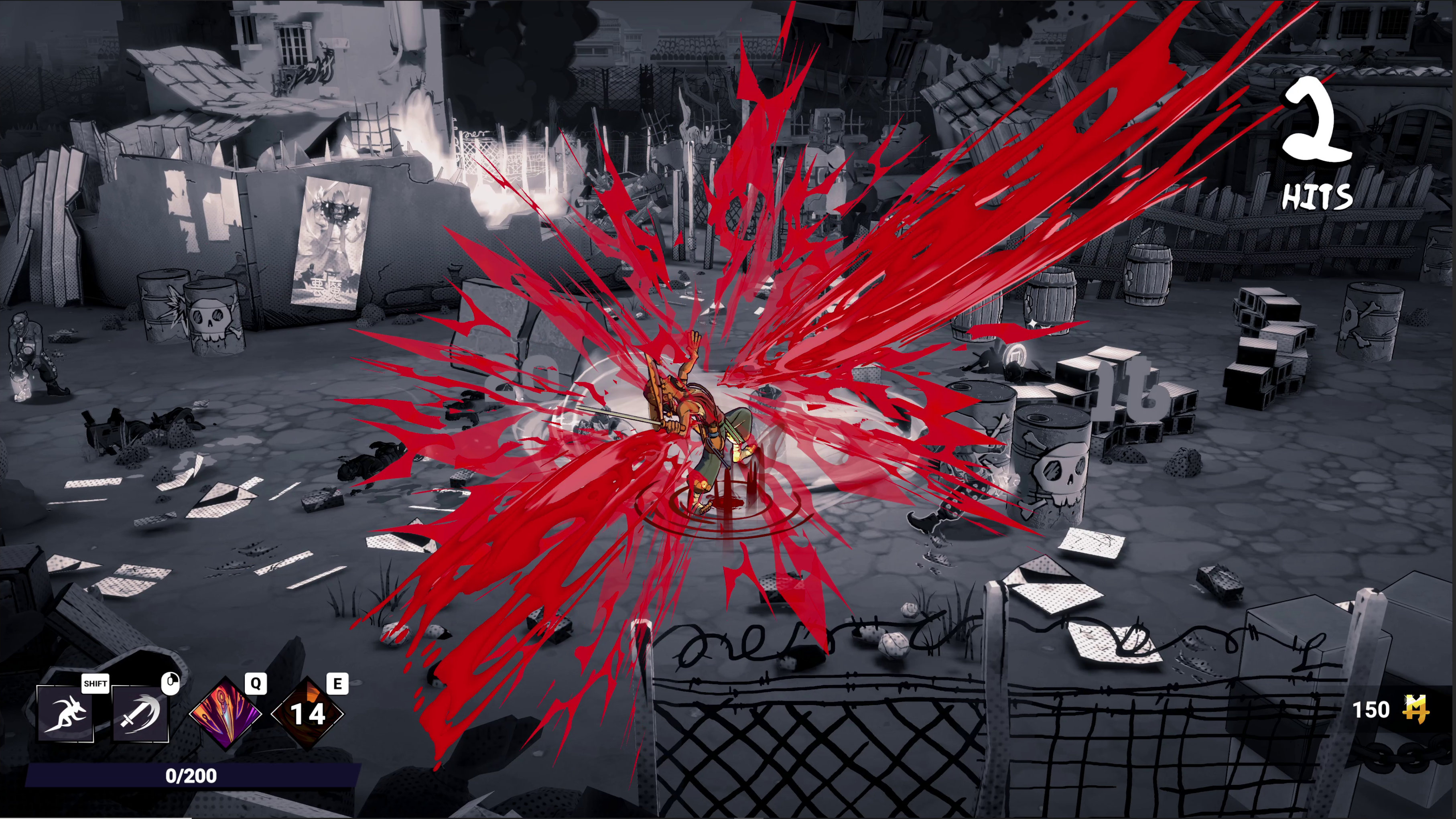
On top of that, there are some balance issues. Mexican Ninja can be relatively permissive in some rooms and suddenly turn into something much more punishing a few minutes later. The limited number of invulnerability frames following a hit makes certain attack combinations particularly annoying: if you're in the wrong position, especially against certain bosses or near traps, you can take several consecutive hits without being able to immediately regain control.
A kawaii show, but not always very fluid
On an artistic level, Mexican Ninja is much more convincing. The cel shading and extremely bright colors give the entire production the appearance of a comic book (yes perhaps we should say manga in this case ed.) animated, while the animations of the attacks manage to communicate well the weight and speed of the blows. Even in the simplest scenarios there is almost always something that captures the attention, including secondary characters, destructible elements and small hidden references. The fusion between Mexican and Japanese aesthetics is not only used as a narrative device, but concretely permeates scenarios, enemies and interface.
The soundtrack adequately accompanies the rhythm of the action, blending electronic sounds with references to Mexican tradition and being particularly effective during boss fights. It will hardly end up in my personal playlists, but it does its job perfectly during the games. Too bad instead for some choices related to the vocal sector. The presence of Spanish contributes a lot to the personality of the setting, especially when it comes from passers-by, telephones or speakers, but I would have appreciated a greater presence of dubbing even in the main narrative sequences.

I also tried the game (actually almost exclusively) on Steam OLED Deck, a platform on which the run structure is particularly well suited to short sessions. The result is decent, but not flawless. During the most crowded clashes I found framerate drops that prevent you from maintaining 60 FPS stably even favoring performance.
Considering how much the combat system depends on the speed of response and the readability of the action, these are more annoying oscillations than they could be in a title with a less exasperated pace. On the autonomy front, however, I did not encounter any particular criticalities, with sessions that can easily approach three to four hours depending on the settings used.
Finally, there remains a lack that could weigh heavily for some: the absence of the cooperative. The beat 'em up is historically one of the genres that best lends itself to sharing the couch and a mode to face Nuevo Tokyo together with a second player would probably have further amplified the chaos that characterizes the experience.
In Conclusion
Mexican Ninja does not reinvent either the beat 'em up or the roguelite and, looking at the mechanics individually, it is easy to find games that better explore each of its elements. What Madbricks manages to do well is combine them within a universe crazy enough to be immediately recognizable. The combat system is fast and satisfying, the bosses represent excellent peaks of intensity and the roguelite progression guarantees enough variety to justify numerous attempts. On the other hand, there is too much visual confusion, some balance problems and a technical component that would need further optimization, especially on Steam Deck. It's not the most refined fighting game I've played or even the deepest roguelite, but it has something that many independent productions struggle to conquer: personality.
And after hours spent among samurai, drug traffickers, tequila, tacos and improbable Jutsu, Nuevo Tokyo is a place that is difficult to forget.
About the Author

Biography
- Staff di KotaWorld.itRecent Articles
- Gallipoli - Many news from the Ottoman Front (Review)
- The Last of Us developers and HBO producers discuss the creation of the Clickers and the work of adapting the Action phases
- Sonic The Hedgehog's animated series, Sonic Prime, will debut worldwide on December 15
- Halloween 2022: undecided about which movie to watch? Prime Video helps us
- [GUIDE] How to Improve PBO on Motherboards ASUS AMD X670 and B650