
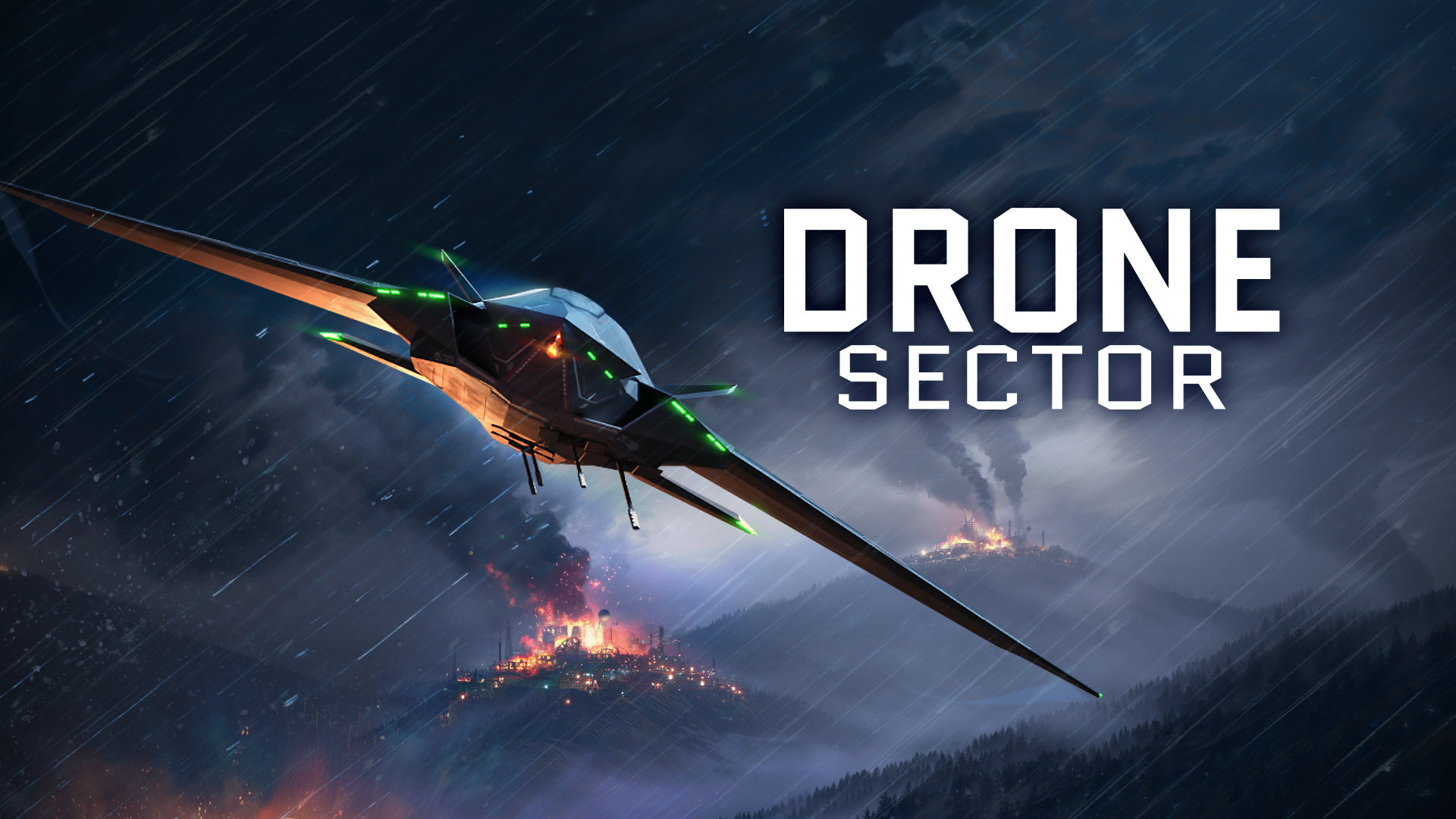
Drone Sector starts from an idea as simple as it is fascinating: take control of a futuristic gunship, observe the battlefield from above and transform yourself into the eye, the coordinator and above all the firepower of your troops on the ground.
A concept that, at least personally, immediately awakened some old feelings. During the first missions I felt strong vibes from Battlefield Commander, especially thinking about when it was possible to play and give orders through the tablet, observing the clash from a completely different perspective than the classic soldier in the field.
Drone Sector partly takes up that philosophy and transforms it into the heart of the experience: we are not simply a pilot called to fire on targets, but a constant presence over the battlefield, capable of following the advance of allied units, showing them where to move and intervening with cannons and large-caliber ammunition when the situation requires it.
The result is a curious encounter between air support, tactical shooter and real-time strategy, with a structure that alternates operational missions with technological research, ammunition production, equipment management and upgrading of its arsenal.
The problem is that we are still in front of a title in Early Access and it shows a lot.
There is no shortage of ideas and some moments already manage to be tremendously satisfying, but Drone Sector still has to deal with a rather problematic artificial intelligence, a limited variety of content and several systems that need to be better balanced.
So let's try to make a nice "aerial reconnaissance" of the state of the art of this title.
Developer: Icosphere
Publisher / PR: MicroProse Software
Release date in Early Access: July 21, 2026
History
In Drone Sector , the story is not the real focus of the experience. The game prefers to build a mixed military framework between the present and the near future within which the player takes control of an advanced gunship called to support the operations of his forces on the ground.
The career mode offers a succession of military operations through which we are progressively introduced to the different game mechanics with increasing difficulty. Assignments can lead us to destroy strategic infrastructures, sabotage enemy installations, recover information, conquer certain positions, eliminate hostile units or protect the advance of our teams.
So don't expect a campaign built around great characters, long narrative sequences or particular twists. The narrative remains above all at the service of the gameplay and serves to provide context to the different operations.
To make the progression more organic, however, the Escalation system intervenes. Our actions progressively attract the attention of the enemy forces and, as the level of escalation increases, the pressure exerted on the battlefield also increases. More numerous forces, more threats and above all anti-aircraft units capable of representing a real danger to our gunship begin to appear. It is an interesting system because it tries to transform individual operations into parts of a larger conflict, even if in the current version the narrative component still remains quite essential.
From this point of view, Drone Sector clearly shows its Early Access nature: the base exists, but it would be interesting to see in the future a more structured, more dynamic campaign capable of giving greater weight to the consequences of our operations.
Gameplay
It is inevitably in the gameplay of Drone Sector that we find the most interesting elements of the entire production. The initial tutorial performs its task well and introduces mechanics that are extremely easy to assimilate, but particular enough to immediately intrigue. The first operations teach us to identify targets, select the correct weapon and use the different observation systems available on board the gunship.
Later the advanced mechanics are introduced and the experience acquires a much greater depth. We can change the speed and altitude of the orbit, change the point around which the aircraft is making its overflight and directly coordinate the teams present on the ground. Just in these moments those good feelings from Battlefield Commander have returned.
The difference is of course huge, but the principle of observing the battlefield from above and deciding where to direct your units manages to give a similar feeling: we are not physically on the ground, but we still have the possibility of directly influencing what is happening below us.
At the same time we have to use the gunship to eliminate threats. The result is a particular combination of RTS and shooter: we give orders to ground units and a few seconds later we can find ourselves using a 120 mm cannon to clear their way.
When everything works, it's definitely fun.
A gunship loaded with firepower
The arsenal is of course an important component. During the progression we can get our hands on cannons, machine guns and different types of ammunition, using specific projectiles based on the nature of the target.
The most important distinction is essentially that between HE and AP ammunition: the former are particularly effective against infantry and poorly protected targets, while the latter become necessary when more armored vehicles begin to come into play. The pleasure of using these armaments is probably one of the main reasons to play Drone Sector.
Spotting a large group of infantry through the sensors, slightly anticipating their movement and seeing a large caliber shell obliterate the entire formation in a few moments gives exactly that feeling of power that one would expect from a game built around the concept of close air support.
As the difficulty increases, it is also important to pay more attention to anti-aircraft units, because they represent one of the few threats really capable of putting pressure on the gunship.
Ammunition Research, Resources and Production
Between one mission and the next, Drone Sector completely changes pace.
In fact, the operations make it possible to collect different resources, including research points, composite material, head material, bulk material, calculation modules, cooling modules and power modules.
These resources are used to develop new technologies through a real research tree. We can unlock new cannons, vehicle improvements, self-protection systems and additional solutions to be used during subsequent operations.
At the same time, we have to deal with the manufacture of ammunition, the equipment of the ground teams and the state of our gunship. On paper, the system works because it introduces an interesting management phase between one battle and the next. In practice, however, the economy still needs some adjustments.
The rewards depend on the missions available and it may therefore happen that you need a certain resource to continue a search without immediately finding an operation capable of providing it. Technological progression then appears faster than the actual growth of threats. It is therefore possible to unlock extremely powerful armaments relatively quickly, when most of the opponents continue to be easily eliminated using the equipment available in the early stages of the campaign.
Lots of weapons, but not always different enough
Here another limitation of the current version emerges. Drone Sector offers several weapons, but it does not always manage to make them really indispensable.
Once the distinction between ammunition dedicated to light targets and that necessary against armored vehicles is understood, most of the clashes tend to follow a fairly predictable pattern.
The problem also affects the enemies. Infantry, vehicles and anti-air units are the really important categories during the fights, but within these families the differences often do not sufficiently change our approach.
This means that, after a few hours, that spectacular initial feeling of dominance on the battlefield can gradually begin to give way to repetitiveness. Firing from above against hundreds of soldiers continues to be fun, but the game would need to force us to change strategy, position, altitude and armament more often.
BOTs are the real weak point
However, if I had to point out the most obvious problem of the current Drone Sector Early Access , I would not have many doubts: the artificial intelligence of the ground units is, in some moments, almost ridiculous.
BOT pathfinding can turn seemingly simple operations into a test of patience. Vehicles that are supposed to be driving down a road may decide to stop against a building. Others get stuck against trees, walls, or scenery elements. Sometimes two units even end up getting in each other's way.
The worst part is that it can happen while you're pretty much dominating the mission. You've eliminated defenses, destroyed the most dangerous units, and cleared the path, but instead of quietly reaching the objective, you find yourself watching an allied vehicle from above that stubbornly continues to try to cross an obstacle. At that point, you have to intervene manually, change paths, assign new movement points, and hope that this time the BOT can figure out which path to use.
During some games I even found a small way around the problem: advance the units along the edges of the map until they reach the objective area and accompany them with some suppressive fire.
It works! But it is clearly an exploit, not a solution. It's definitely a shame because the ground units should represent one of the elements capable of differentiating Drone Sector from a simple shooting game with a top-down view.
When it works, it really works
Despite these problems, there are times when Drone Sector succeeds perfectly in its intent.
A squad is advancing towards a building and we spot some enemies through thermal vision. An armored vehicle appears along the way.
We quickly switch to the correct armament, eliminate the vehicle, return to the infantry and open a corridor through which our men can continue to advance.
It is at these times that the system shows its full potential. On higher difficulties, the formula also becomes more interesting, because the increase in enemy forces finally forces us to use the tools we have developed more.
The hard mode could therefore be the best choice once you have assimilated the fundamental mechanics.
Graphics
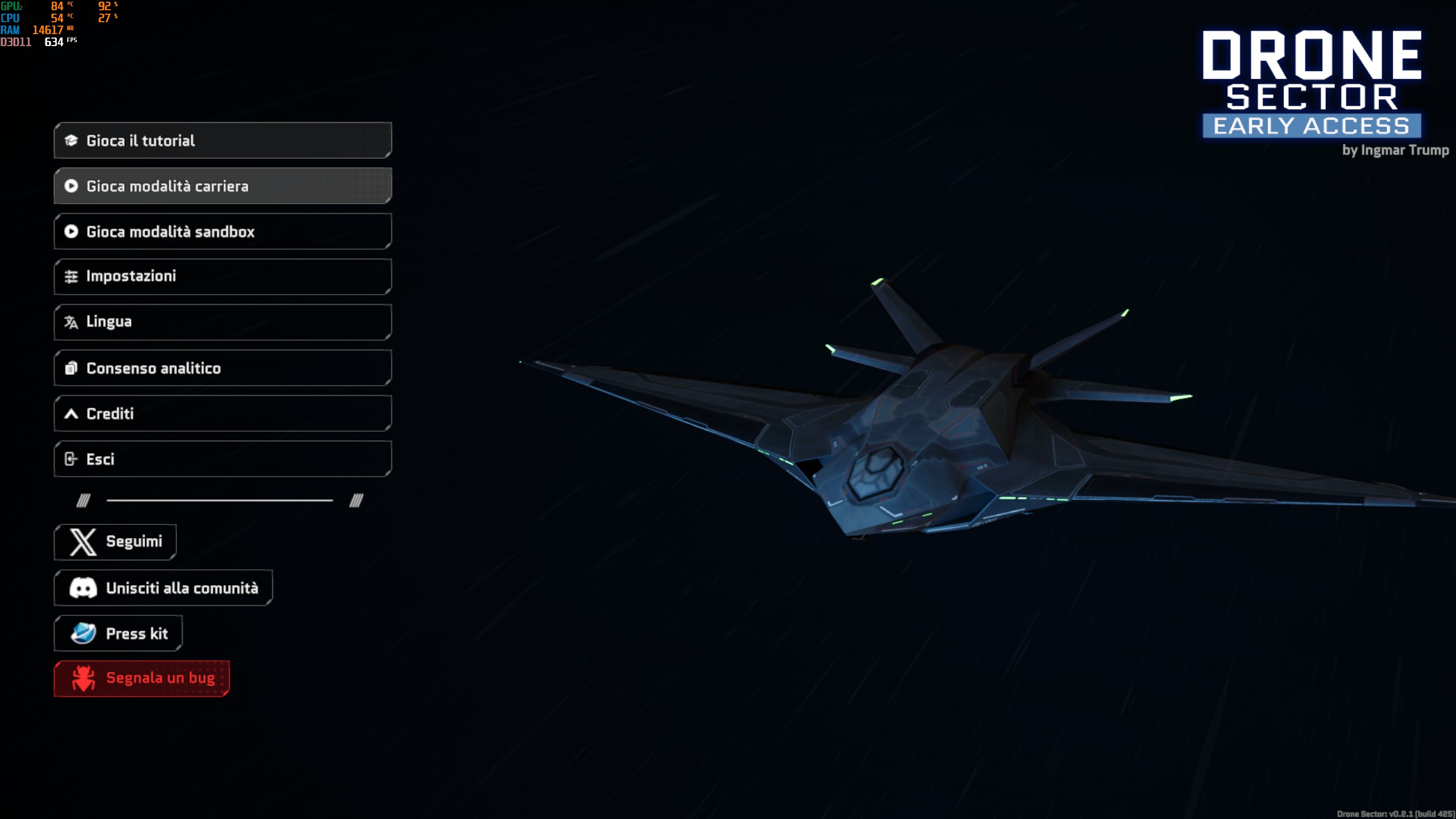
From a graphic point of view, Drone Sector does not aim for absolute photorealism, but still manages to build a visual identity perfectly consistent with its setting.
The real protagonist is of course the gunship. The model is detailed, aggressive and characterized by a futuristic design that immediately manages to communicate the idea of a technologically advanced military platform.
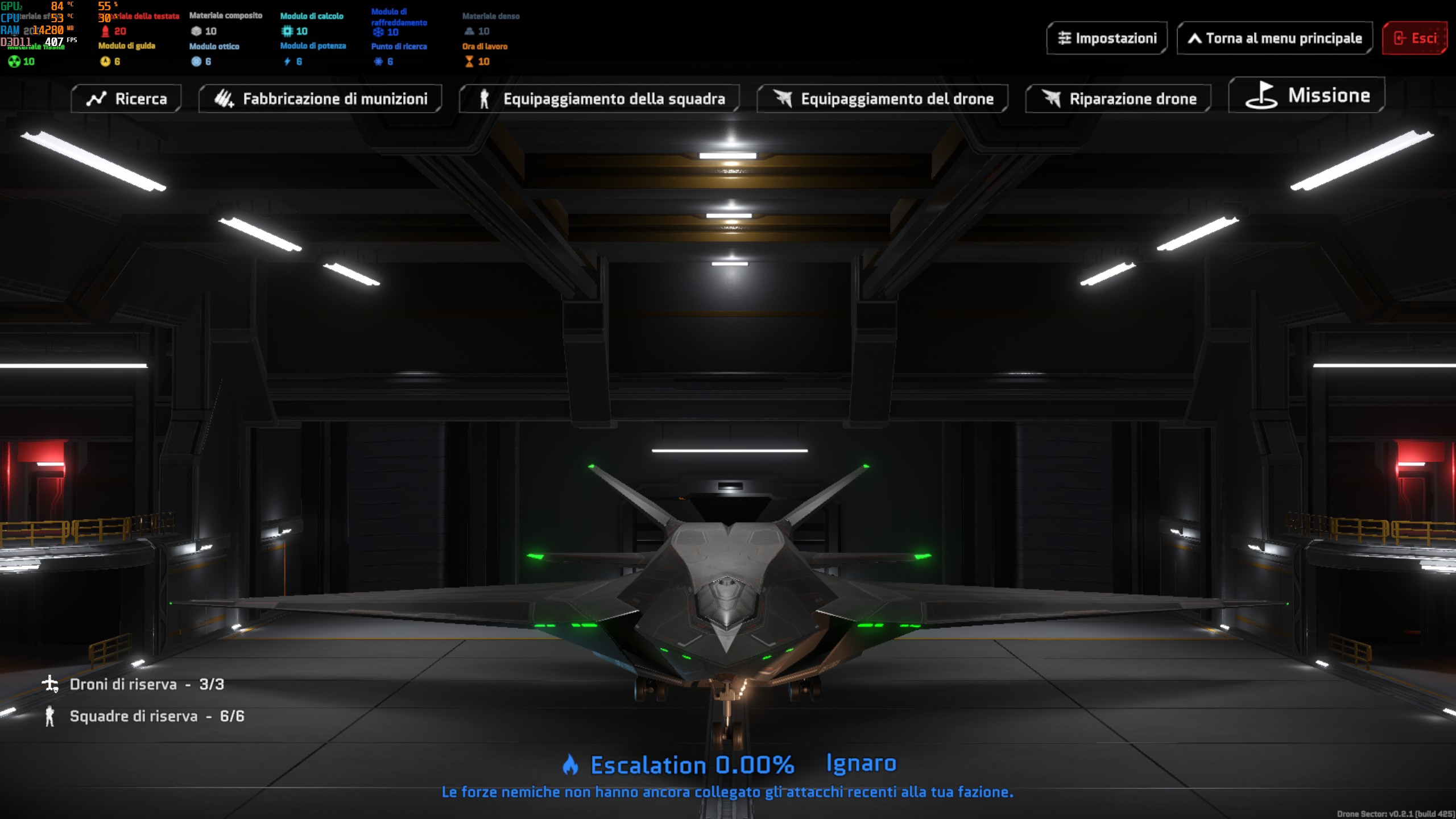
The hangar used between one mission and the next also performs its task well, alternating metal surfaces, large industrial environments, cold lights, dimly lit areas and small luminous elements that further emphasize the sci-fi character of the aircraft.
A functional and consistent UI
The interface is also particularly simple but effective. Menus, technology research, ammunition management, drone repair and equipment use an extremely consistent visual language.
Black, white, green, red, and a few other colors are used to quickly separate information, resources, and alerts. Despite the amount of data present on the screen at once, the interface remains readable and easy to interpret in most cases.
The battlefield as seen from sensors
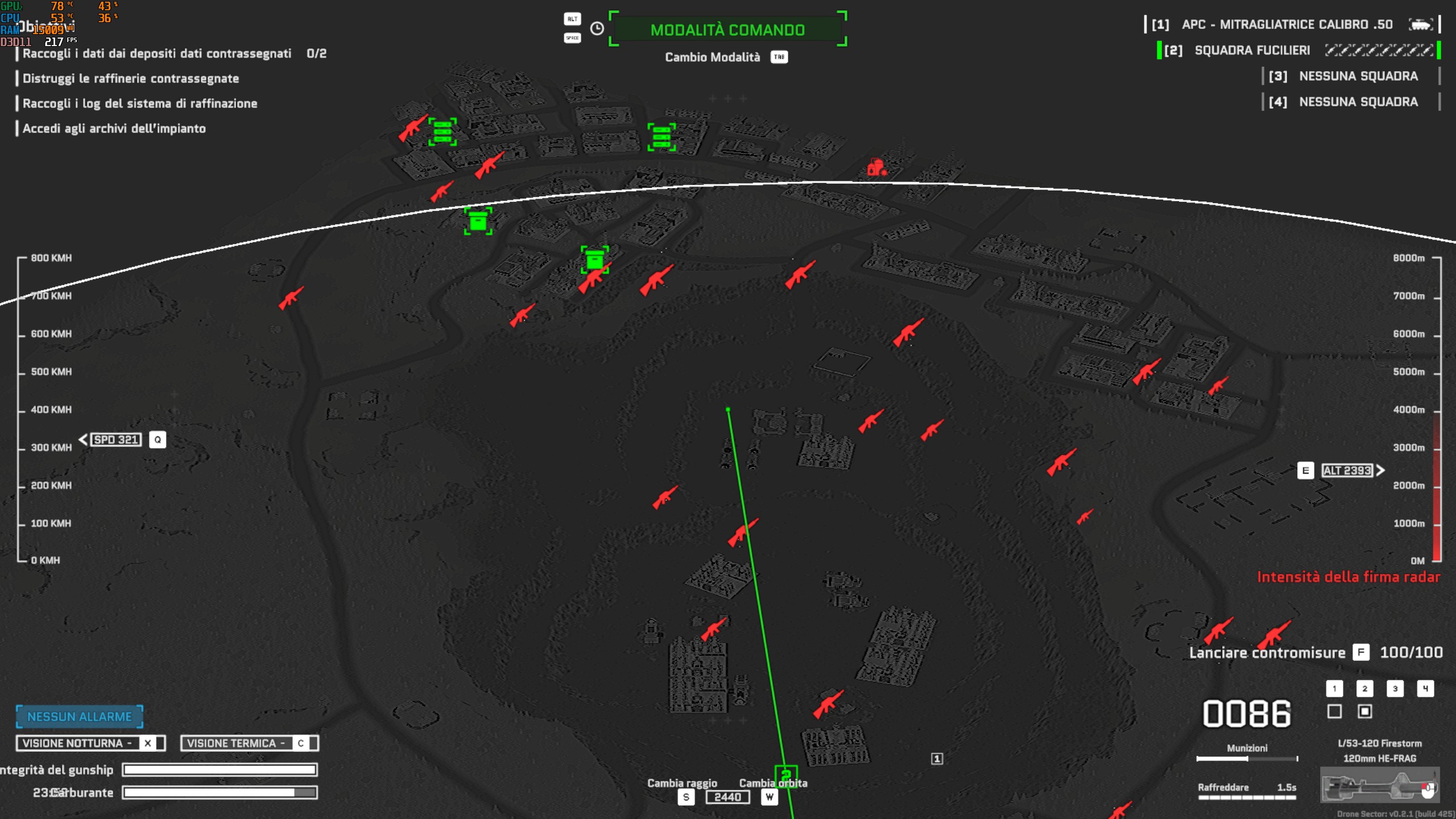
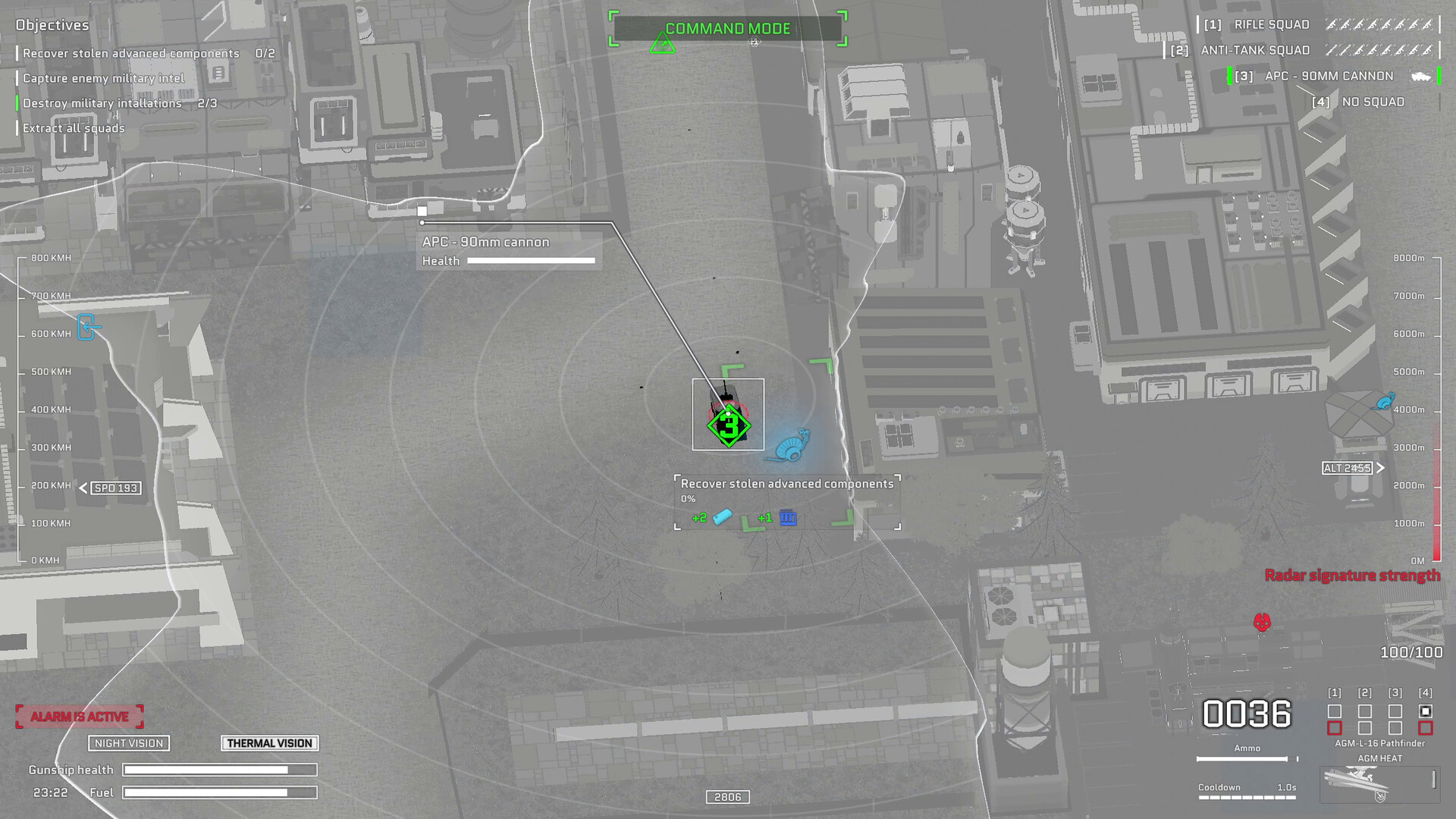
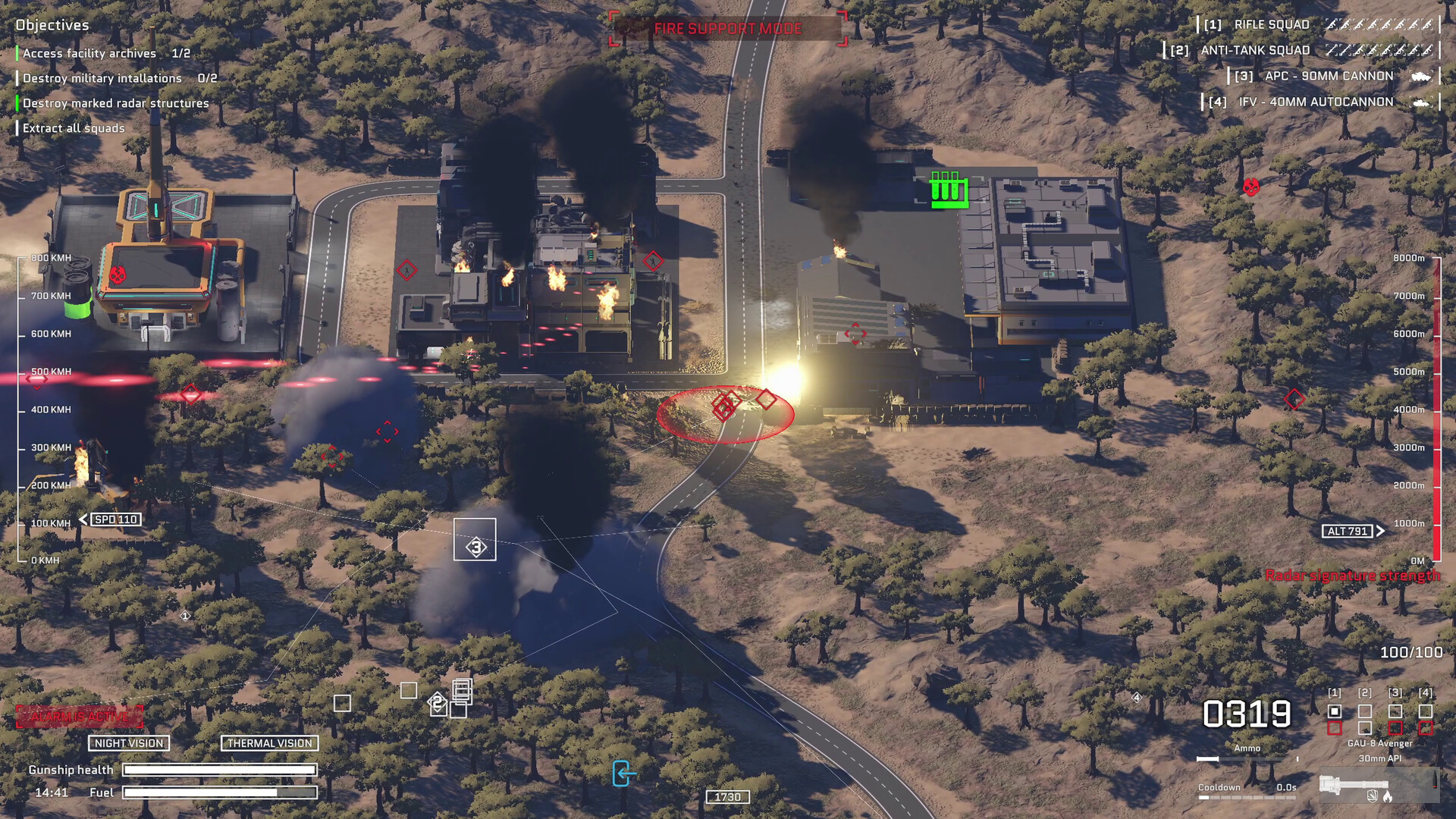
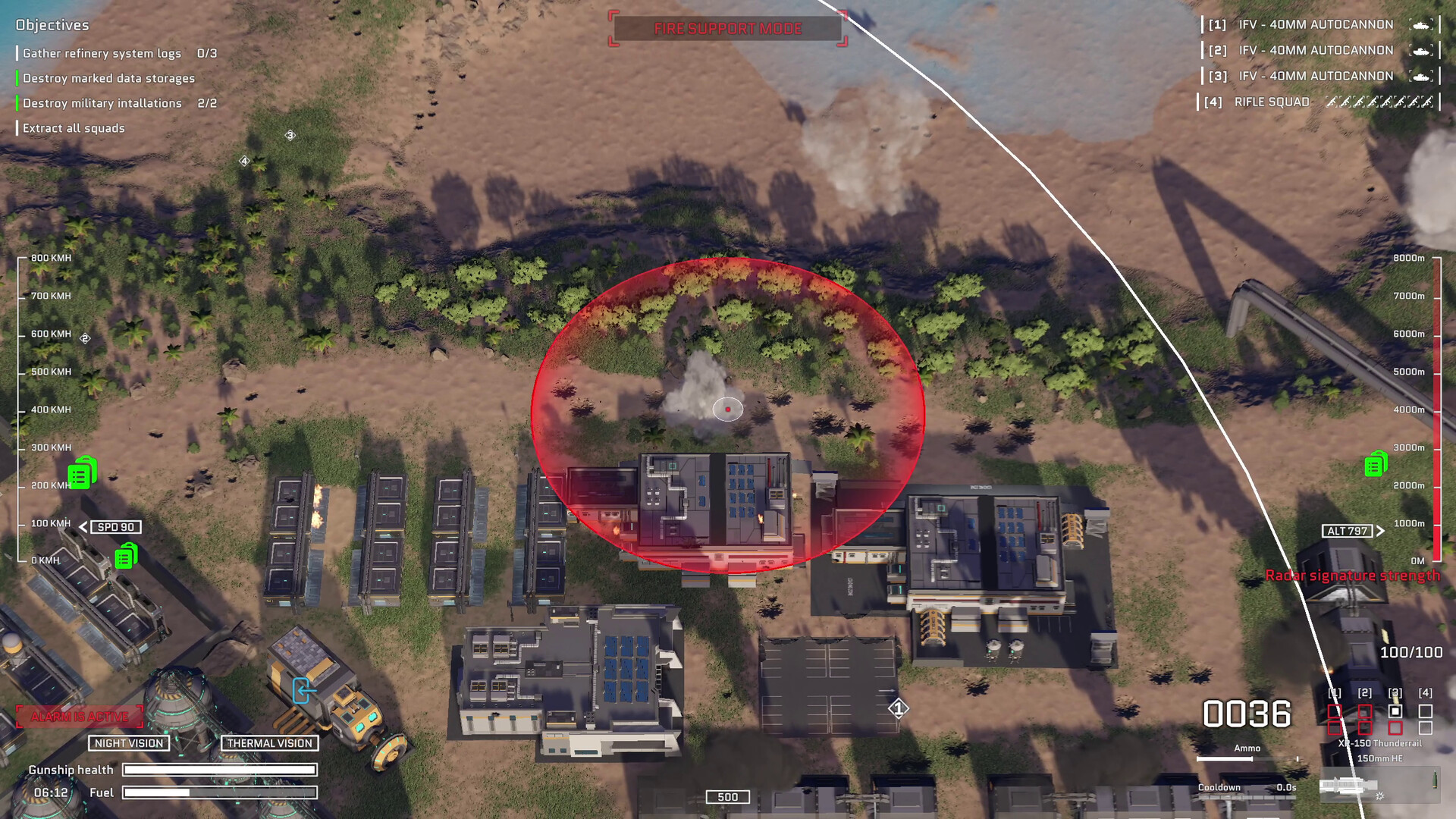
During missions, the graphic layout changes completely. The world is observed predominantly through the gunship's optical systems, with night vision, thermal vision, radar indicators, and target markers.
Speed, altitude, aircraft integrity, fuel, ammunition and intensity of the radar signature remain constantly under control. It is a stylistic choice that works because it makes Drone Sector immediately recognizable and manages to convey the feeling of really observing a war zone through a military platform.
You don't necessarily need spectacular graphics when the goal is to make us feel in front of a aiming system. From this point of view, I think the title fully succeeds in the intent.
Maps can still improve
Where the limits of the current Early Access are most perceived is instead in the variety of scenarios. The maps do their job, but it would be interesting to see in the future settings capable of changing our approach to missions more.
Mountains, canyons, fortified areas, more complex infrastructures and greater natural obstacles could force us to really exploit the systems of variation in altitude, speed and orbit.
Currently, once a particularly effective position has been identified, there is not always a concrete reason to change it. Greater complexity of the terrain could instead transform these systems from a simple possibility to a real tactical necessity.
Price
At the time of our review, Drone Sector is offered on Steam with a list price of 16,99 euros and a promotional discount of 10%, which brings the cost to about 15 euros.
This figure places us exactly halfway between the "right price" and the "we want to trust development".
At about 15 euros, Drone Sector does not seem expensive to us, but part of its value inevitably depends on how much Icosphere will be able to expand and refine the project in the coming months.
The developers themselves have indicated that during the Early Access additional ground vehicles, new maps, improvements to team management, new types of units, additional systems and helicopters are planned.
A progressive increase in price is also expected with the addition of new content. The current base is interesting enough for us to grant this confidence.
In Conclusion
Drone Sector is one of those Early Access titles in which it is easy to glimpse something very interesting.
The concept works. Taking the spectacularity of classic gunship missions, turning it into the core of the entire experience and adding ground unit management, technological research, ammunition production and strategic progression is an idea that undoubtedly has potential.
And personally, that almost Battlefield Commander feeling of watching the battle from above and coordinating air support and ground troops at the same time is one of the things that intrigued me the most. When the game runs the right way, it works really well and is fun.
The problem is that Drone Sector also shows all its limits too soon.
The variety of enemies must increase, the weapons must be able to differentiate themselves more, the economy and the research tree need a better balance, the maps could offer much more interesting tactical situations.
But above all , the artificial intelligence of the BOTs must be heavily improved.
Drone Sector wants us to feel like the commander of a very sophisticated futuristic military platform, capable of coordinating an entire operation from above, but at the same time sometimes forces us to babysit an APC unable to get around a tree. I admit, however, that I continue to see more potential than problems.
Drone Sector is not yet a fully mature product and those looking for a particularly long-lived campaign or an extremely deep tactical experience today could run out of content quite quickly.
At the same time, those who have always appreciated the air support missions present in military shooters and wanted a game built completely around that fantasy may find something very special here.
We are not facing a rigorous simulator or even a traditional RTS but Drone Sector is probably a hybrid.
I repeat again that in my opinion there is still a long way to go, but the foundations are there and they are good.
About the Author

Biography
- Direttore di KotaWorld.itRecent Articles
- GTA VI will have an official 34-track album: Travis Scott, Yung Lean and Keith Richards among the first artists
- Golden Swirl is available on Steam
- Acer at IFA 2026: all the news between Predator Atlas 7, 1000 Hz monitor, Swift Blade 14, Vero 16, Aspire, Veriton AI and RTX Spark
- Monster Hunter Wilds: Ascendance shows up at the State of Play
- Green - The Review PC