Le Noldór
Imagine the scene: you are sitting at a table in the middle of a room full of other people, also seated. Soft lights, classical music in the background... The volume of chatter remains within the limit. Open an elegant leather-lined menu and let your eyes run along the list when a person dressed to the nines turns to you: "Monsieur?" (or "Madame"). You look up and see Noldor with a bottle of red wine in his hand. He continues to speak with a soft R and a strong French accent, coming from the worst bars in Torbèlla (a well-known district of Rome): "ce sehra, se Monsieur mi consentò l'ahrdire, voulez-vous un novelló del 2026? La cantinà est Gaijin et le vin c'est Matter Team". You wave with your hand, like the good nobility that you are, and Noldór uncorks, pours into his sommelier's silver cup, tastes, nods and fills you with half a glass.
The camera follows Noldór as he goes towards the kitchen, then zooms slightly outwards and then cuts to the outside of the restaurant. The illuminated sign lights up and shows: "Le Steam".
I like to imagine myself like this, as a vintage extraction shooter taster for my audience and today what we are going to taste is a much talked about title and already available for a while in the cellars of the "early version".
Why this habit? Because among all the KotA, I think I'm unquestionably the one who has made the deck (a bit out of madness, a bit out of passion) more than anyone else on different wipes of "Escape from Tarkov" (ah, when I was still young...) which is always configured as the benchmark for every title of the genre that you want to review.
This content is provided by YouTube. To view it, you must allow external content. Activation may result in data being shared with the third party.
But... Were you active?
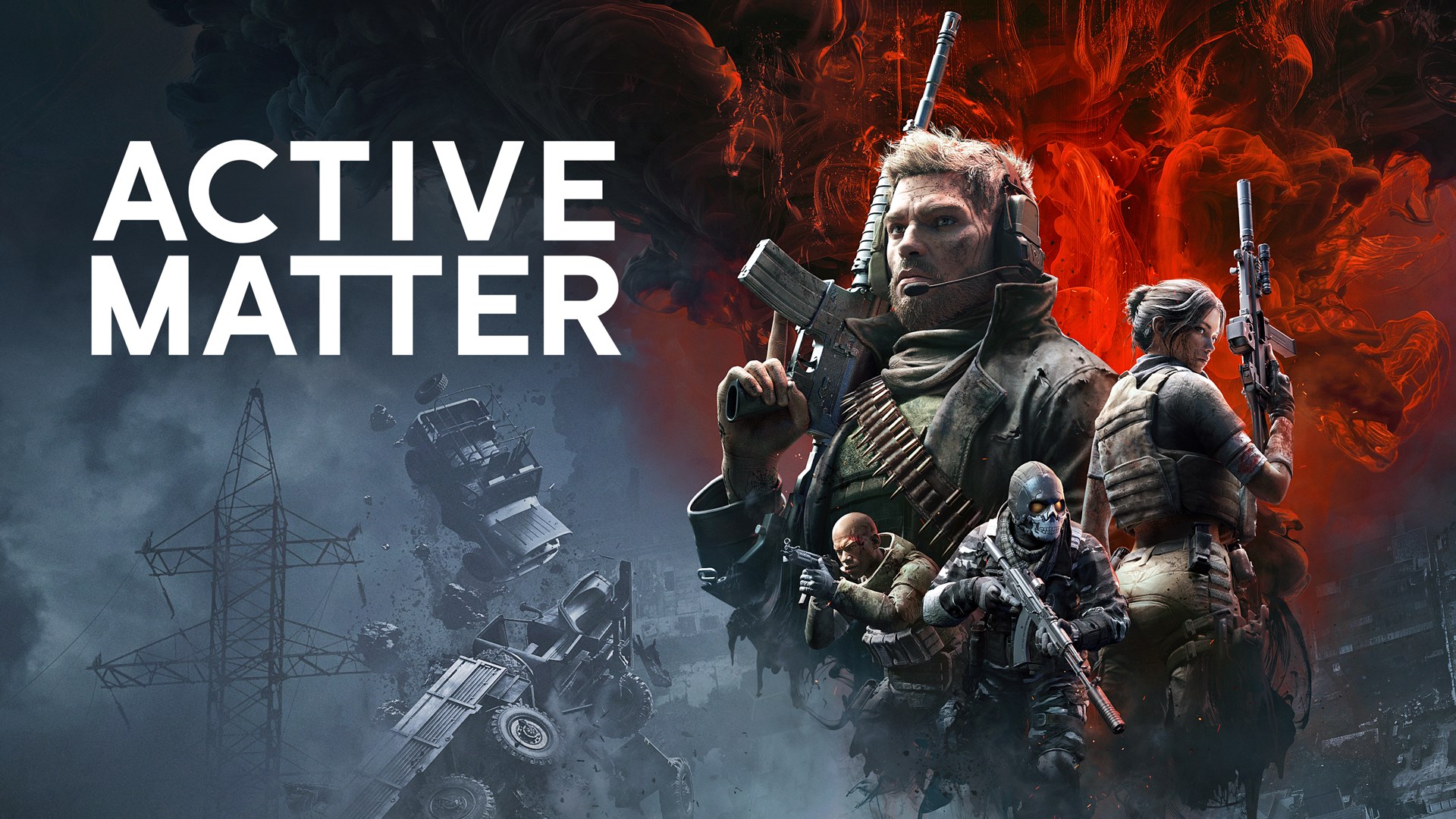
Active Matter starts from a structure that is now well recognizable for those who frequent the genre but tries to build a lore by exploiting an idea that does not remain confined to the script: the player plays an operative of a phantom agency trapped in a time loop and forced to repeatedly enter areas of quantum instability, recover active matter, photonically superfuck the maps by completing objectives and, above all, possibly returning to the extraction point with the loot still in the backpack. Despite the (trite and trite) setting with a Soviet-like aesthetic, the substantial difference compared to a simple variation on the Tarkov theme lies in the fact that the active matter concretely alters the environment and the rules of the clash, introducing anomalies capable of transforming a normal tactical situation into something much less predictable and... much less tactical.
The most successful part of the project is precisely this fusion between military realism and paranormal phenomena à la "S.T.A.L.K.E.R.", because the gunplay remains heavy, reasoned and based on weapons attributable to real war technology, but the context continuously forces you to question your habits: there are gravitational anomalies that allow you to walk on vertical surfaces, energy phenomena like ball lightning, areas that look like geysers of fire, swarms of very unpleasant insects and so on.
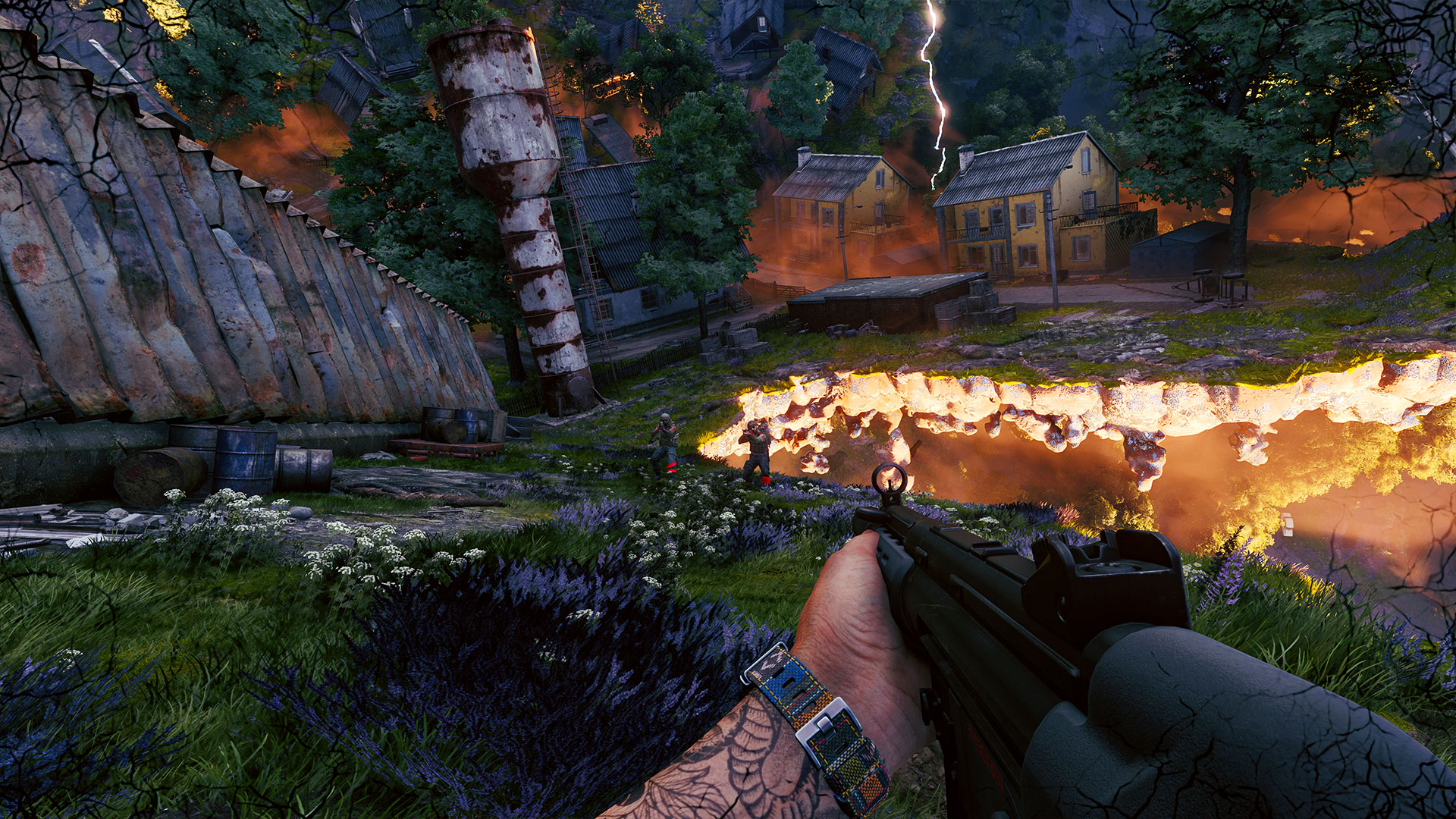
In certain circumstances, the anomaly is therefore not only an environmental obstacle, but becomes a tactical resource that allows you to attack from normally impossible angles or to completely change the reading of an area: walking on a wall constantly exposes you to enemy fire, while standing still while a ball lightning is nearby will soon force you to review your cover. Moving constantly becomes almost a necessity and, if I have to be honest, it breaks a lot that tension to which we have been trained (shout out to the good soul of the Pera, with whom I spent countless hours at "stop, I heard footsteps" in that of the Norvinsk region) by dear old Nikita (if you don't know what I'm talking about, go and watch this old review).
The combat system tries to maintain a certain ballistic credibility in parallel, offering an arsenal of many weapons, perhaps even too many: pistols, assault rifles, machine guns, sniper rifles, shotguns, grenade launchers and melee weapons, with the ubiquitous modification system that allows you to attach this or that accessory to the selected weapon.
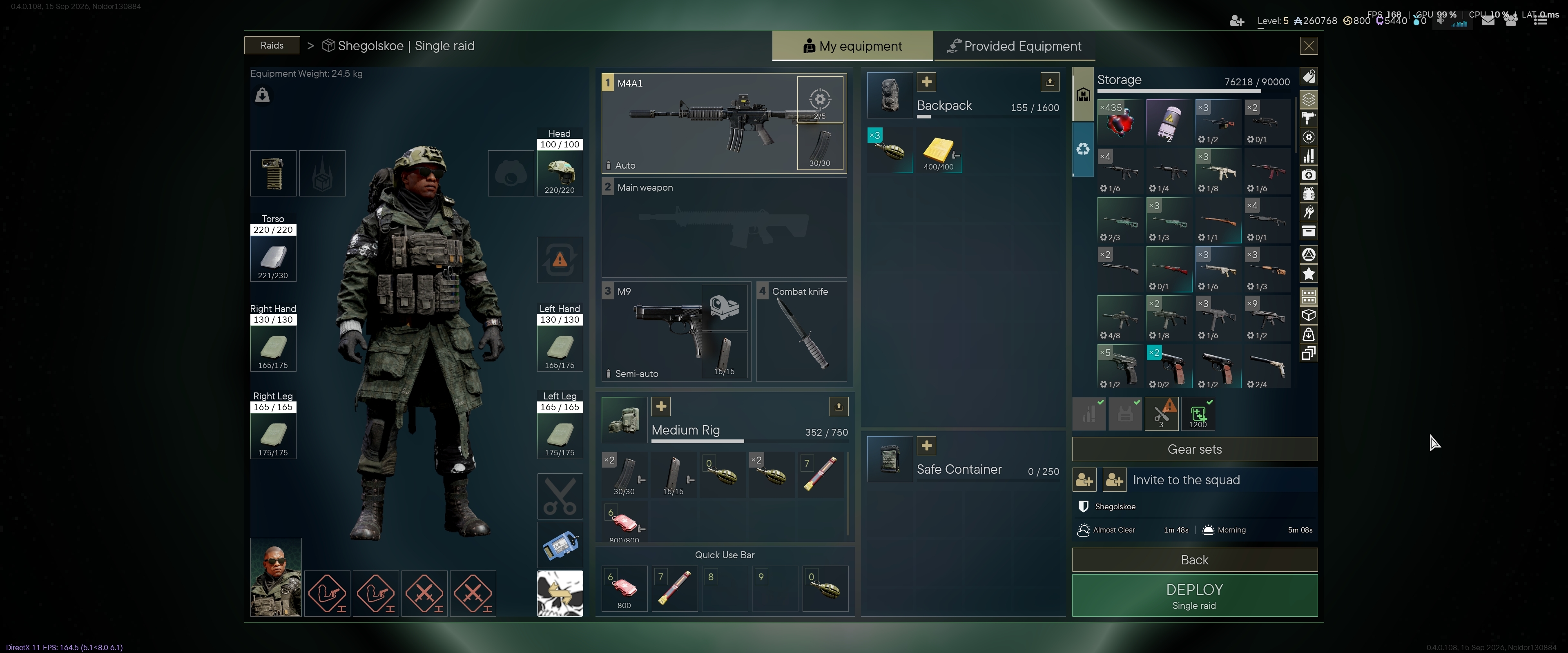
The result, however, is not always perfectly smooth: precisely because Active Matter focuses on a more physical and less arcade management of weapons, the recoil of some guns appears aggressive (yes, even if you have put the compensator) and sometimes not very funny, especially if you add to the time to kill of the various targets in my opinion a bit high.
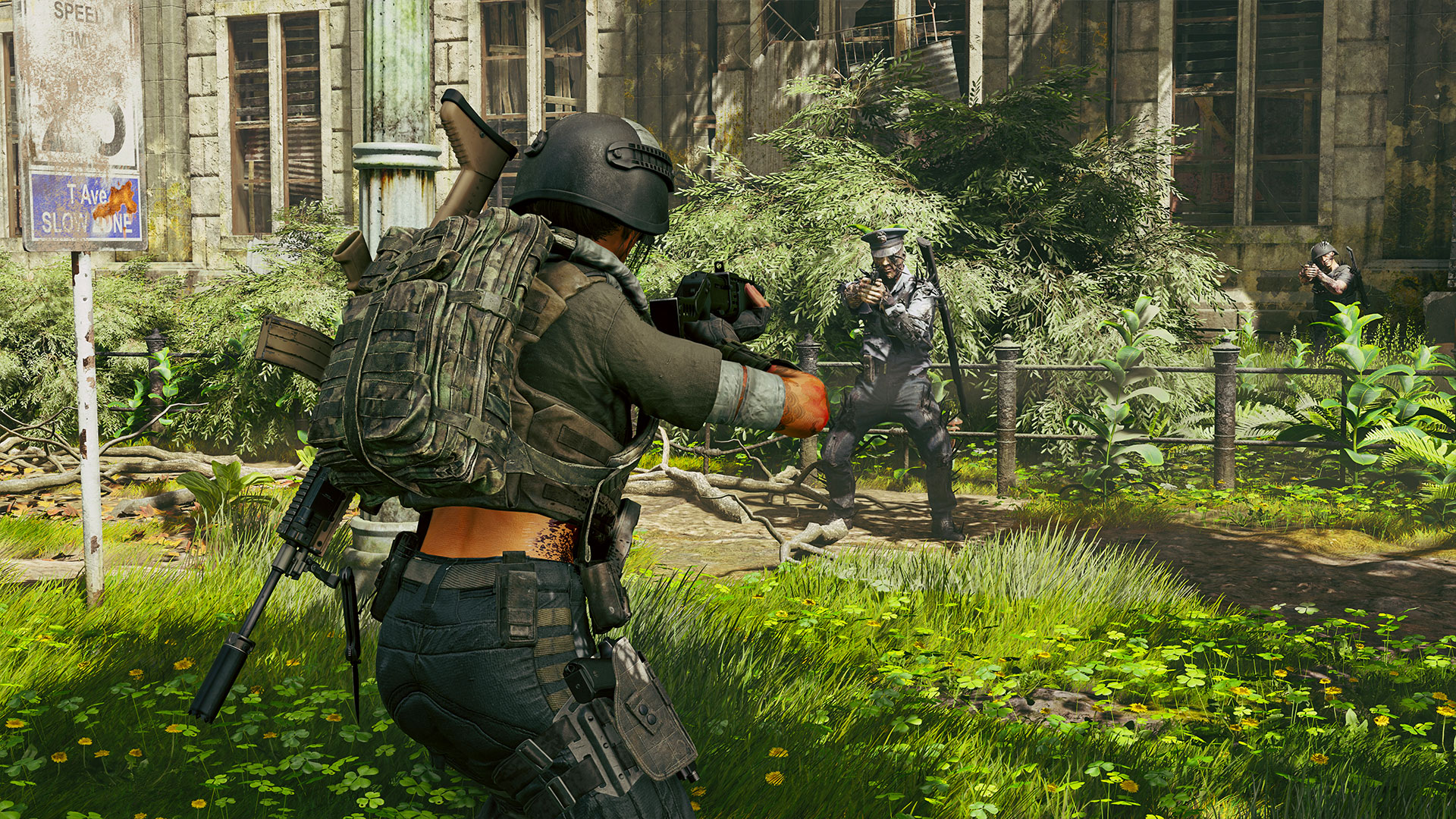
OK, but so what is PvPvE like? Let's start by saying that the Russians of Matter Team (who by the way are a holding company of Gaijin) have however solved one of the thorniest questions of the genre rather elegantly: do you want to play? Choose a map, then select if you want to do an Isolated raid if you don't have a damn about doing PvP or Open raids, where the PvPvE element comes into full play. Giving one shot to the circle and one to the barrel however, although PvE is quite linear (fun without any doubt),PvP has no way to create that tension of "what do we do, if we shoot or make friends?" of "ARK raiders": you shoot anything that moves and that's it.
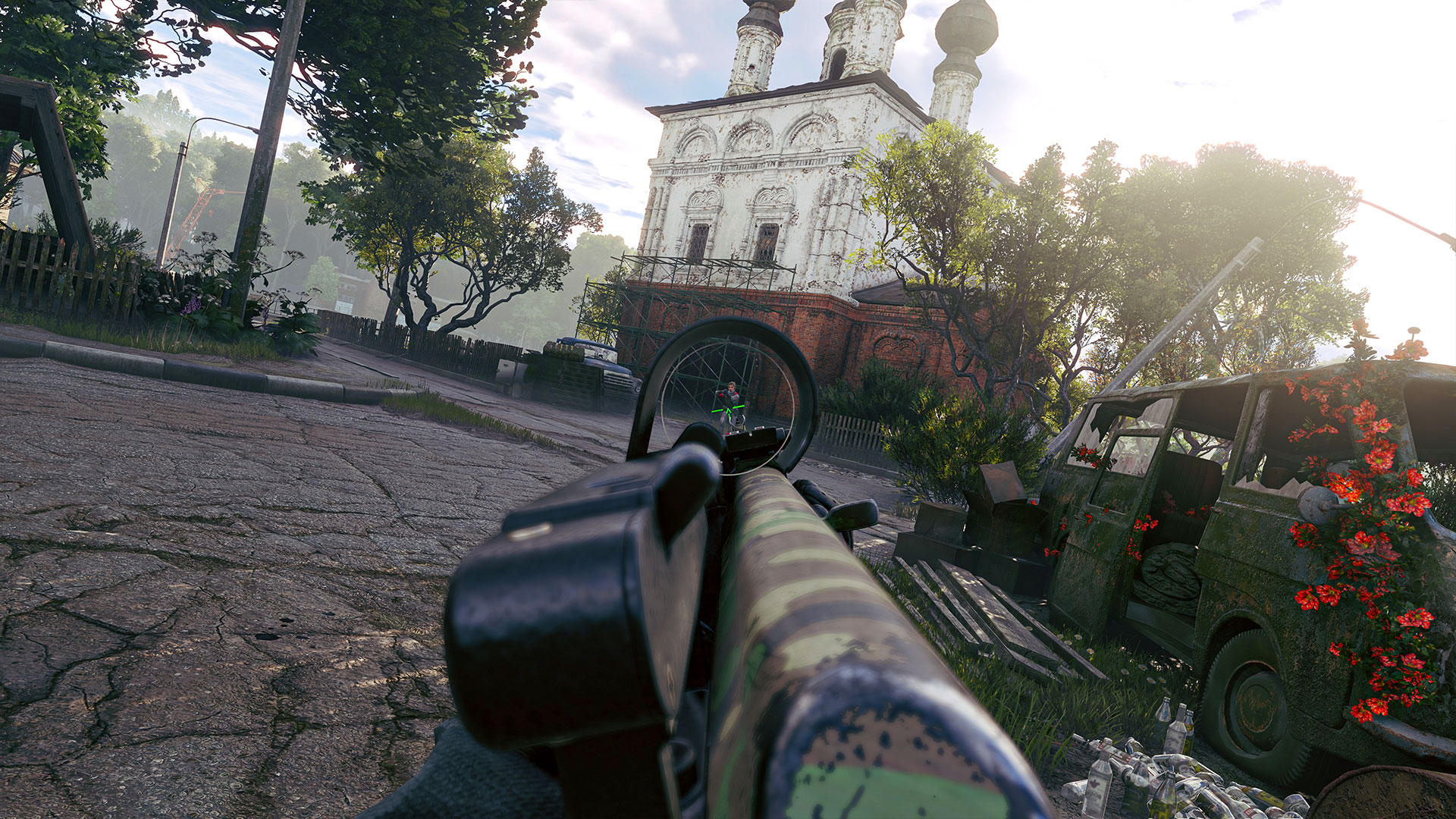
Just for those with an easy trigger like me (how could Noldor's traditional teamkill be missing during the first raids? To War goes an affectionate hug and a lot of respect for having been patient) there are however ways to keep the blasphemies of teammates to a minimum: a marker on the compass superimposed on your screen that signals the direction in which your teammates are, colored stripes that you can activate on your arms and legs in order to be recognizable and ... well, if despite all this you are great pirates like myself, there is an opportunity to resurrect the one you have smashed. Finally, there is the opportunity to resurrect yourself through some types of "space-time signals" which, however, make everything a lot less risky and therefore more "meh" from an adrenaline point of view. At this point I have to open a parenthesis that I close immediately on the rest of the equipment: safe containers that do not make you lose the loot that can be purchased and gadgets such as object robots, drones and so on add in my opinion too much wood to the fire that then burns my roast.
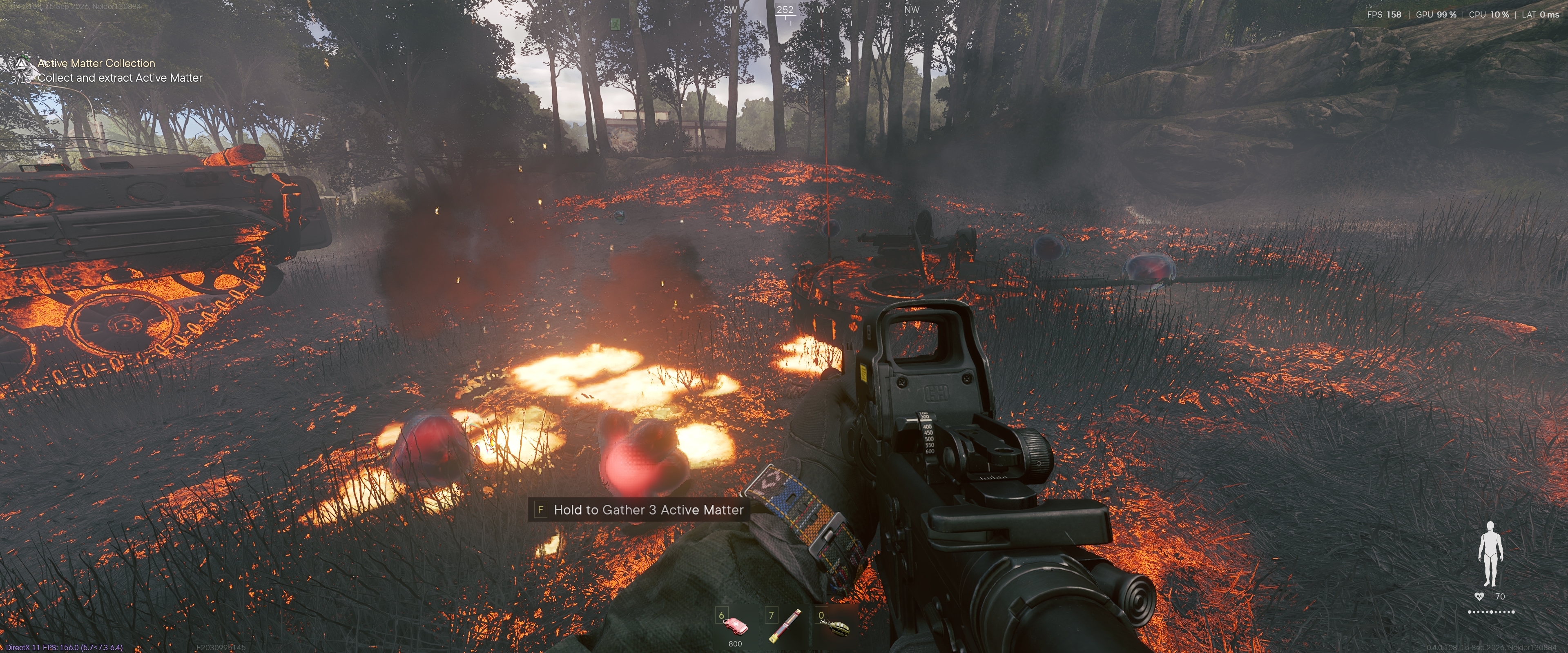
Returning to PvP, we also have Arena the Nexus mode, a separate mode dedicated to team combat with equipment provided directly by the agency and therefore unrelated to the risk of losing your arsenal accumulated in raids. The possibility of facing raids alone or in groups of up to three players significantly changes the game experience depending on the mode chosen: alone the reading of the environment takes on enormous weight and you have to look at those damn statues that if you turn around they run after you, while in the team communication and information management become offensive and defensive tools in all respects ("War, are you this one running?" RAT-TAT-TAT-TA-TA. [EOS]"War? War? Was it you that?").
The heart of the experience, however, remains the relationship between risk and reward and even in this respect Active Matter is a little disappointing. Of course, you have to understand when the loot collected justifies the risk of continuing, when it is better to change route and above all when the time has come to leave the area but... What is the use of the loot collected? Honestly, apart from missions that tell you to collect this or that type of items, I didn't find too much sense in the variety of items (which are then "refined" in a handful of basic materials) nor was there that topical moment when I found an item that seemed a little more valuable to me. Weapons aside.
Returning to talk about lore, Active Matter does not seem particularly interested in turning into a traditional narrative shooter . The story emerges mainly through descriptions, investigation contracts, settings and fragments of information scattered throughout the various maps, while the concept of the time loop and active matter is deliberately left enigmatic enough to push the player to try to reconstruct the situation. The developers themselves have explained that, at least for now, much of the "story" must be discovered directly through the game rather than through a linear narrative (or, worse, a wiki).
The variety of content has grown significantly during the development of the Early Version, with a commendable variety of maps (which is usually the Achilles' heel of similar titles coming out lately) including environments with a strong character, bosses, usable vehicles, etc... Each area tends to change the way you deal with movement, visibility and combat.
Headaches that do not depend on abnormalities
The interface of Active Matter is one of those elements that improve significantly as you understand the game, while during the first few hours it can convey a certain feeling of overload. Between inventory, equipment, contracts, investigations, Monolith, Workshop, Replicator, Refinement, profile and progression systems, the player must quickly learn to distinguish a considerable amount of screens and resources, a choice not exactly immediate for those approaching the genre for the first time. Although the developers have dedicated many updates to the ergonomics of the menus, moving and reuniting functions and improving filters, tooltips and objective display, so much stuff seems superfluous and ends up filling the screen, seeming redundant.
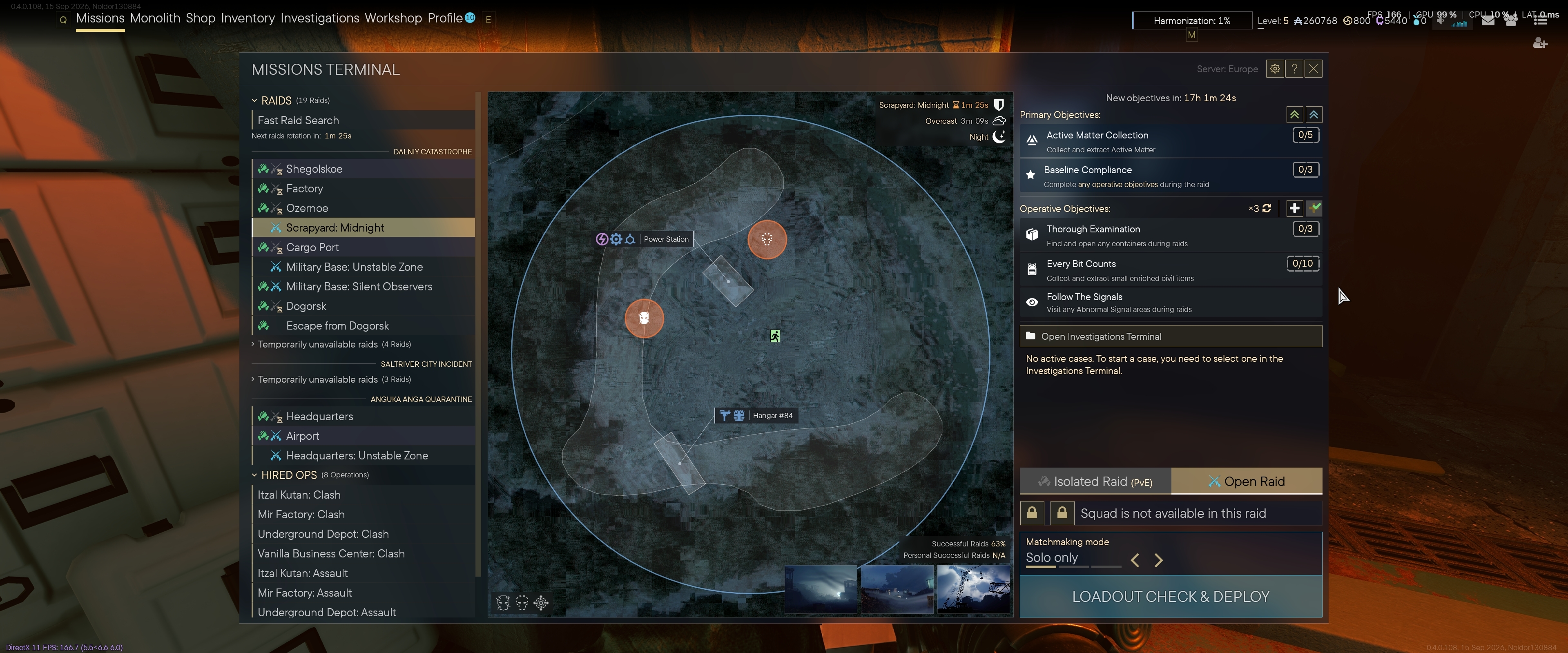
The progression is built in such a way as to give value to both survival and preparation. The active material recovered in raids feeds the growth of the operative and the base, allows you to obtain equipment and improvements and contributes to the search for new possibilities, while the "investigations" help to give direction to the raids by preventing each game from turning into a simple random hunt for loot. The harmonization system and its merits also add a structure to the "battle pass" with rewards linked to the active cycle.
Another aspect that I personally found very annoying is the constant voice of the operational support, that is, an annoying little woman who every few minutes tells you about things that happen on the map and that she thinks are important. The problem is that... she talks. If I need silence to hear enemies, I hear the girl ranting about drops, points of interest, etc... Which could also have a semblance of usefulness, if it weren't for the fact that she says that she marks the things she talks about on the map, but nevertheless either I'm crazy, or on the map you don't understand which points she is talking about.
Last but not least, to consider for those who play on PC with peripherals other than mouse and keyboard (you're crazy!) or on consoles (yes, the title is multiplatform): the controller is supported, but the developers themselves specify that the system is still being improved, a fairly clear sign that the experience has been designed first of all thinking about traditional control from PC. Finally, the absence of the integration of the "friends" function of Steam makes the invitation of your acquaintances to the team a further pain in the ass (which I'm sure will be mitigated in the future, don't you friends of Team Matter?).
Graphic and sound distortions
From a visual point of view, Active Matter adopts an artistic direction that initially might seem that of a classic realistic military shooter, but which is progressively deformed by the elements of quantum instabilities. Industrial structures, abandoned roads, forests, laboratories, ruined buildings and other infrastructures are believably modeled, only to look up and see buildings suspended in anti-gravitational zones and other phenomena that transform the landscape into something alien (and chromatically aberrated). The contrast between the everyday and the surreal certainly gives the game a stronger aesthetic personality than it might suggest at first glance.
The rendering of the environments also benefits from a rather accurate lighting, with attention to fog, sky, reflections, adaptation of exposure during aiming and rendering of weapon flashes. The most recent updates have worked specifically on global illumination, fog, clouds, water reflections and the effects of shots in relation to different materials, while optimizations of the rendering of environments have also been carried out. It is therefore not a graphic sector that simply aims at the number of polygons, but rather at the ability to support the atmosphere and tactical readability. However, if there are incredible "highs" (darkness and the functioning of light), there are some "lows" that still need to be improved (water as a maximum example, but also the rendering of the environments is still quite far from photorealism).
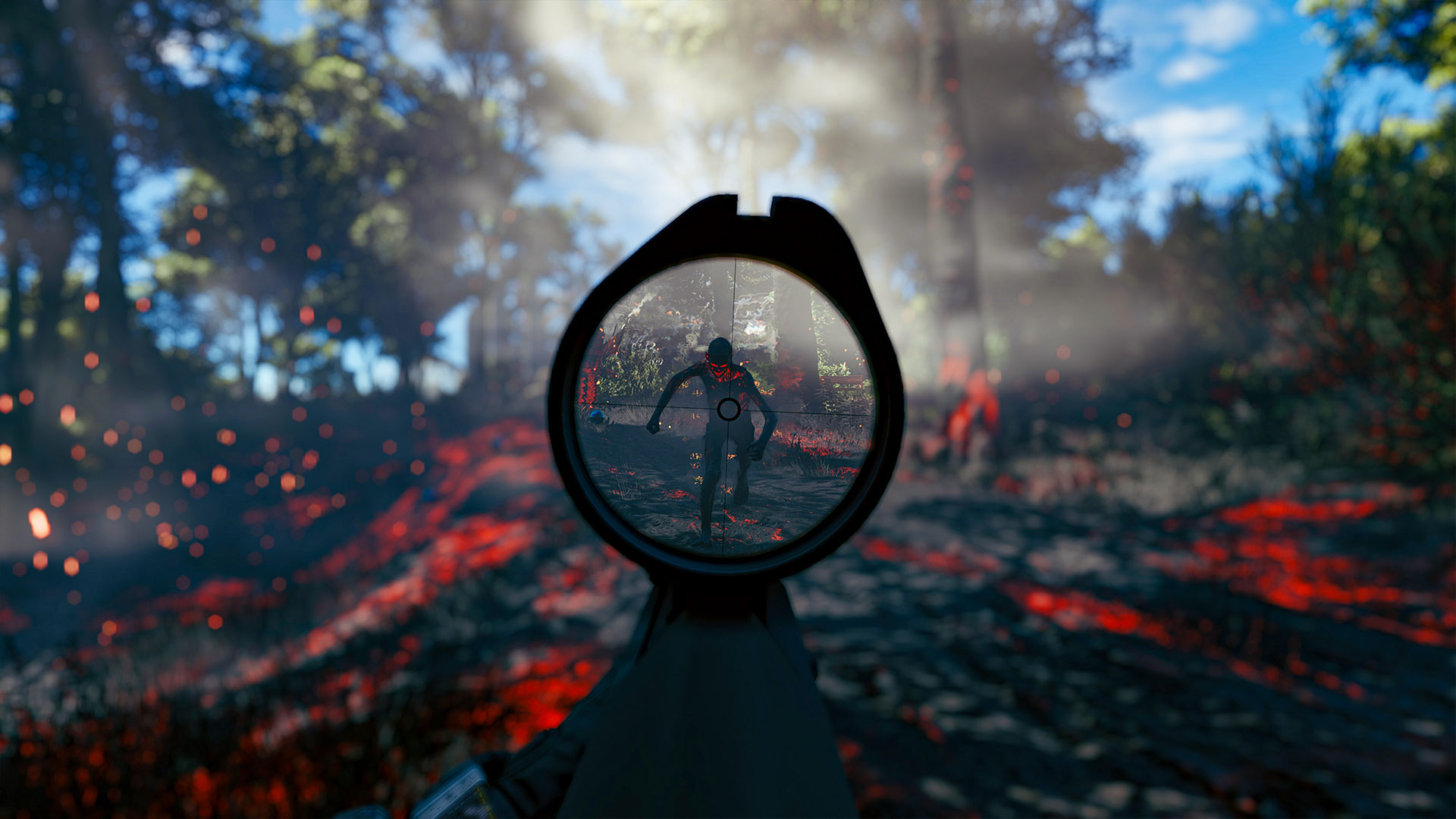
On the other hand, on a technical level, the title is perfectly adequate for those looking for a certain breadth of scenarios (maps that are not excessively large but well characterized) without demanding extreme configurations: on Windows, a Core i5-6600 or Ryzen 3 1300X, 8 GB of RAM and a GTX 1050 Ti/RX 470/Arc A580 are indicated as minimum requirements, while the recommended configuration rises to 16 GB of RAM, Core i5-8700/Ryzen 5 3600 and RTX 2060/RX 5700 XT/Arc A770, with 45 GB of space required on SSD. With my configuration (see below) I didn't notice any stutter or frame drops even for a moment on several maps and prolonged gaming sessions. A DirectX 12 version is present and selectable, but still considered in beta.
We can say a lot about the sound: it is probably one of the most interesting elements of Active Matter. Footsteps, gunshots, reloads, anomalies and ambient noises have a concrete tactical importance like all self-respecting games of the genre and the sound occlusion system makes the perception of sounds coming from rooms and areas separated by obstacles credible. However, as I mentioned earlier, there are these "slips" of annoyance of the operator that completely break the pathos.
The soundtrack is instead surprisingly ambitious for a project of this type. The game has an internal music player in which tracks found during exploration are collected and which can be listened to while in the headquarters. Some more pleasant, others... less (de gustibus...), some copyrighted , others less ( streamer mode is available). Close to the launch, Team Matter also announced the entry of Akira Yamaoka (better known for "Silent Hill") as the author of new songs.
Before jumping into the multiverse...
Active Matter is not free-to-play and is marketed through multiple editions, with the "Standard" set at around €30, but also with the more gargantuan edition coming in at €100 (and if you really want to throw money away, there is one at €140 which, however, also includes 2 standard editions to show to your friends). the PC has already been achieved through the Gaijin Store, while the launch on Steam is scheduled for *drum roll* today, September 15, 2026. Those who purchased the game through Gaijin can also transfer the same edition and its progress to Steam for free by November 23, 2026, a particularly important aspect for those who decided to start before the opening of the Valve store and above all much more honest than other Russian developers have done (*cough cough* BSG *cough cough*).
For now we didn't seem to see cheaters around, also thanks to BattlEye with anti-cheat component at the kernel level, an element to keep in mind especially for those who have special needs related to system security or Linux configurations.
Materiattiva is therefore a project that certainly deserves attention because it takes a now overpopulated genre of ... ahem, titles and tries to rise a head above, using original narrative elements and tools through which to alter combat, exploration and risk management. The combination of realistic arsenal, PvPvE gameplay, anomalies and almost horror atmosphere works especially when the player agrees to leave behind the logic of more conventional shooters and begins to consider the environment itself as part of the equipment.
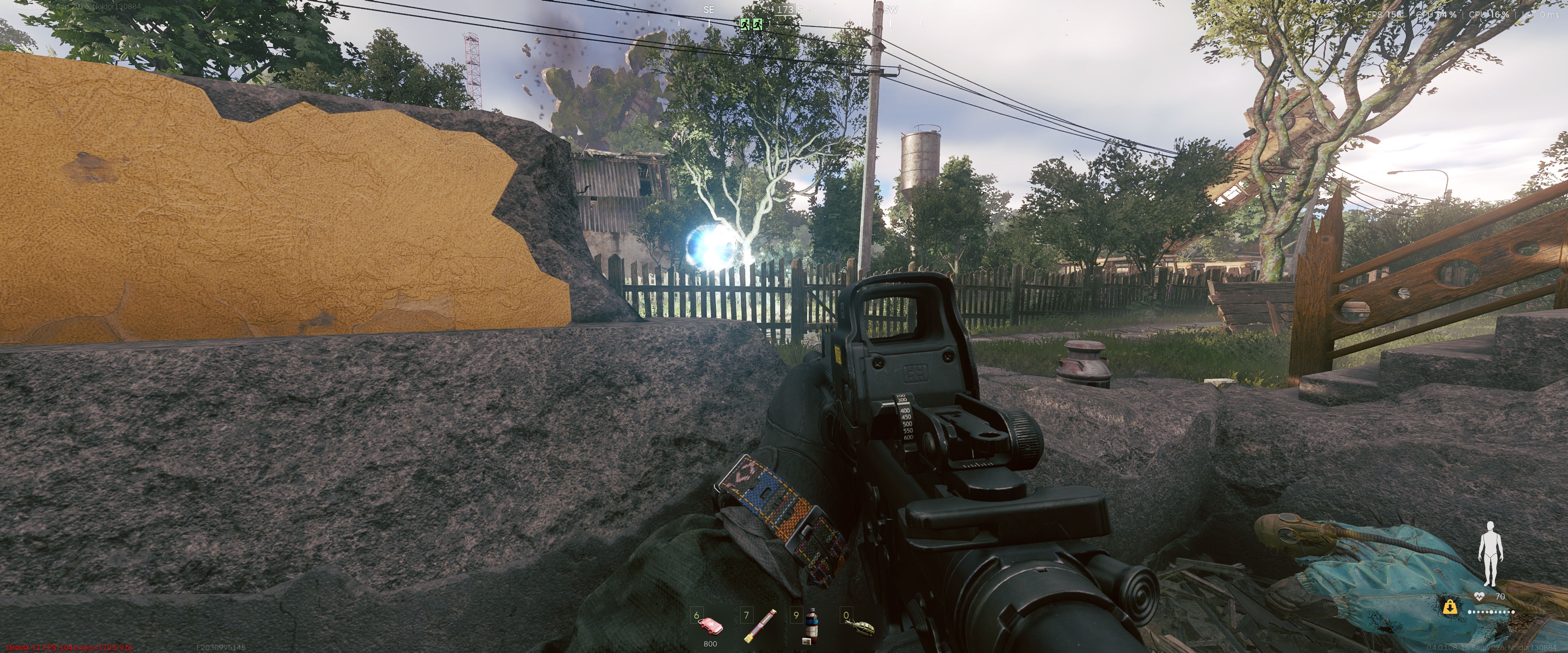
However, it is not a perfect title and, above all, it is not a game designed for those looking for immediate gratification: the interface and progression require infamous headaches, some mechanics still show some roughness and the technical component testifies to the still evolving character of the project. The overall feeling remains that of a title with a fairly solid base, supported by a clear artistic direction and an idea strong enough to justify dozens of hours of experimentation.
About the Author