Mycopunk is a co-op shooter developed by the independent studio Pigeons at Play and published by Devolver Digital, which after more than a year spent in Early Access has finally reached the version 1.0. A game in which we control a team of malfunctioning robots, work for a multinational with at least questionable working practices, and are sent to a moon infested with fungal organisms with the objective of solving a problem that, probably, no one should have allowed to occur.
On paper, it might appear to be yet another attempt to blend Deep Rock Galactic, Helldivers, and some borrowed elements from Borderlands, with a splash of Risk of Rain to make everything even more chaotic. And, in fact, much of its foundation will immediately feel familiar to fans of the genre. The point is that Mycopunk manages to use those ideas to build something surprisingly original, thanks largely to a gear customization system that seems to have no intention of preventing us from breaking the game. In fact, it seems almost to encourage us to do so.
And considering how often the genre ends up becoming an unpaid second job, finding a shooter whose main goal is to entertain us already represents a rather interesting news item.
This content is provided by YouTube. To view it, you must allow external content. Activation may result in data being shared with the third party.
Welcome to SAXON, you’re already licensable
The story takes place in the year 4083, when the SAXON Corporation, a multinational that evidently considers corporate ethics a particularly annoying form of bureaucracy, discovers significant deposits of Saxonite on New Atlas, a remote moon destined to become the next opportunity to turn a natural resource into an interplanetary problem. After launching colonization operations, the company comes into contact with the Hashetty, an alien civilization from another galaxy that, rather than proposing a particularly advantageous commercial agreement, decides to declare war on the Milky Way.
As if that weren’t enough, New Atlas is gradually being devastated by a mysterious fungal infestation capable of taking over machinery present on the surface, turning them into hostile creatures and making extraction activities decidedly less profitable than expected.
What’s Saxon’s solution? Naturally, hire a team of robots deemed already close to being scrapped, promise them money and glory, and send them to solve the problem. Thus is born the New Atlas Hazard Crew, a group of mechanical decontaminators who probably represent the last professional frontier before being disassembled and resold as spare parts.

It’s a deliberately absurd premise, but perfectly coherent with the game’s tone. Version 1.0 enriches the narrative context compared to the early Early Access builds, offering some additional information about the disaster’s origins and Saxon activities. However, don’t expect an especially intricate plot or a cinematic campaign built around dozens of characters: the story remains chiefly a pretext to justify increasingly implausible missions, ranging from clearing infested zones to reactivating massive military infrastructure, all the way to operations that essentially involve destroying space installations using cannon-sized weaponry.
Fortunately, the writing has a good dose of irony, especially when it needs to portray Saxon’s attitude toward her employees. The game constantly mocks corporate jargon, productivity rhetoric, and the particular tendency of multinational corporations to view any catastrophe as an opportunity for growth. All of this without turning every conversation into a contest to see who can deliver the most exaggerated punchline. The humour is present, works, and above all knows when to step back, a trait I personally appreciate a lot after having played games in which every character seems to have a desperate need to prove they’re funnier than the last.
Rock and Stone! Ah no...
The structure of Mycopunk is relatively simple. From our orbital hub, we select a mission, prepare equipment and upgrades, choose the character to use, and are sent to the surface of New Atlas to complete a series of objectives while increasingly large waves of fungal creatures attempt to turn us into a collection of scrap. The reference to Deep Rock Galactic and Helldivers is quite evident, especially regarding the mission structure and wave management, but Mycopunk manages to stand out through a generally more frenetic pace and a significantly greater degree of freedom in approach.
Objectives can range from simple enemy concentration eliminations to reactivating structures, from resource gathering to defending installations, passing through more complex tasks that require reaching specific areas and interacting with machinery while the entire local ecosystem attempts to kill us. Difficulty does not necessarily stem from the presence of particularly intelligent or resilient individual enemies, but from the progressively increasing pressure exerted by the hordes. As in Risk of Rain, spending too much time on the field can gradually make the situation more complicated, forcing us to balance exploration with the need to complete objectives.
It’s a philosophy that works mostly because the game doesn’t constantly force us down a mandatory path.

The progression system rewards almost any activity, allowing us to unlock new equipment and character modifications without being forced to repeatedly complete a specific mission simply because someone decided that the only way to unlock a particular enhancement was to collect forty glowing mushrooms during a specific lunar phase. There is still a task system, the Backlog, which lets you track more structured objectives and earn additional rewards, but it remains primarily a tool at the player’s disposal rather than a constraint around which every session must be organised.
The progression doesn’t seem designed to artificially keep us stuck, but to always give us another chance to experience something new. Naturally, this doesn’t mean repetition disappears entirely. Mission types inevitably recycle familiar situations, especially after several hours, and the variety of objectives can’t compete indefinitely with the desire for novelty among those who spend hundreds of hours on the same shooter. The point is that Mycopunk often compensates for this unavoidable repetition through what happens during missions, making encounters sufficiently unpredictable to make even two operations built around the same objective feel different.
The fungus is alive. And it stole a machine gun
The combat system probably represents one of the most original components of the entire production. Mycopunk’s enemies are not simply robots covered in fungi with a health bar to empty. They are modular creatures, composed of mechanical parts and fungal organisms capable of dynamically reacting to damage and environmental changes. This means shooting an opponent doesn’t necessarily mean you’ve definitively eliminated them. We can destroy their limbs, separate certain components, neutralise specific offensive systems, or reduce them to pieces, but the remaining fragments on the ground can be picked up by other enemies, who use them to modify their own structure and become even more dangerous. In certain circumstances, even what we’ve just destroyed can contribute to the formation of a new threat.
It’s a mechanic that significantly alters how we approach fights, because eliminating an enemy doesn’t necessarily mean you’ve solved the problem they represented: image yourself focusing on a particularly annoying creature, finally destroying its weaponry, and only seconds later realizing another opponent has picked up that very piece and added it to their gear.

What’s interesting is that this modularity allows squads to evolve during combat, constantly altering the composition of threats on the battlefield. We don’t just need to identify the most dangerous enemy and eliminate it, but also assess which components to destroy, where to do so, and what consequences leaving certain debris near other creatures might entail. Pigeons at Play has also put considerable effort into making vulnerable areas more legible, making weak points and damaged components easier to identify. This intervention is particularly important given how quickly the screen can fill with enemies, projectiles, and particle effects. The result is a combat system that transforms simple dismemberment into a genuine strategic component, without compromising that sense of controlled chaos — one of the core pleasures of the experience.
Not everything is perfectly legible, of course. When armies reach considerable sizes and different creatures begin to mutate simultaneously, understanding exactly what’s happening can become complicated. Some situations end up resembling more like a massive explosion of scrap and organic material than a fight in which every threat is immediately recognizable. But it’s hard to deny that Mycopunk manages to offer enemies far more interesting than the classic sequence of normal, special, and elite units that characterises so many co-op shooters.
Finally, someone leaves us breaking the game
While modular enemies represent a solid idea, it’s the customisation system that turns Mycopunk into something truly special. The arsenal doesn’t boast the overwhelming quantity of weapons we can find in Borderlands or Destiny, but it compensates through a selection of tools with sufficiently distinct behaviours, and, above all, a modification system capable of radically altering its function.
Building the builds revolves around an hexagonal grid in which we must place enhancements of different shapes and sizes. Each modification occupies a specific amount of space and can affect stats, bullet behaviour, elemental effects, or specific weapon characteristics. Therefore, it’s not enough to simply obtain the most powerful available enhancement: we must also understand how to insert it correctly within the grid, potentially sacrificing some modifications to make room for more interesting combinations. It’s a kind of Tetris for people who prefer to see something explode at the end of the match.
The most powerful modifications typically take up more space, while smaller ones allow us to better utilise available space and build intricate combinations. The result is a system that constantly encourages experimentation, thinking not only about the effectiveness of individual upgrades but also about how those already equipped interact with each other. We can build weapons capable of applying elemental effects with extreme aggression, alter projectile behaviour, significantly increase damage, or develop combinations in which one effect directly fuels the next.
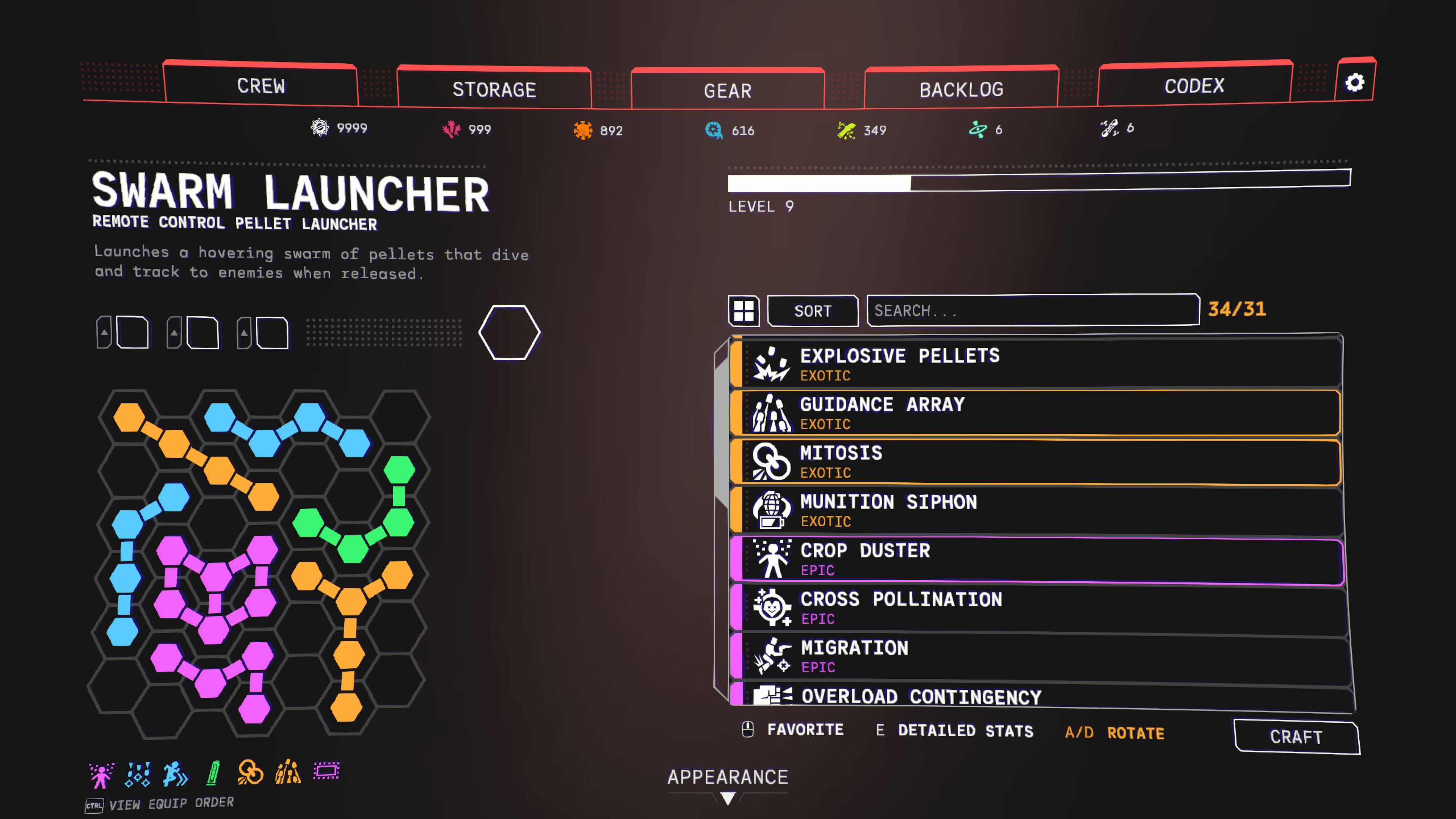
The game doesn't seem particularly focused on preventing us from reaching seemingly absurd power levels, because the goal is not to keep every build within rigid boundaries, but to allow the player to discover how far they can push themselves by intelligently exploiting the available systems. It's a philosophy I personally prefer over that of many modern looter shooters, in which the search for the optimal configuration inevitably becomes the pursuit of a predetermined meta.
Here, we don’t need to wait for a developer to decide which weapon should be particularly effective this season. We can experiment, make mistakes, discover unexpected interactions, and build something that works according to our own gameplay style. The most fitting reference — paradoxically — isn’t even a shooter. Mycopunk manages to deliver that particular satisfaction typical of Diablo, in which progression becomes a constant search for synergies capable of transforming an apparently ordinary character into a wandering deity. Only here, instead of compulsively clicking on a group of demons, we can make them explode using completely out-of-control sci-fi weapons.
Of course, it takes some time to get used to the system. The sheer number of modifications, statistics, and interactions available can initially feel overwhelming, and some combinations require a fair bit of experimentation before they truly become effective. But the game at least has the merit of not treating the player as someone who must be guided hand-in-hand through fifty consecutive tutorials. The core information is introduced gradually, and the rest is left to the player’s curiosity and willingness to experiment.
A choice that helps make progression much more personal, while still leaving some unavoidable difficulty for those who prefer immediately understandable systems.
Four robots, no identity crisis
Another aspect that pleasantly surprised me concerns the character management. In modern co-op shooters, it’s common to encounter extremely rigid classes, built around pre-established roles that force the player to abandon certain weapons or tools to maintain the ideal team composition. Mycopunk takes a decidedly more flexible approach.
Every member of the New Atlas Hazard Crew possesses specific abilities and characteristics, but weapons are not rigidly tied to individual classes. This means we don’t necessarily have to pick a character simply because we want to use a particular revolver or a specific type of weapon. It’s an apparently trivial difference, but one that ends up having important consequences for build construction. We can, in fact, choose the character primarily based on the abilities we prefer and then tailor their equipment around the role we wish to fill, without necessarily adhering to a traditional division between tank, support, and damage dealer.
Personal abilities also offer a greater flexibility than one might expect. Through upgrades, we can modify their behaviour and adapt them to different situations, eventually building configurations that significantly diverge from the immediate usage originally intended by the developers.

The difference between the characters remains important, but it doesn’t become a cage within which we’re forced to organise the entire experience. It’s a choice that makes co-op particularly enjoyable, because it allows you to compensate for any team shortcomings without necessarily having to change characters. And, above all, it helps make the title more accessible even solo.
Mycopunk clearly emerges as a cooperative experience and delivers its best when four players begin combining different builds against increasingly numerous waves. However, mission balancing allows the adventure to be tackled even without companions, avoiding turning every operation into a punishment for those lacking three friends available at 2 a.m. With version 1.0, the number of characters increases further thanks to the introduction of the Mycologist, a new team member that we must first recover during the Expedition Alpha mission. Surviving for over a year after the infestation on New Atlas, the Mycologist brings abilities particularly tied to manipulating fungi and infection. Among these we find Sporelift and Fungal Skewer, along with a passive mechanic that allows us to accumulate infection by exploiting our own abilities.
It’s an interesting addition because it introduces another layer of risk management, allowing you to boost your effectiveness by using abilities, but requiring attention to prevent infection buildup from becoming counterproductive. It’s a consistent approach with the rest of the production, in which even seemingly simple mechanics can be modified until they become the core of particularly elaborate builds.
Version 1.0 didn't just remove a label
So we arrive at the most important question for those who had already had the chance to experience Mycopunk during its Early Access period: how has the game actually changed?
The answer is quite a bit.
On 20 October 2026, Pigeons at Play released a definitive version that goes beyond collecting previous updates, introducing additional content and a substantial amount of improvements. Besides the already mentioned Mycologist, we find Population Control, a new mission focused on eliminating particularly high concentrations of enemies, with the opportunity to face some of the terrifying Abominations.
A new region, X11-B, is introduced, located on a minor satellite of New Atlas, designed to put more advanced setups to the test. This addition is particularly significant for those who had already reached the advanced stages of progression and were seeking new opportunities to test their gear.
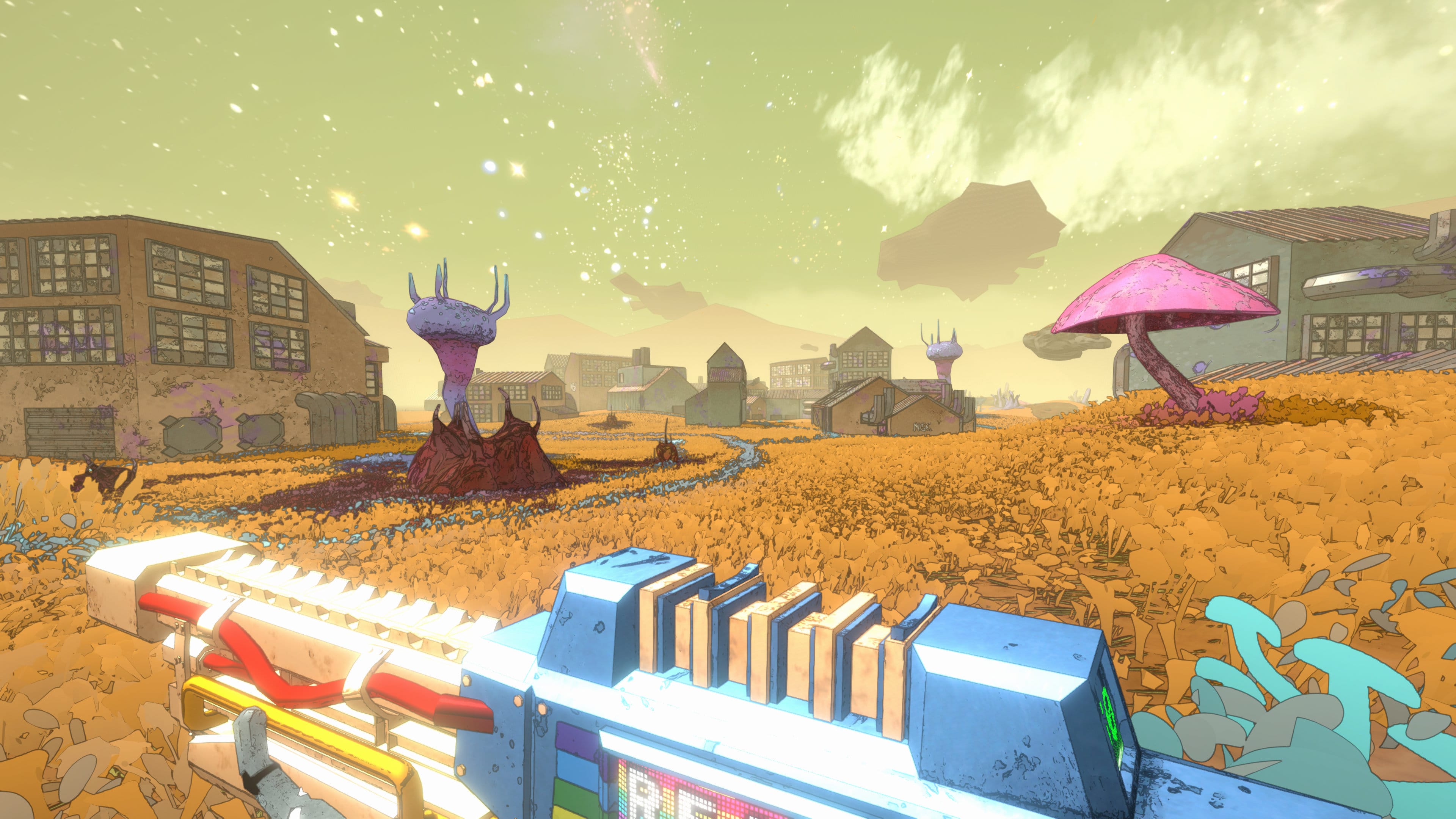
On the arsenal front, we find the Diffraction Driver, an ion-dispersion weapon capable of emitting a short-range energy cone, adjustable to focus the beam more intensely and extend its range. Unlocking it requires reaching level 10 and investing some resources, offering further incentive to continue progressing. Accompanying it is the Snowball, a cryogenic grenade that further expands battlefield control options and is unlocked via X11-B content. These additions align with the game’s philosophy, as they don’t simply introduce new offensive tools but offer additional opportunities to build combinations and exploit elemental effects during combat.
The final version also introduces several life-quality improvements, including interface changes, enemy balancing, and crafting system tweaks, along with a revised hub and capsule used to reach missions. Even the environments have benefited from a significant evolution compared to the early builds, with more detailed biomes, more recognizable structures, caves, and paths that help make encounters more dynamic. Initially, some maps risked appearing as vast open spaces primarily used to host waves of enemies; now, level design more confidently exploits the terrain’s layout, forcing us to find passages, use cover, and manage fights in increasingly complex environments.

There are, of course, definitely less revolutionary additions, but perfectly consistent with the overall tone of the production. We can finally wear hats, earn cosmetic rewards through the Fulfillments system, and even tackle a small mission dedicated to retrieving a sofa for the hub. Because, obviously, no planetary decontamination operation can be considered truly professional without an adequate relaxation area.
The presence of activities and seemingly superfluous small details still helps make the world more recognisable and gives characters a personality that goes beyond their respective abilities. Mycopunk doesn’t seem to want to be merely a collection of perfectly optimised systems, but also a game that enjoys existing.
An artistic direction that might warrant an eye exam
From an aesthetic standpoint, Mycopunk certainly represents one of those games capable of immediately dividing the audience. The art direction combines stylised 3D models, particularly aggressive colours, gritty and industrial surfaces, and a pronounced use of graphic elements that contribute to building a deliberately chaotic visual identity. It’s not a game that seeks to be beautiful in the traditional sense, and perhaps precisely for this reason it manages to stand out.
The fungal creatures have a grotesque appearance, the robots seem to have been scavenged from a scrapyard and assembled by someone with decidedly questionable mechanical knowledge, and the environments alternate between sci-fi structures and organic formations that appear to have grown in the least suitable locations. The overall effect is a kind of psychedelic industrial sci-fi, in which every element appears deliberately excessive.
The style won’t necessarily break through the hearts of all, and, especially during the most crowded battles, the volume of visual effects can compromise situation readability. But once the game’s aesthetic language is absorbed, it becomes hard to imagine Mycopunk with a different artistic direction.
The audio department also plays a significant role in shaping the overall identity.

The soundtrack employs electronic sounds, synthesizers, and particularly energetic rhythms, accompanying combat with an intensity matched to the gameplay’s pace. Weapons provide a solid feedback response, and the destruction of the various mechanical components of enemies is accompanied by sufficiently convincing effects to make every hit feel particularly satisfying. The voice acting and dialogue also maintain that deliberately absurd tone that defines the entire production, without ever becoming a constantly intrusive presence.
It’s a far from certain balance, especially for a game published by Devolver Digital, a company that over the years seems to have developed a particular skill in identifying productions capable of making any idea seem perfectly reasonable, provided it’s sufficiently strange.
Technically speaking
From a technical standpoint, Mycopunk clearly benefits from a stylised aesthetic that allows it to allocate a significant portion of its resources to managing hordes, visual effects, and interactions between the different components of enemies. Version 1.0 is accompanied by several optimisation improvements, including enhancements to vegetation and specific environmental rendering, as well as a review of certain graphical effects that could cause stability issues.
The PC performance overview based on available data is generally positive, though it remains tied to the configuration used and the number of elements displayed on screen. Mycopunk focuses primarily on fluidity and control responsiveness, characteristics essential in a shooter where continuous movement and managing large groups of enemies are fundamental to gameplay.
Our PC review benchmark setup consists of NVIDIA GeForce RTX 5080, AMD Ryzen 7 9800X3D and 32 GB of DDR5 RAM, hardware significantly above the requirements of a title of this kind. Without specific numerical benchmarks, it would still make little sense to assign precise performance figures to the game, especially considering how performance can vary between ordinary missions, particularly crowded combat scenarios, and combinations of extremely heavy effect modifications. The final version also introduces several control improvements, including changes to ability and interaction management via controller, along with the option to separately disable damage numbers and textual indicators to make the interface less cluttered.
In conclusion
Mycopunk represents one of the most interesting surprises emerging from the landscape of independent co-op shooters, especially because it seems to have grasped a point that many figures in the genre stubbornly continue to forget: becoming extremely powerful should be fun, not a problem to fix at the first opportunity. Pigeons at Play builds an immediate gameplay loop, yet capable of offering surprising depth thanks to the freedom in customising equipment, the possibility of experimenting with particularly aggressive synergies, and a progression system that rarely tries to force us into using our time in a specific way. The modular enemy system represents perhaps its most original intuition, turning every fight into a dynamic confrontation in which destroying a creature can inadvertently contribute to the growth of the next one. Added to this are flexible classes, weapons capable of radically changing behaviour through upgrades, and a roguelike mode that intelligently exploits the same mechanics to offer a different experience.
Version 1.0 completes and expands a project that had already shown during the Early Access phase to possess decidedly interesting ideas, introducing new content, an additional protagonist, more detailed environments, and a considerable amount of quality-of-life improvements. The art direction can appear overly chaotic, combat readability occasionally suffers from the sheer number of enemies and on-screen effects, and mission structure inevitably repeats familiar situations after several hours. The progression system, while extremely satisfying, requires a certain period of adaptation and might discourage those who prefer immediate, low-effort progression. But these are limitations that rarely succeed in undermining what Mycopunk does best: entertaining without constantly asking for permission.
Mycopunk prefers to give us a arsenal, hundreds of modifications, and a planetary surface infested with particularly unpleasant creatures, leaving it up to us to decide how to tackle the problem. And considering that the official retail price is 14.99 euros, further reduced during the launch promotion of version 1.0, it becomes even harder to ignore just how generous the offer is. We are not facing the largest, most spectacular, or most content-rich looter shooter ever made, but rather something I personally find far more interesting: a game that possesses a very clear identity, systems capable of communicating perfectly with each other, and a sufficient amount of freedom to make every new build a small criminal engineering experiment.
Devolver Digital has found another small gem, and this time, the only thing that really risks infecting us is the desire to do another mission.
About the Author