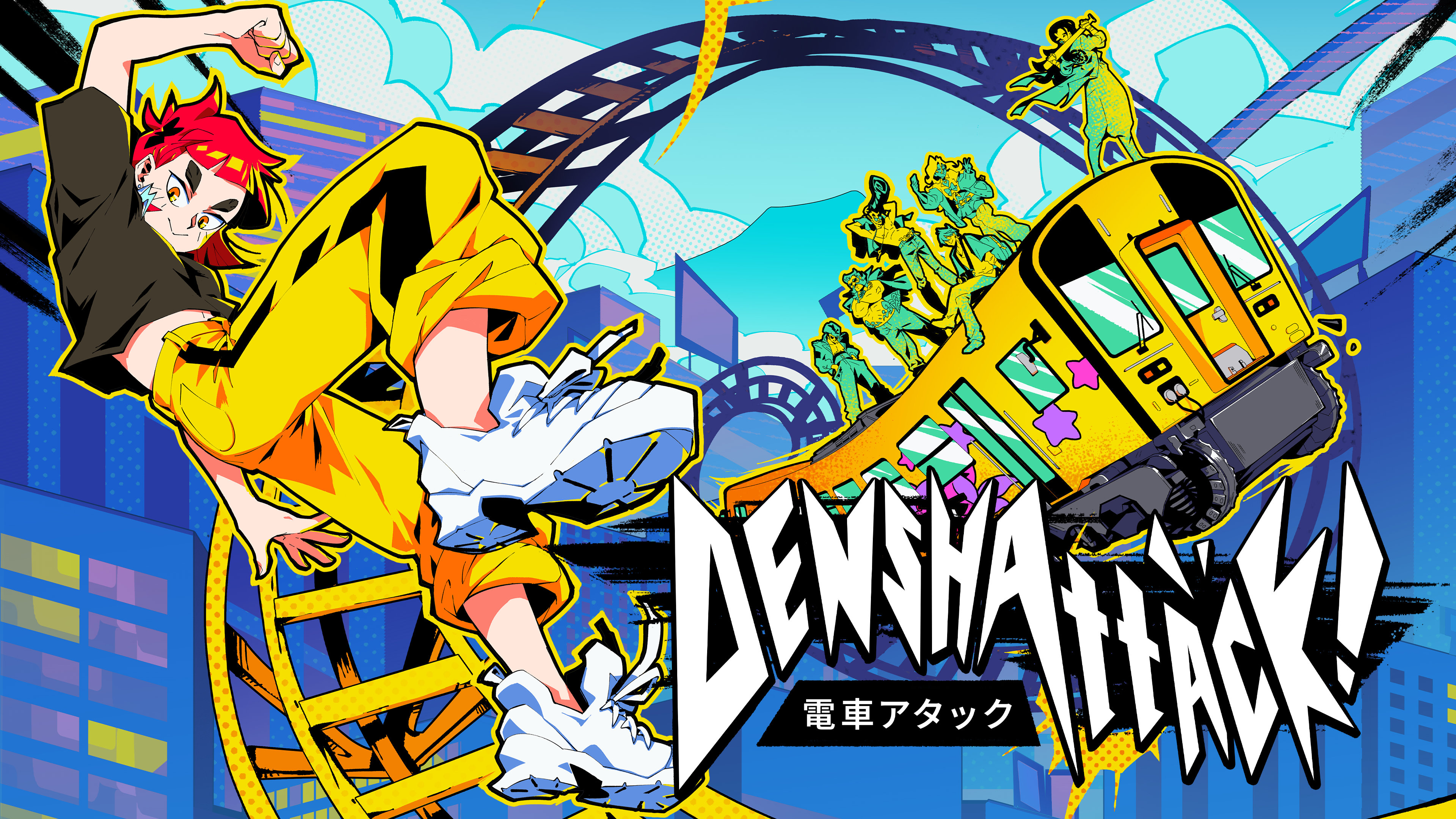
What do Tony Hawk, Jet Set Radio and Japanese trains have in common? Apparently, not much, at least until someone decides to turn anti-gravitational trains into giant skateboards launched at full speed against a malevolent corporation. It’s precisely from this absurd yet irresistible premise that Denshattack! emerges — an arcade surprisingly thoughtful, deep, and full of personality.
The title developed by Undercoders seems to come from an alternate era in which the Dreamcast never stopped receiving new games. Its rebellious aesthetic, its frenetic speed, and the constant encouragement to improve performance immediately evoke titles like Jet Set Radio, Tony Hawk’s Pro Skater, and the 3D chapters of Sonic. These influences are supplemented by a control system that, especially during maneuvers executed via the right analog stick, recalls Skate. Yet the result is not a simple sum of references. Denshattack! manages to transform easily recognizable nods into an experience with its own identity, built around an implausible yet perfectly functioning concept: becoming the best railway acrobat in Japan.
This content is provided by YouTube. To view it, you must allow external content. Activation may result in data being shared with the third party.
Railway skateboarding
The structure of Denshattack! is that of an arcade divided into levels. The player controls a train launched along predetermined paths, passing through cities, rural areas, volcanoes, coastlines, and numerous other scenarios inspired by the Japanese landscape. It’s not enough to reach the end of the track. During the race, obstacles must be avoided, curves tackled, ramps used, elevated tracks grabbed, and every opportunity exploited to perform acrobatics. Ollies, nollies, spins and other maneuvers earn points, while chaining tricks progressively increases the combo multiplier. Some movements are executed through partial rotations of the right analog stick. The solution makes the system slightly more technical than a standard platformer, without transforming it into a simulation. The fundamentals are easy to grasp, but achieving high scores demands precision, memory, and good route reading ability.

The closest reference remains that of Tony Hawk, especially when you start chasing a perfect combo and use the nollie to extend it between sections. Denshattack! however maintains a speed and level design closer to Sonic’s: the train moves quickly, obstacles arrive one after another, and the player must make decisions in seconds.
Easy to learn, hard to master
The first missions gradually introduce the various game systems. Denshattack! avoids immediately dumping a command manual on the player and instead adds new possibilities slowly. By the end of nearly every level, you feel as though you’ve acquired a new skill, ready to apply it in future challenges. Beneath an initially simple appearance lies thus a layered structure. As you progress through the campaign, both the speed and complexity of the paths increase, while new maneuvers allow you to tackle sections that previously seemed inaccessible. The tracks become progressively longer, more intricate, and richer with岔路口.
The first completion of a mission often represents only the beginning. Levels are designed to be replayed in search of a better time, a higher score, or missing collectibles. Getting a gold medal on the first attempt is rare, because many sequences require prior knowledge of the obstacles and ramps along the route. The generosity of checkpoints prevents errors from becoming excessively frustrating. At the same time, the desire to complete a whole section without collisions or interruptions fuels that classic “just one more attempt” mechanic typical of the best score-based arcade games.

Denshattack! therefore works very well even in short sessions (and, on this point, runs quite well on Steam Deck), but it offers enough depth to engage those who wish to study every level and perfect every move.
Not only raced against time
Not all missions are limited to asking you to reach the goal with the best score. Some levels prioritise exploration, others test your ability to build combo chains, while others introduce specific objectives and conditions. The number of different situations presented during the nine chapters of the campaign is truly impressive. Particularly successful are the boss fights. Although they may seem difficult to integrate into a game focused on rail-based acrobatics, they represent some of the most spectacular sequences in the entire experience. During these encounters, the movement system is used creatively, forcing the player to quickly interpret the opponent’s attacks and to exploit the environment and tricks to counterattack.
The variety is one of the main strengths of Denshattack!. Not all modes are equally effective, but the game changes frequently enough to avoid making its core system feel repetitive. Each chapter introduces different scenarios, characters, and mechanics, giving progression a steady pace.
Underground gangs and dystopian corporations
To set the stage for the competitions there is the fight against the left Miraido Corporation. The player joins a group of outcasts and rebels, traversing Japan to earn the respect of clandestine railway gangs and convince new adversaries to join the rebellion. The story does not aim for a particular political depth, but is more present and detailed than one might expect from a game built around trains capable of performing kickflips. The characters are eccentric, recognizable, and supported by enjoyable dialogue, while the events change noticeably from chapter to chapter.

The gaming world blends Japanese culture, urban imagination, independent aesthetics, and openly retro suggestions. Even elements like fanzines help define a credible subculture, giving the impression that the Denshattacker movement has existed for some time and possesses clear rules, myths, and well-defined rivalries. The narrative inevitably follows recognizable patterns, such as the need to face a rival in order to earn their trust. However, the good pacing and the variety of situations prevent the campaign from becoming merely a sequence of identical encounters.
A Dreamcast from the future
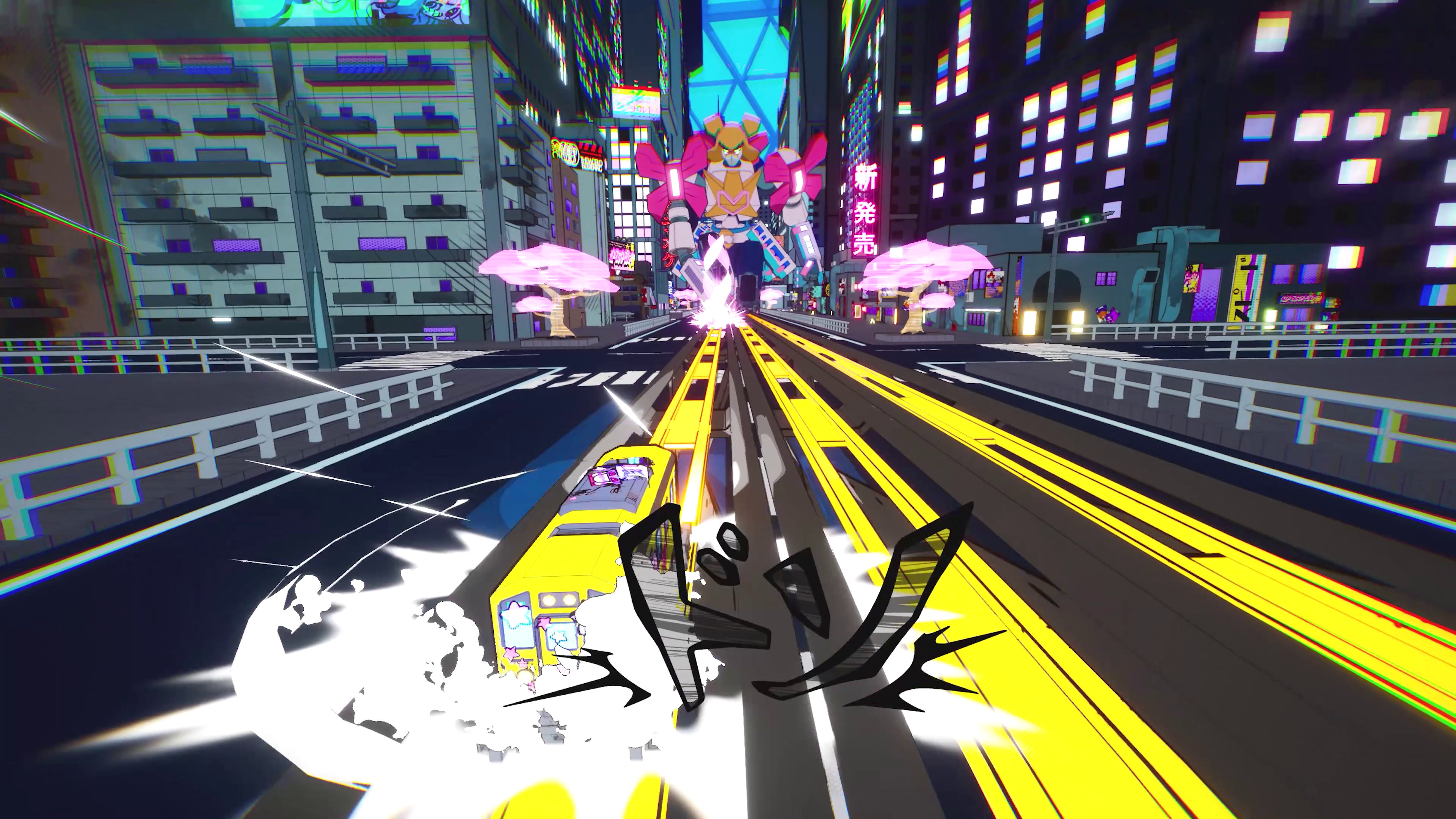
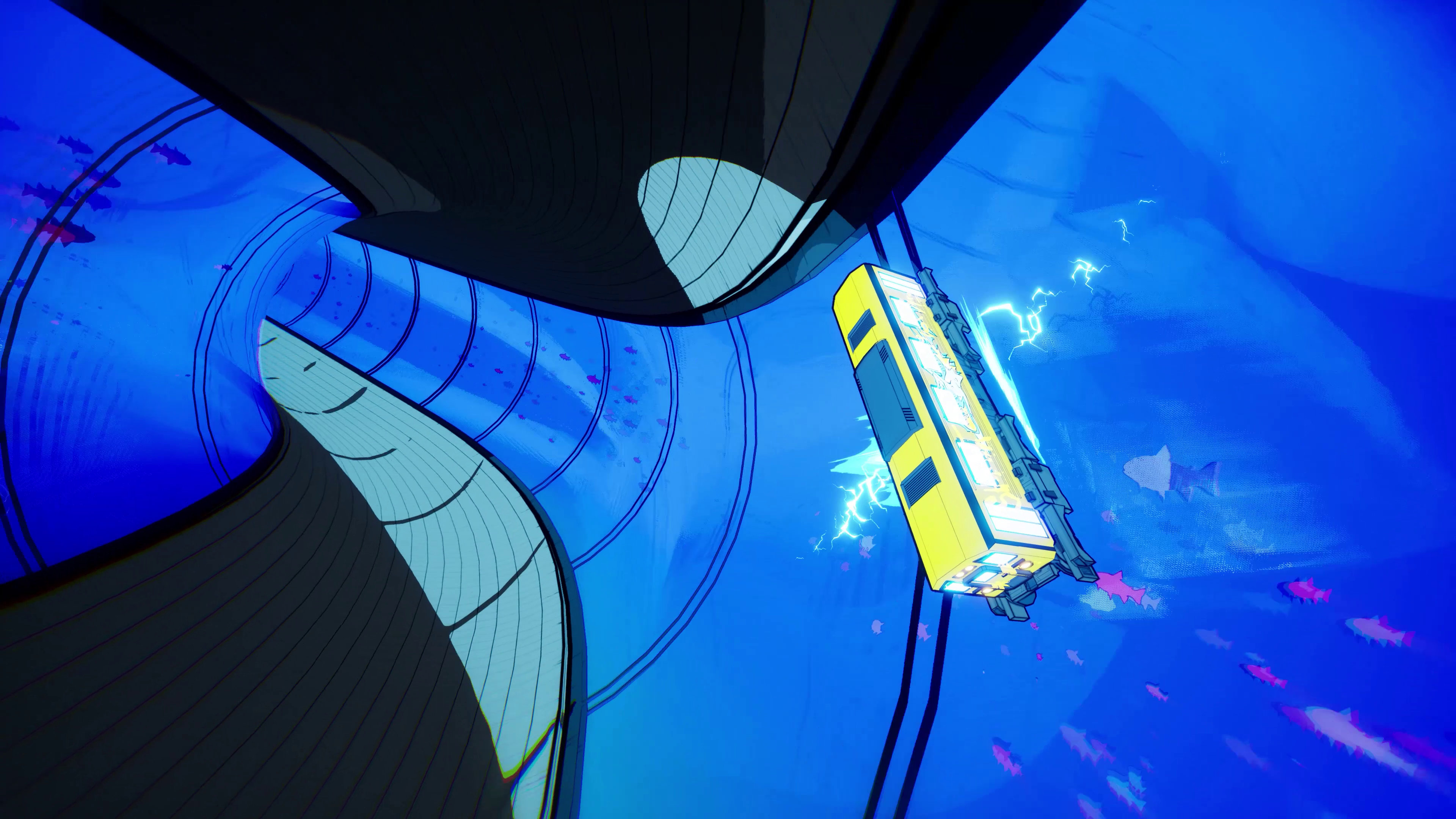
From a visual standpoint, Denshattack! presents an extremely colourful, noisy, and deliberately exaggerated artistic direction. The characters appear to come from an animated series from the early 2000s, while the interface, graffiti, graphical effects, and animations constantly transmit that energy. The variety of environments is notable. One moves from Japanese metropolises to grassy plains, volcanic zones, industrial ruins, and suspended tracks over the ocean. Each setting attempts to introduce at least one visual or mechanical element that distinguishes it from the others.
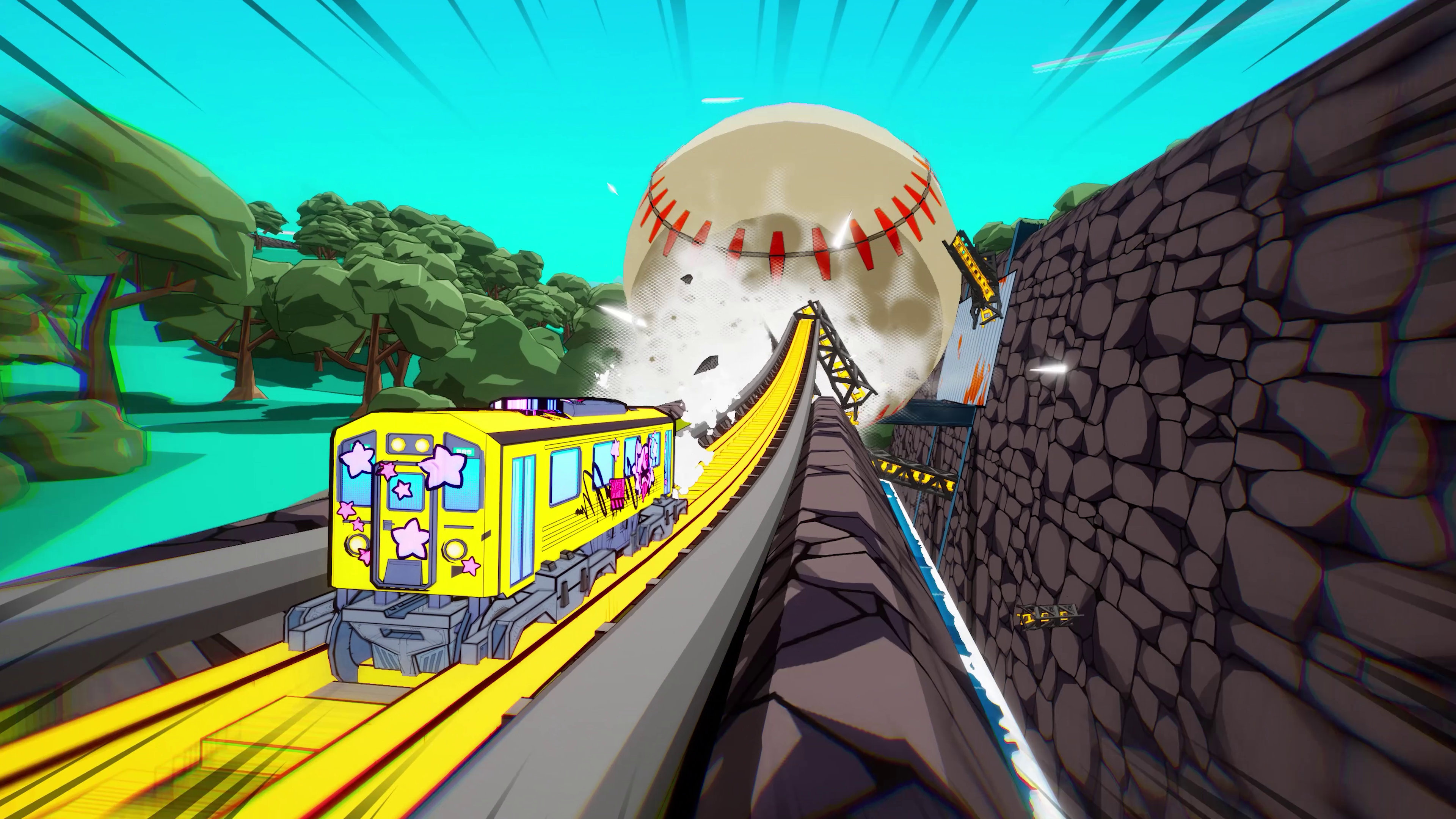
This wealth can however also become a limit. During the faster sections, the screen is filled with obstacles, particle effects, indicators, and bright colours. In some circumstances it can be difficult to immediately distinguish a usable track or understand which direction to take. Considering the train’s speed, a fraction of a second of hesitation is enough to miss a ramp or break a long combo. The situation doesn’t compromise the fun thanks to frequent checkpoints, but it makes clear that Denshattack! is a game that needs to be learned visually. Only after several attempts does one begin to recognise the language of its levels and distinguish decorative elements from those genuinely useful for racing.
A soundtrack out of this world
The soundtrack is not simply an accompaniment, but one of the foundational pillars of Denshattack’s identity!. The musical selection is broad, energetic, and capable of traversing funk, hip hop, urban rock, jazz fusion, chiptune, techno and drum and bass without losing coherence.
Leading the musical direction is Tee Lopes, a composer known for works such as Sonic Mania, Teenage Mutant Ninja Turtles: Shredder’s Revenge, Streets of Rage 4 and Penny’s Big Breakaway. His ability to blend retro sounds with modern production perfectly matches the game’s spirit. The inclusion of Shoji Meguro, the legendary composer tied to the Persona series and Metaphor: ReFantazio, adds jazz, rock and hip hop influences to urban atmospheres. Richard Jacques, closely associated with the Jet Set Radio musical tradition, brings his experience with acid jazz, big beat and electronic funk to the project.
The hip hop and breakbeat elements are strengthened by 2 Mello, known also for his work on Bomb Rush Cyberfunk, while Ryo Nagamatsu, active composer on series Nintendo such as Splatoon, Mario Kart and The Legend of Zelda, contributes with frenetic melodies and structures particularly suited to the most energetic sequences. The cast also includes Harumi Fujita, veteran associated with Capcom titles such as Mega Man 3 and Final Fight, and Kohta Takahashi, known for his work on titles such as Ridge Racer, Ace Combat 2 and Tekken 5. Further musicians and producers join them, including Andrew One, Sean Bialo, The Noble Demon and Toni Leys.
The vocal component can also count on important names. Takenobu Mitsuyoshi, the voice synonymous with several classic Sega titles like Daytona USA, brings an enthusiasm perfectly aligned with the arcade soul of the project. Lotus Juice, renowned for collaborations with the Persona series, adds sharp rap verses, while Alice Peralta, MIYACHI, milkyPRISM, JUNKY58%, THE DO DO DO’s and Yunosuke further expand the repertoire’s variety.
Each level is accompanied by a track capable of matching the pace of the race and turning even a simple repetition into a new performance. The average quality remains surprisingly high, and the number of artists involved grants the game an uncommon musical authority, especially considering the scale of the project.
The voice acting completes the audio aspect positively. The performances are lively and consistent with the characters' exuberance, without becoming overly caricatured.
Some derailment
The experience isn't entirely free of issues. At times, players may find themselves missing rails that appeared correctly aligned with the character or crossing partial ramps and surfaces during riskier dodges. These are not constant bugs, but in a title built around precision, they can become particularly noticeable—especially when they interrupt a combo painstakingly built up.
The main shortcoming, however, is the lack of a true training mode. The game features a tutorial area, but the time limit prevents free experimentation with all movements. Given the number of tricks and the importance of chaining combos, a timer-free space without obstacles or mandatory objectives would have been extremely useful. A practice area would allow players to calmly study stick rotations, nollie management, and the correct moment to grab a rail. Its absence does not prevent learning the system, but it makes the learning curve more arduous than necessary.
The visual impact could also become fatiguing during extended sessions. Bright colours, high speed, and numerous on-screen effects require a certain level of focus, making regular breaks advisable.
In conclusion
Denshattack! is one of those games that seem impossible to describe without resorting to a long list of comparisons. It’s a bit like Tony Hawk, a bit like Jet Set Radio, a bit like Sonic, and, in some control choices, even a bit like Skate. But reducing it to its influences would be ungenerous. Undercoders has built an original arcade, layered and rich in content, capable of constantly introducing new ideas without losing sight of the immediate pleasure of racing. The trick system is accessible but challenging to master, levels invite repetition, and the variety of missions keeps curiosity alive throughout the campaign. Some imprecisions in collision detection, occasional anomalous respawn behaviour, and the absence of a training mode prevent the experience from reaching perfection. Yet these are relatively minor flaws compared to the quantity of creativity, energy, and skill present elsewhere in the production. With its aesthetic reminiscent of a forgotten classic Sega, an exceptionally simple soundtrack, and a concept that no one else would likely have dared to turn into a full video game, Denshattack! stands out as one of the most surprising and recognisable arcade offerings of the past few years.
About the Author