
The Fermi Paradox, or the Fermi Paradox, is that “evaluation” (as Wikipedia calls it) according to Enrico Fermi (a Roman physicist, not pizza and figs!) we are a civilization friend-zoned by the rest of intelligent life.
We humans, as my high school biology teacher (peace to her soul) used to say, are a sort of dung in the universe’s economy, true, but the more intelligent Enrichetto nazionale told us that, given the universe’s vastness, by the law of large numbers, there should be plenty of dung, so much so that the universe should be literally covered in intelligent life... which, however, hates us. Or it lasts too short (and I believe you, look at how we’re currently situated). Or it’s too far away. Or perhaps neither we nor they can communicate via radio. In short, we are a civilization of losers... Or of fools, because it’s possible that the resources in the universe are a precious commodity and that everyone hides from everyone (in which case, only we humans would have a space program attempting to communicate with potential aliens), and if then the xenomorphs invade you, you deserved it.
Thanks to the good Fermi, our self-esteem is off the charts. Good thing he died in Chicago, at least we can make a bit of a joke about it... And fortunately, there are video games to distract us from our existential misery.
The Fermi Paradox is a game in which you are God dealing with several civilizations in a galaxy that evolve from primordial life forms and gradually become more advanced, until eventually capable of transmitting signals into space, traveling with generational spacecraft, and potentially colonizing new planets and developing futuristic technologies. The game's objective is to unlock "the ultimate technology" which you obtain when a certain number of civilizations reach the maximum level of scientific discoveries. However, since [insert your phrase on free will], life forms always end up harming themselves, and it’s always up to you to fix it... or widen the hole.
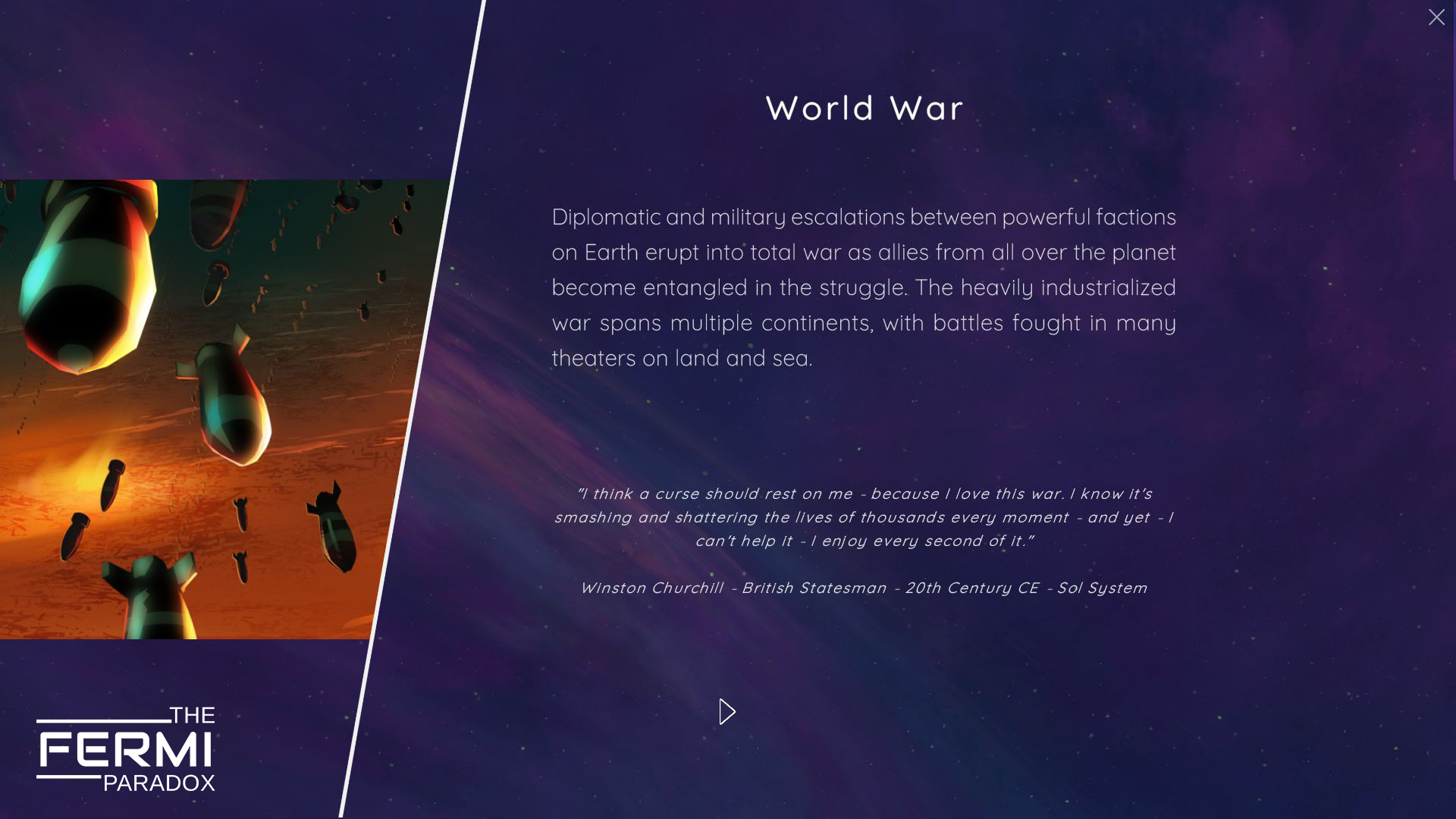
Actions that tend toward good and saving lives often require spending “synthesis” points (essentially the gods’ currency), while those that are bad or aim to sink a civilization are rewarded with the same currency. Time passes in “impulses,” and at each impulse, choices will be presented that will impact the populations of the universe, all with an interactivity comparable to that of a bookgame (call me a boomer if you like, but you young fella’s missed an era playing “Lupo solitario”), punctuated by multiple-choice menus ("press 1 if you have connection problems, press 2 to speak with an operator, press 3 for global apocalypse").

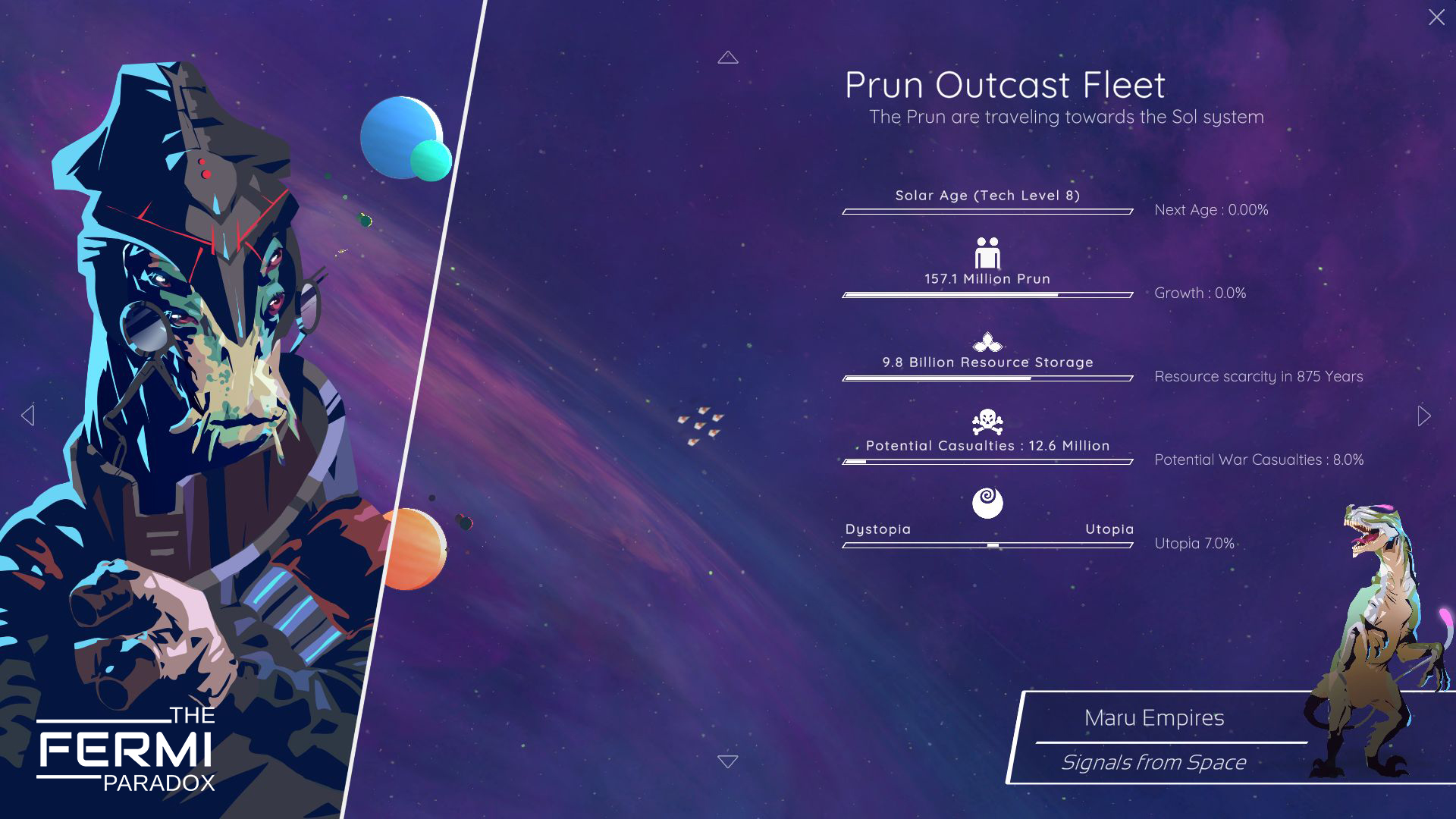
From time to time, there will be major events concerning the transition to a higher technological level or significant events impacting life on planets, such as the construction of important cultural projects, nuclear wars... In general, species survival is governed by five parameters:
- Science (which governs the ascent towards new technologies)
- Population (and birth rate, which influences a few of the other entries)
- Resources (bad luck if you run out! Otherwise, you’ll have to endure the speeches of various alien Thunbergs)
- Victims in the event of war (...which, if you’re really running out of resources, a small conflict to restructure the population, almost... )
- Justice (practically the meter that indicates the place where civilisation lies on the spectrum ranging from Cyberpunk to Peppa Pig cartoon)
Hard to avoid bad events. Impossible to save them all. God will constantly put you to the test to ensure a future for various intelligences, but eradicating them is a matter of seconds.
Despite the artwork, the game doesn’t offer many visually impressive aspects to be utterly dazzled by — and to be honest, getting used to the sheer volume of purple being dumped into your eyes is tough. Music and sound effects are mostly unremarkable, and despite the difficulty, this seems to be the classic educational game you might gift to a child who’s just stepping into the world of PC games for the first time ("No, Doom 10, I won’t buy it because it’s too violent. Here’s an educational game for you" — how many of you heard this phrase as kids, eh!? For me, the farthest I ever got from those attempts at educating through gaming was the Christmas gift of "Actua Soccer 2", a dreadful English football game... which I never actually enjoyed playing on PC either!)
Loading times for a game of this kind are truly ridiculous. To give the ratings below, I had to keep repeating the mantra "it's in early access" for days, because I relied on the hope that it would improve. As I played it, it didn’t even have a save function (though the developer had already announced it).
Overall, the verdict is somewhere between “meh” and negative. Perhaps it’s better suited to a platform like the Switch rather than PC, and certainly isn’t a title I’d personally spend money on. To the future, the difficult verdict (unless we run out of resources first, in which case...)
About the Author