
The second installment in the Hellslave series was released earlier this month, exclusively on PC. Hellslave II is developed by Ars Goetia and published by Dear Villagers, a publisher that can also boast titles such as The Dungeon of Naheulbeuk: The Amulet of Chaos in its catalog.
Gameplay
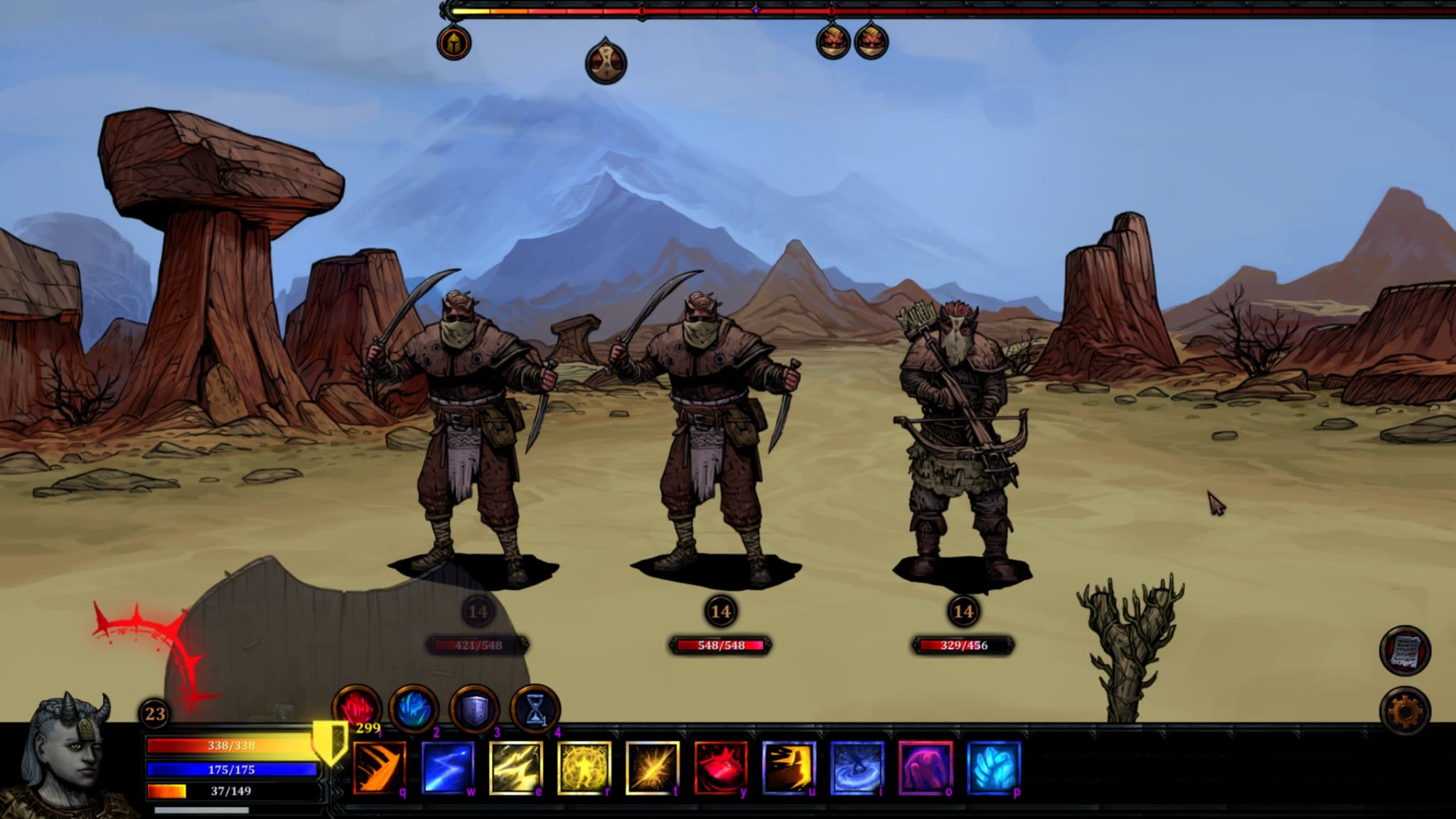
The game offers turn-based combat that immediately recalls the old Final Fantasy, while introducing a substantial difference: in Hellslave II the player controls a single character instead of the classic party made up of three, four or five members. This choice makes it even more important to build your character and the ability to find an effective build.
Both the protagonist and the enemies can in fact accumulate elemental damage, status alterations, bonuses and penalties. The different mechanics can interact with each other, creating interesting combinations and pushing you to experiment with skills and equipment. This is probably where the combat system offers its best: finding a particularly effective synergy and seeing it work against groups of enemies is definitely satisfying.
The downside is a certain confusion during clashes. When numerous effects come into play at the same time, each accompanied by its own animation, it is not always immediate to understand which skill, status or combination really determined the outcome of the fight. Greater clarity in the return of information would have made the system more readable, especially in the most crowded battles.
Personally, I also found the difficulty level quite low. I therefore recommend choosing one of the two higher levels from the beginning: at lower difficulties many battles risk becoming too simple and, in the long run, accentuating that feeling of monotony and repetitiveness that emerges during some phases of the adventure.
History
The story begins in an interesting way, even if the premises are not particularly original. We have a corrupt monarch, a hero with exceptional powers that manifest themselves once every hundred years, and different factions intent, depending on their interests, to eliminate or pass on the knowledge of mysterious arcane rituals.
These are rather familiar elements for those who frequent the fantasy genre, but initially they work well and help to create a fair amount of curiosity about the game world. The problem comes shortly after, when the pace slows down significantly due to a series of rather conventional fetch quests : yes, there are also the inevitable skins to recover, almost a rite of passage for any fantasy adventurer.
After this phase, however, the plot changes register and tries to become decidedly more ambitious. The protagonist is involved in a political intrigue at the highest levels and ends up supporting a regicidal general. The latter accepts a mission that involves the extermination of the population of a rebellious region and the protagonist, surprisingly, seems to accept the situation without expressing particular objections.

We later discover that the general grew up in the region in question and actually supports the cause of the local population, but still decides to command the occupying army to avoid detection. It is a passage that could have offered interesting material to address issues such as loyalty, compromise, power and individual responsibility, but which is developed too hastily.
The problem is not so much the presence of morally questionable situations – which could indeed represent one of the most interesting aspects of the story – but the way in which the characters react to events of enormous magnitude. Some decisions seem to lack the narrative weight they should have and the behavior of the protagonist does not always appear consistent with the gravity of what happens around him.
It is not possible to know if this depends on precise narrative choices, production needs or simply the desire to speed up events in the second part of the adventure. The result, however, is a plot that seems to lose part of its solidity just when it should reach its most important moment. The second half of the story therefore remains, in my opinion, one of the weakest points of Hellslave II.
The graphics
A decisive strength is instead represented by the artistic sector. Hellslave II adopts a style reminiscent of sketches and illustrations made by hand, with characters, creatures and settings characterized by a dirty and deliberately disturbing stroke.
The choice of colors contributes significantly to the narrative: dark shades, marked contrasts and desolate scenarios often manage to communicate the atmosphere of the game world better than dialogues and descriptions. The aesthetics therefore do not seek realism, but focus on the construction of a strong visual identity.
Combined with the gloomy atmosphere and the decadent nature of the setting, the result can be reminiscent of Darkest Dungeon, especially for the way the drawing is used to convey a constant feeling of danger and discomfort. Hellslave II still manages to maintain its own personality and its graphic style is undoubtedly one of the elements that remain most impressed after a few hours of play.
In Conclusion
Hellslave II is a title with some obvious imperfections, but also with ideas interesting enough to deserve attention from fans of RPGs and turn-based combat. The build system and the numerous interactions between elemental damage and status alterations offer good possibilities for experimentation, even if a difficulty that is not always well calibrated risks making the clashes too simple.
The artistic direction is probably the most successful element of the entire production, while the plot starts from promising premises but progressively loses consistency, especially in the second half, where some narrative choices would have deserved more in-depth study.
It is not a game designed to engage the player for hundreds of hours and does not revolutionize the genre, but what it offers is overall well made. For those who appreciate dark fantasy atmospheres, experimentation with builds and turn-based combat, Hellslave II therefore remains a title that I can recommend and that, overall, is worth the price of admission.
About the Author