Dear readers… lettric… well, but what’s with this “schwa” on the character map, when you actually need it!? Anyway, nice to all. Today I want to talk to you about a little thing, and I’ll do so with a whole lot of fever (please forgive any rambling) after having survived the first wave of extreme heat at 36 degrees Celsius and quickly returning to 18… You understand well that my no longer young body, therefore, can feel the effects, and that shortly I’ll be in that group of people Studio Aperto recommends avoiding the hottest hours and hydrating a lot.
But let’s cut to the chase. You’re here for “M.O.L.E.” and M.O.L.E. (which will be written without the dots from now on, because otherwise I’ll start shouting) — it’s yours! I played the “leak” (mole in Italian) a couple of days before its June 15 release and finished the game in a single long session (also thanks to the absence of distractions at home). I came out half-battered… And due to home renovations, I wasn’t able to review it before now (apologies!).
Anxiety in the belly of the Earth
MOLE is the perfect example of how the independent horror of the past few years has progressively abandoned the pursuit of immediate scares in favour of building experiences capable of unsettling the player through the environment, pace and immersion. Along this journey, the title being reviewed by your preferred Noldor fits perfectly, the debut work of the four Swedish creators of Off Black Creations and published by Oro Interactive.
This content is provided by YouTube. To view it, you must allow external content. Activation may result in data being shared with the third party.
From the first “Start New Game”, MOLE will immediately reveal itself as a title that draws inspiration from some of the most interesting works of the contemporary scene but manages to develop a clearly defined personality (if you grew up on bread and Commodore 64, you’ll appreciate the cassette-based mechanics that can be used almost everywhere – even in the main menu).

At first glance, the closest comparison is inevitably “Iron Lung”. Both confine the player within a claustrophobic vehicle (in the case of Iron Lung, a submarine, while in MOLE, a digging machine heading toward… I mean, the center of the earth? Although it’s not entirely clear), both tell the journey toward an unknown that seems to defy any rational explanation and build tension through what is not shown.
It would be reductive to stop at this comparison, since MOLE is far less interested in the “fear of the dark” and much more inclined to the idea of transforming an industrial machine into a living, incredibly oppressive environment, in which building a routine (drilling work) becomes increasingly long and “comfortable” only to destabilise it at every step, becoming the player’s heartbeat. This game is also a mindfuck psychologically that speaks of isolation, trauma, and… obsessions: one of which is the conquest of territories that might have been better left unexplored, the other that of immortality.
The setting is probably the strongest point of the entire production: assuming I’ve lost a bit of the lore (perhaps not very clear in the game?): we should be in the final years of the Cold War or perhaps in a parallel reality of a (non-ex-)Soviet republic. A massive experimental drill is sent deep into the Earth’s crust for a mission that initially appears to be a scientific-military project. But soon, something goes wrong: the crew has vanished, communications are fragmented, and phenomena emerge from the depths that seem to defy any scientific explanation. You are the pilot of the MOLE, a second drill (drillol!) tasked with locating the first expedition, understanding what happened, and possibly ending the mission.
There are no endless videos or redundant dialogue. What happened emerges from the documents found along the way and from the radio recordings, and what unfolds can be understood from the phone calls (which I’m not sure whether my ignorance, or whether the language used is truly some Slavic tongue, or merely a series of mumblings meant to represent it — in any case, very suggestive), from the scattered details within the environments. Observing the environments is an approach reminiscent of “SOMA”, where the context becomes an integral part of the narrative, while the player gradually reconstructs the events rather than passively experiencing them.

This choice makes exploration extremely rewarding. Each new section of the drill recounts something about its crew, emergency procedures, failed attempts to regain control of the situation, and, gradually, the increasingly ambiguous nature of what lies beneath the surface. Every door opened, every metre descended hides, however, another equally open door in the protagonist’s story and another equally deep descent into his disturbed psyche
All this is interspersed with sessions in which the anxiety component takes the lead: having to escape from entities that are chasing you through narrow corridors where you can’t orient yourself and don’t know where to find shelter, and having to get the MOLE out of a magma sack while everything around you starts to break and stop working… MOLE has rewritten the definition of anxiety in my vocabulary from scratch.
…And once the game is over? Even after the credits, doubts and open questions remain. Personally, I understand that this is a choice that fits perfectly within the game’s narrative philosophy, but maybe, to allow for greater replayability, I’d have, you know, let you do a second playthrough after finishing the first, with additional details surfacing, or a different ending, or… well!? At least give us a MOLE 2!
Fear is not graphical
MOLE demonstrates a considerable maturity in crafting horror: i jumpscare are few and tension arises almost exclusively from anticipation. The alarm at the start of the day and the catchy radio jingle make way for the constant sound of the drill, which becomes a kind of permanent soundtrack that eventually anesthetises the player. Precisely for this reason, any auditory variation immediately assumes a precise meaning: a metallic clank, the phone ringing, a distorted radio transmission, a knock coming from outside the hull, sudden silence… All are apparently mundane elements that manage to induce far more anxiety than any monster explicitly shown.
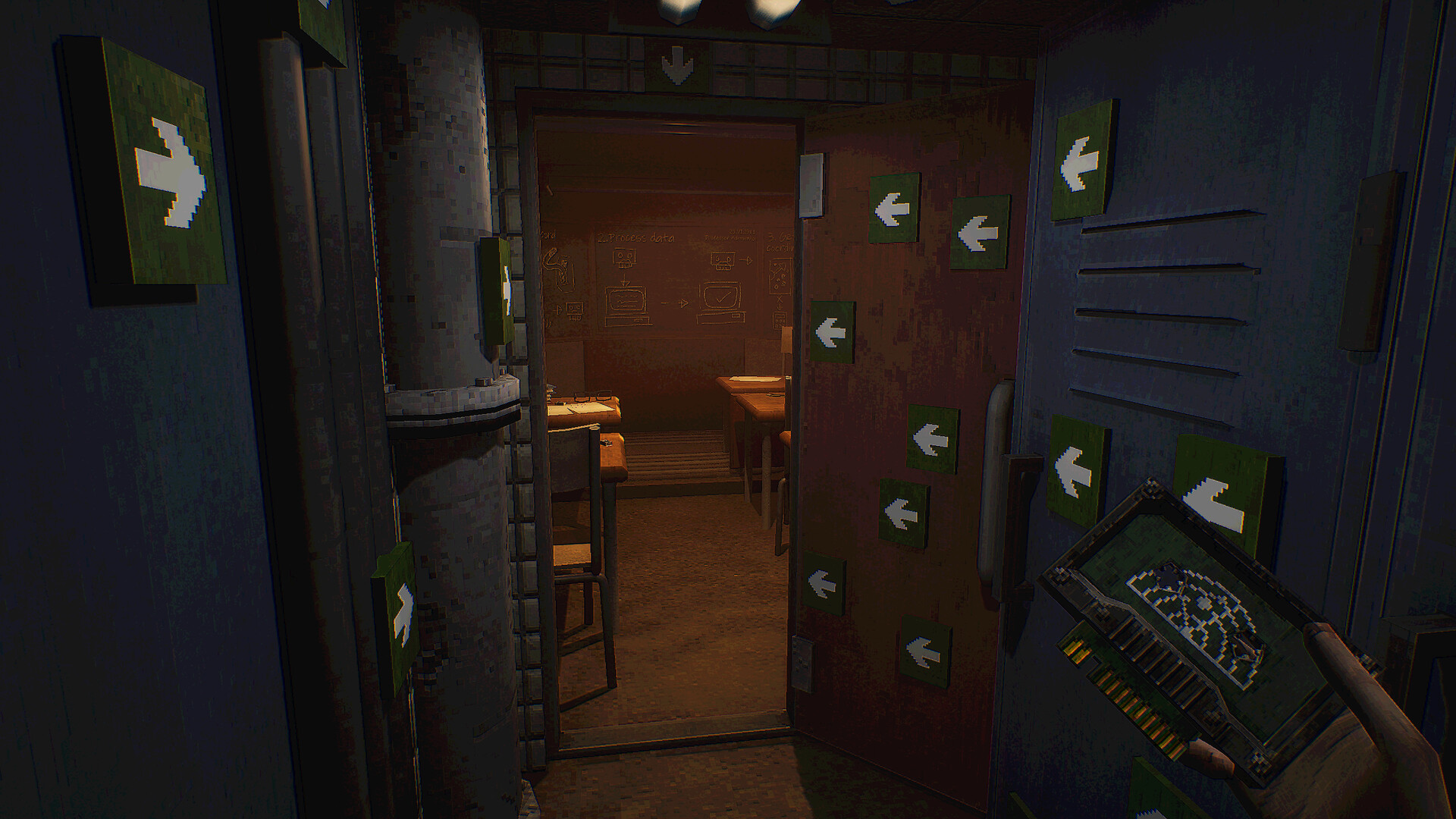
In this regard, the work undertaken recalls one of the chapters of “Amnesia”, another title that uses sound and resource management to maintain a constant psychological pressure without constantly relying on the creature’s appearance.
The music is used with extreme restraint: an extremely bold choice that nevertheless helps make even the most seemingly calm sequences memorable.
In this regard, MOLE could have used any visual style, but the choice fell on a simple, pixelated aesthetic reminiscent of PlayStation 1, with a palette gritty and moody but not cold, which truly gives the impression of being in the womb of Mother Earth. Low-resolution textures, essential geometry, and some deliberately crude effects contribute to making the environments even dirtier and more oppressive.
The lighting, instead, uses more advanced techniques where torches illuminate the suspended particulate matter in the air and metallic surfaces weakly reflect emergency lights, but the true protagonist of the graphics is the darkness, with shadows becoming an integral part of the gameplay.
The deliberately minimal interface enhances immersion but makes some actions less immediate (perhaps intentionally too), especially during emergency situations.

MOLE is an intelligent, patient, and deeply atmospheric horror: those seeking a horror packed with chases or combat may be disappointed. It doesn’t aim to impress with spectacular effects or excessively grotesque creatures, but instead slowly seeps into the player’s mind before hurling them into panic. It demonstrates how the horror genre still has much to say when it stops chasing shock value and trusts imagination again.
I also align myself with Steam’s general opinion, which portrays this title as “very positive”... and, overall, not too expensive.
About the Author