4PGP is an arcade racing game developed by 3goo Co., Ltd. and Vision Reelle, published subsequently by the same 3goo Co., Ltd.
In 4PGP we’ll take the wheel of Formula 1 single-seater from the late 1980s to early 1990s, with catchy names but liveries and chassis faithful to the originals — an aspect that warmed our hearts a little and brought back memories of the first F1 games for PlayStation.
External content blocked
This content is provided by YouTube. To view it, you must allow external content. Activation may result in data being shared with the third party.
I’d start with the term “arcade”, which, for this game, is almost a euphemism. Indeed, the modes are truly very limited and include: a championship featuring three circuits each, a single fast race, or a time trial mode where you must record the time for the most efficient lap — which, in our view, makes it unappealing and lacking at launch. Moreover, one of the reasons that made us raise an eyebrow is that each circuit is only drivable for three laps, with no option to increase this even at the highest difficulty levels, thereby removing fun from the player and preventing them from mastering the circuit to race it smoothly. There’s also no free practice mode, which would allow the player to enjoy the tracks without specific objectives, test the unlocked single-seaters, memorise every corner, and then exploit that knowledge during actual races.

The game includes four different difficulty levels: beginner, novice, veteran, and expert, which, in our view, feature skill gaps a bit too steep between one and the other, especially due to the limited number of laps available to complete the race. At the beginner level, you feel like you’re racing alone, and even very coarse braking or trajectory errors are forgiven, allowing you to easily recover any lost positions; at the novice level, things become noticeably more demanding: you must be more precise, know how to use the boost (which we didn’t particularly enjoy, as it reminds us a bit of a anachronistic DRS) to overtake and take advantage of straights, and coarse errors are not forgiven at all, even if some cleverness allows you to recover a few lost positions; from veteran onwards the jump is abyssal, as the single-seaters pull away from the first corner, and it seems that even precision won’t help you reach the top three. The difficulty is understandable, but to us it seemed like a too sharp drop from novice to veteran. We didn’t even try the final one, as we were already sufficiently discouraged by the unexpected gap in difficulty between the lowest and intermediate levels.
Talking about errors, if you go off course and end up on the grass, in some cases it makes absolutely no difference, giving the impression of cheating and taking corners “dirty”, while on other circuits you are legitimately slowed down by any deviation off the track. It would be better to be penalised on every circuit, but since we’ve just started, we give the devs time to fix any glitches or bugs that might give the player an advantage, as we’ve personally observed. Moreover, when other cars come at us, they change our trajectory and penalise us quite heavily, sometimes even sending us off the track, whereas the opposite happens, contributing to making the race system and gameplay feel very “arcade” and arbitrary.
We didn’t even like that there are no settings that can enable or disable damage on single-seaters, which encourages a much more cautious approach during corners or starts, where a small bump is roughly equivalent to a lap around the crash barriers without real consequences. Moreover, it doesn’t seem as if the statistics of the various single-seaters affect driving style: the only value that actually changes is top speed, while acceleration and road control appear identical across all single-seaters: you remain firmly grounded even during tight corners, and there are no real differences in launch performance—even with the single-seaters that have the highest acceleration statistic.
We have nonetheless appreciated the circuit fidelity, although the chicane after the Montecarlo tunnel is missing, the kerbs are painted with the flag’s colours of the country being raced in, and there’s a small “box” mode that allows for quick Pit Stops to change tyres and recharge boost.
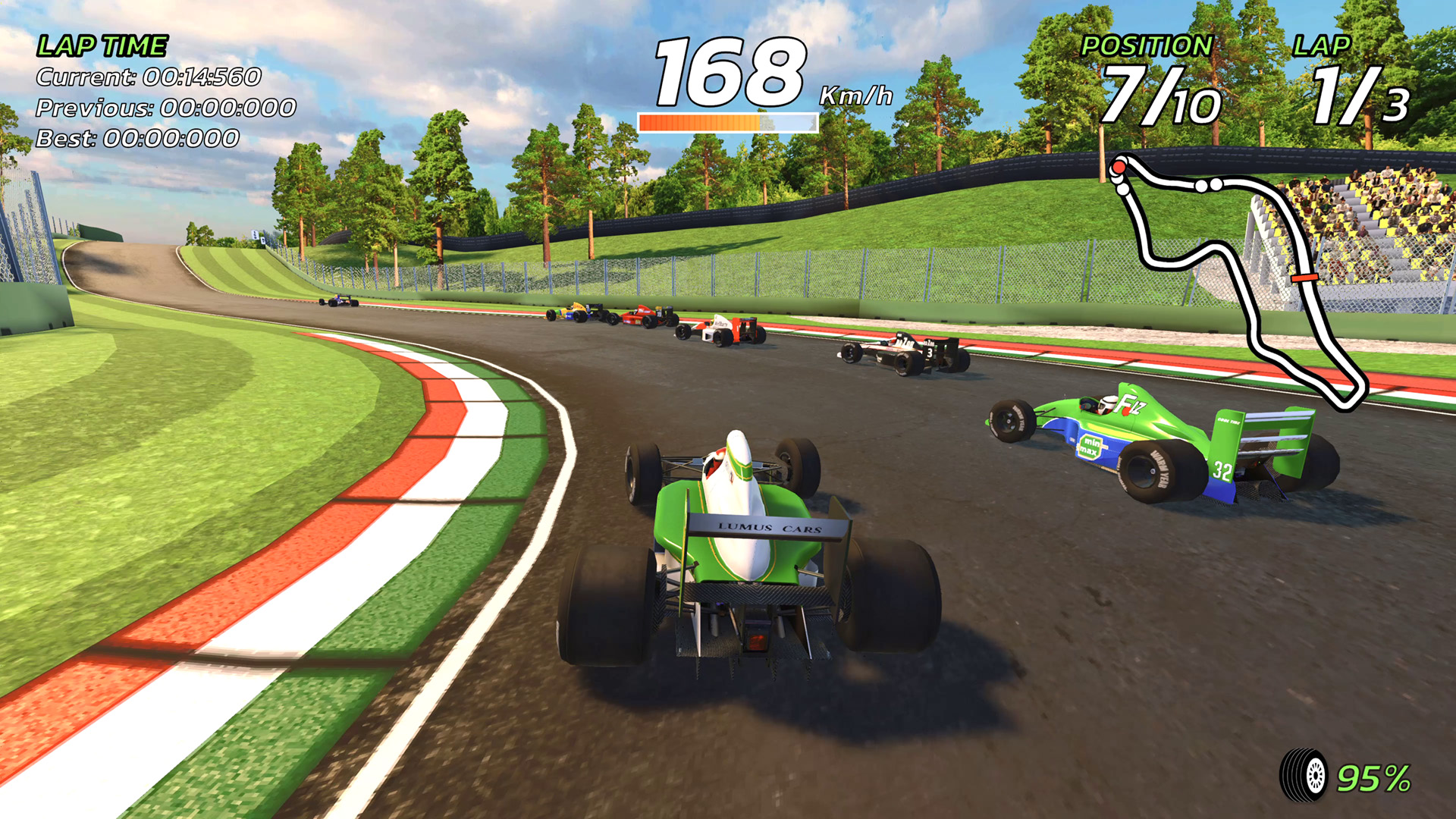
In conclusion, 4PGP is a cheerful arcade Formula 1 game best enjoyed as a short break between a shooter and another, thanks to the shared-screen multiplayer, but it’s certainly not a title that will keep you glued to the joystick or keyboard for more than 30 minutes per session. There are many aspects that could be improved, and we hope the developers listen to the community and implement the option to complete more laps or take more damage to the single-seaters. No one expects it to become a simulation, but a bit more spice wouldn’t hurt this title, which already has good potential to be a valid and fun game.
About the Author

Lemonsurf
Articolista di KotaWorld.it