
Hearts & Science, in partnership with Twitch, has presented the results of a study that explored gamers’ habits in five countries: Italy, Germany, France, Spain and UK. All this during Lucca Comics & Games, the largest European event dedicated to pop culture, in a panel moderated by the Branded Entertainment Agency FUSE.
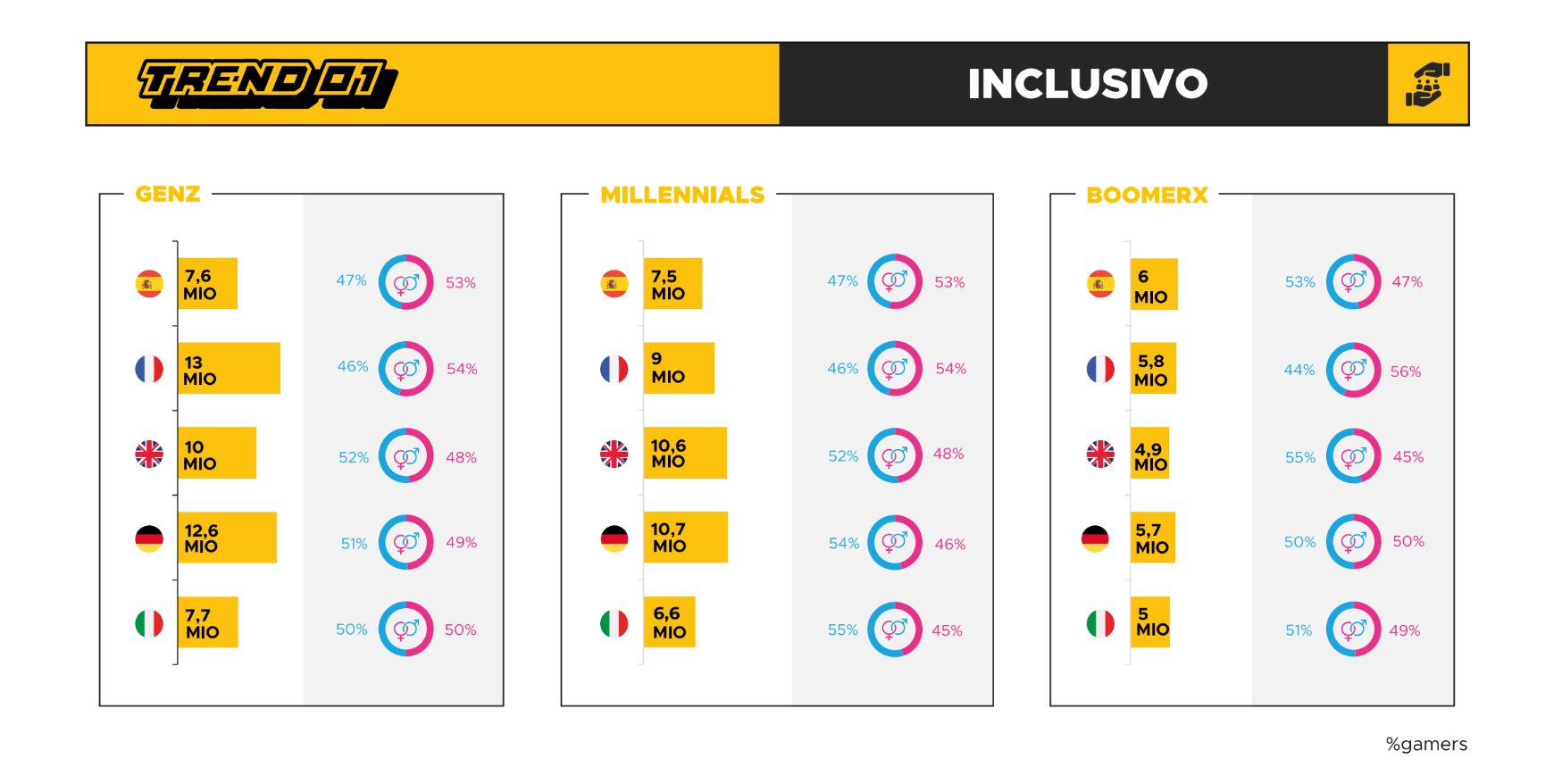
According to Hearts & Science, the game has been seen as a new model of social engagement over the past decade, now firmly embedded in European habits and with the potential to become a true must-have for free time for many people. Among the five nations examined, 123 million players represent 38% of the population, and the gender gap is almost equal: 50.3% male, 49.7% female. The video game as a form of entertainment has demonstrated an impact across all age groups, from GenZ to BoomerX to Millennials. The results show that multiplayer is not only the most popular trend in video games, but can also incorporate educational and learning components.
The game thus proves to be an indispensable tool for those who wish to build engagement and reach their target audience, whether within national borders or beyond.
This comparative study on the gaming world conducted by Hearts & Science has revealed the following results:
Gaming is inclusive
More than one in three people in Europe are interested in gaming. Players are extremely diverse and cannot be more associated with the GenZ male category. The reality is more complex: these days, gaming involves a broader range of people. It is intergenerational and includes GenZ, Millennials, and BoomerX; it is a game where there is almost a gender parity, with a 50/50 balance between male and female players.
Gaming is educational
A new trend is emerging: the game becomes a learning tool. A trend that sees Italy and France as the top countries, particularly among GenZ (with 21% and 20% respectively). We must not forget that we are still talking about games, so fun and passion are fundamental elements for respectively 54% and 32% of players. The factor that drives screen time is precisely this, and it refers to more than an hour every day.

Not only that, but 28% of players play for the thrill that the challenge provokes.
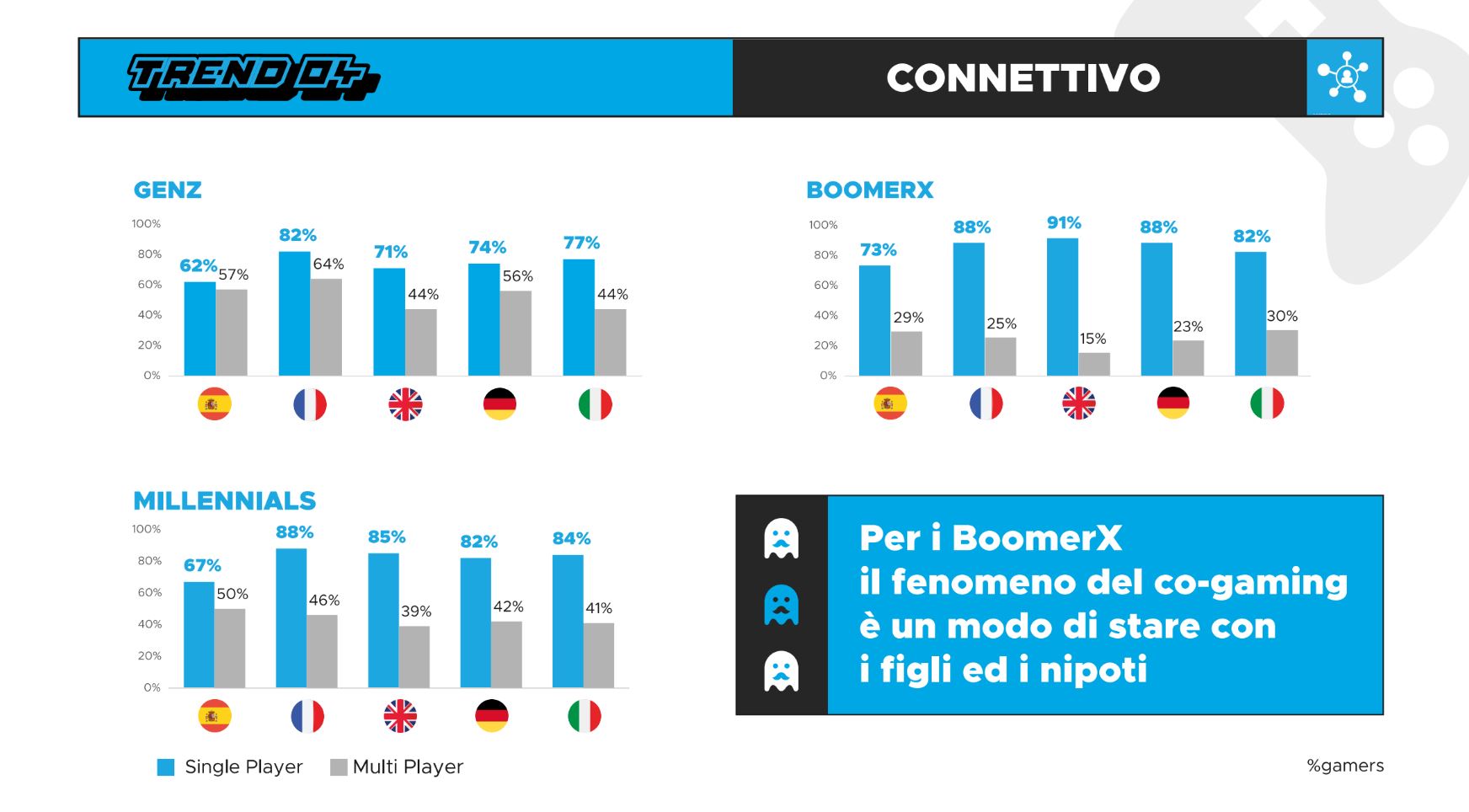
This adds another dimension unique to gaming, namely its function as an aggregative and social activity. Often, you don’t play alone. This trend is particularly strong among French, Spanish and German GenZ gamers, at 64%, 57% and 56% respectively.
Gaming is attractive
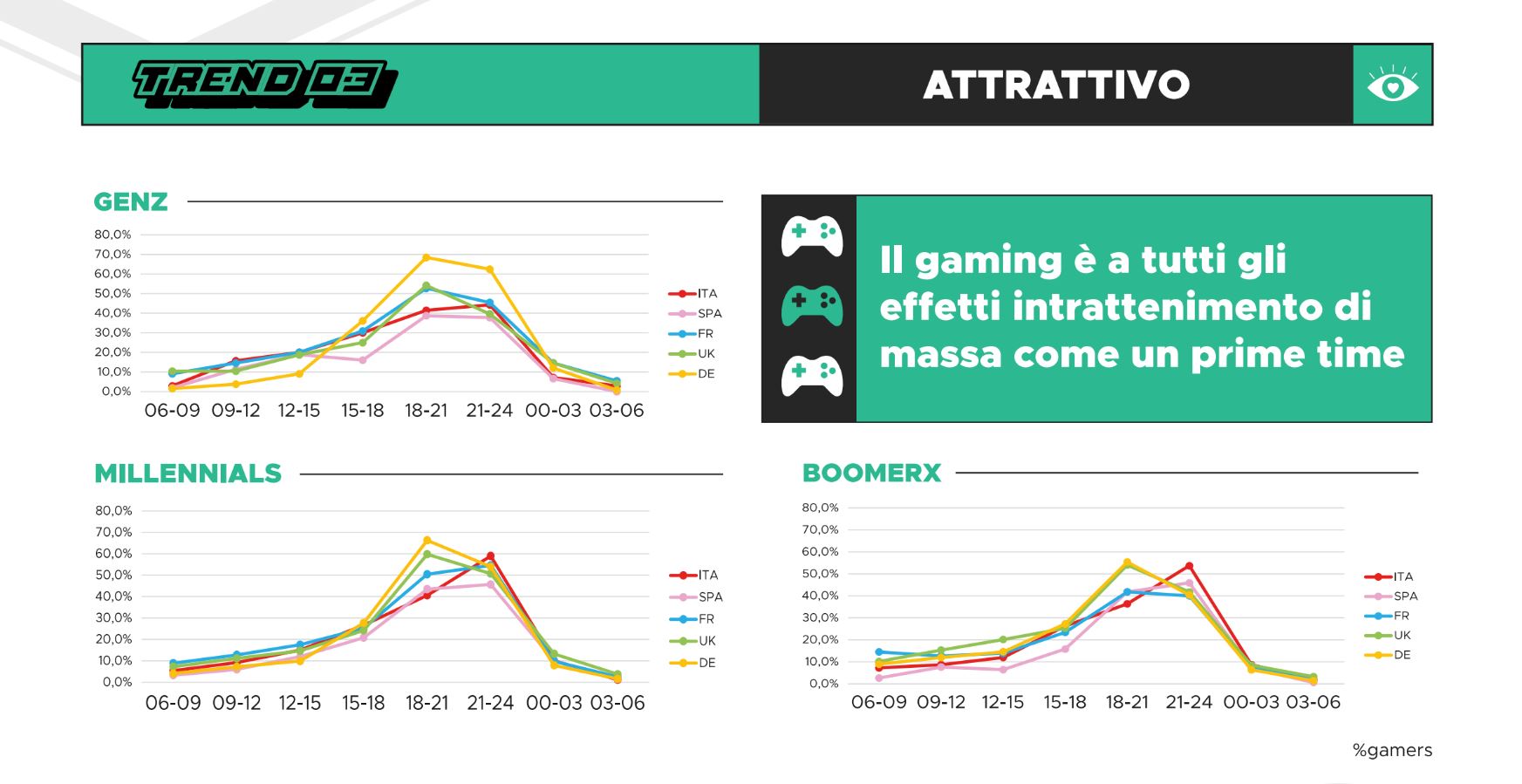
The game is an attractive activity practiced with regularity after 18:00. When the highest proportion of players participate, this is the most valuable moment. Within this time slot, the game and television compete for the title of prime-time king. When it comes to devices used, there’s an interesting trend gaining traction among GenZ, particularly in the UK: the adoption of virtual and augmented reality, technologies that even Millennials appreciate. BoomerX, on the other hand, prefer using tablets.
Gaming is connective
Every generation has played and has its favourite game. In particular, 46%, 36% and 31% of GenZ gamers prefer Minecraft. Fifa and Super Mario are the favourites of Millennials, with peaks of 40% in Spain and around 30% across all examined countries. The nostalgic BoomerX retreat to Candy Crush, which is a true success in all countries with percentages above 27%.
With this research, we wanted to analyse the habits of five major European nations regarding the gaming phenomenon. Far from being an activity tied to a certain social, gender, or sexual stereotype, we have shown how gaming is transversal, popular, and perfectly assimilable into mass culture. Everyone plays, even the most unexpected. Gaming is a universal language and an agent of integration, actively contributing to cultural closeness among European peoples and fostering a European habitus in terms of leisure. Gaming is the ‘Games without borders’ of the new decade, bringing together people from different languages and cultures. I pose a challenge: what if gaming, in its virtual dimension, does not merely create new spaces for exchange among European peoples, contributing to the formation of a new European identity? I am convinced. In this virtual dimension, Europe already exists, built thanks to gamers: young (and not) from Valencia, Strasbourg, Dresden or Manchester, who, between a beer, a slice of pizza and a match, have built a transnational community, free of borders and cultural barriers.’’ commented Emanuele Giraldi, Managing Director of Hearts & Science.