
In the distant year 2002, more than 20 years ago (sigh), I first encountered the grim reality of console exclusives. As a proud PlayStation owner, I found myself spending a carefree afternoon at my friend’s house, who possessed the first Xbox. That sweltering summer afternoon, my naive seven-year-old mind was utterly stunned by a game developed by Smilebit for SEGA, as an exclusive for Microsoft: I’m talking about Jet Set Radio Future.
In a futuristic Tokyo where free expression has become illegal, we took on the role of a member of a group of writer skaters, tasked with “decorating” the city with vibrant graffiti while evading the police and challenging rival gangs. Believe me, I was utterly captivated by every element of that game, to the point of actually (remember that childlike naivety I mentioned?) playing that disc on my PlayStation. But why talk about all this?
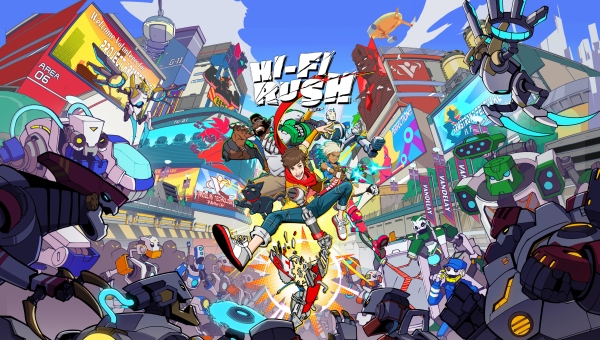
Why, on January 25 last year, Microsoft and Bethesda — during Developer Direct — unveiled a plausible contender for the GOTY 2023, which immediately reminded me of Jet Set Radio. Gentlemen and ladies, here is the protagonist of this review and the latest work from Tango Gameworks: Hi-Fi Rush.
This content is provided by YouTube. To view it, you must allow external content. Activation may result in data being shared with the third party.
Music in the Heart
In a video game landscape built on hype generation, preorder religion, and the inevitable betrayal of expectations, Tango Gameworks, Microsoft, and Bethesda have stunned all players by presenting and simultaneously launching a game about which no one knew absolutely nothing.
"Were you expecting news about Redfall, Forza Motorsport or The Elder Scrolls Online? Well, here’s this stylish and colourful rhythm action game". 10 points to Grifondoro for the courageous and brilliantly executed launch strategy.
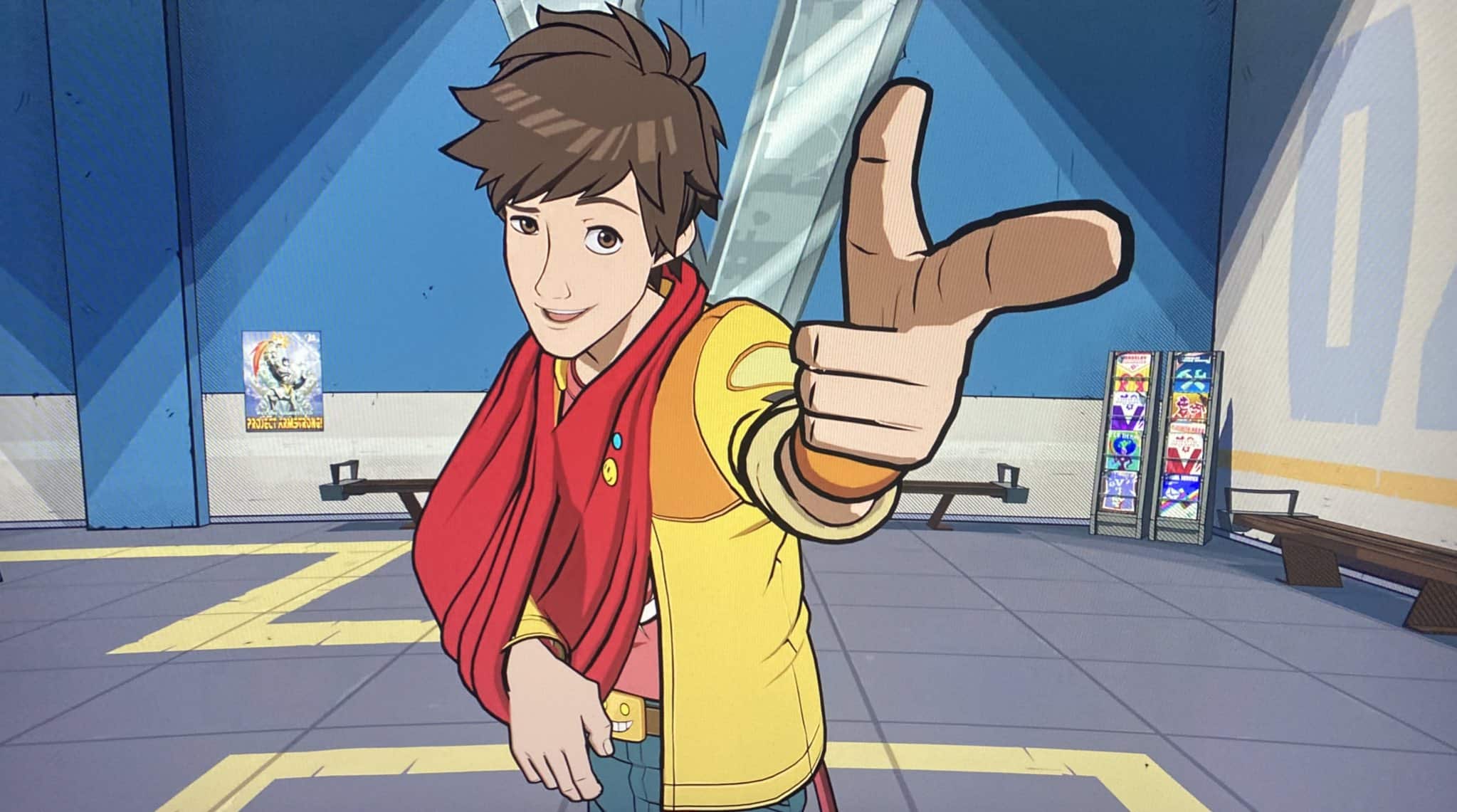
In Hi-Fi Rush we take control of Chai, a young wannabe rocker who participates in the Armstrong Project by Vandelay, one of the many megacorps vying for market share in the cyberpunk universe imagined by Tango. The Armstrong Project, in full cyberpunk style, involves the implantation of hardware modifications and enhancements into the bodies of volunteers who willingly sign up for the initiative. Chai manages to cure his arm problem by acquiring a fully mechanical one, but during the procedure, something goes wrong.
His most faithful mp3 player accidentally falls into the machinery and is thus implanted in Chai’s chest: the rhythm of his heartbeat is replaced by musical beats. His life, as well as the outside world, now proceeds to music but for Vandelay, Chai is nothing more than a manufacturing defect and should therefore be removed from the market (see: eliminated).

Chai discovers that she can create an electric guitar by magnetically attracting screws, bolts, and other metallic objects, and she will use it as a blunt weapon to defend herself from Vandelay’s robotic security.
These are the premises of the Hi-Fi Rush story, certainly a secondary element, not outstanding, but still manages to flow smoothly and pleasantly, offering us a few plot twists, more or less "telephoned".
Chai will team up with other secondary characters that we’ll meet by progressing through the 12 "tracks" (i.e. levels) that make up the game, such as the hacker Peppermint and his robotic cat 808 (a clear homage to the famous Roland drum machine) and the former Vandelay employee Macaron with his robotic companion CNMN (who plays it cool with Claptrap for the title of best video game robot of all time).

Talking about Claptrap, and therefore Borderlands, beyond the iconic cel-shaded art style, the Tango trilogy from Gearbox Software has also taken the sometimes delusional humour that dominates every situation and dialogue.
There are also nods to The Evil Within, a title always developed by Tango, Xenogears, and, hear hear, there are even some JoJo plateali references... what more could one ask for?
Blow up on all four sides
If the plot serves merely as a pretext to link the 12 chapters that make up the title, the gameplay represents the true jewel of Tango’s work. Hi-Fi Rush is a action rhythm game in which we’ll see alternately adrenaline-fueled combat and more relaxed platform/exploration phases, drenched, according to many, in excessive linearity. The developers’ choice, for us, fits the title perfectly and also imparts a sense of old-school charm that we unquestionably appreciated.
The combat system largely echoes the giants of the hack 'n' slash genre, adding to the mix the twist due to the need — not the obligation — to execute combos in time with the music. We’re talking about need rather than obligation because Chai, regardless of our input timing, will strike each slash precisely on the beat; however, pressing the right button at the right moment will yield a non-negligible bonus to both damage dealt and the point multiplier.
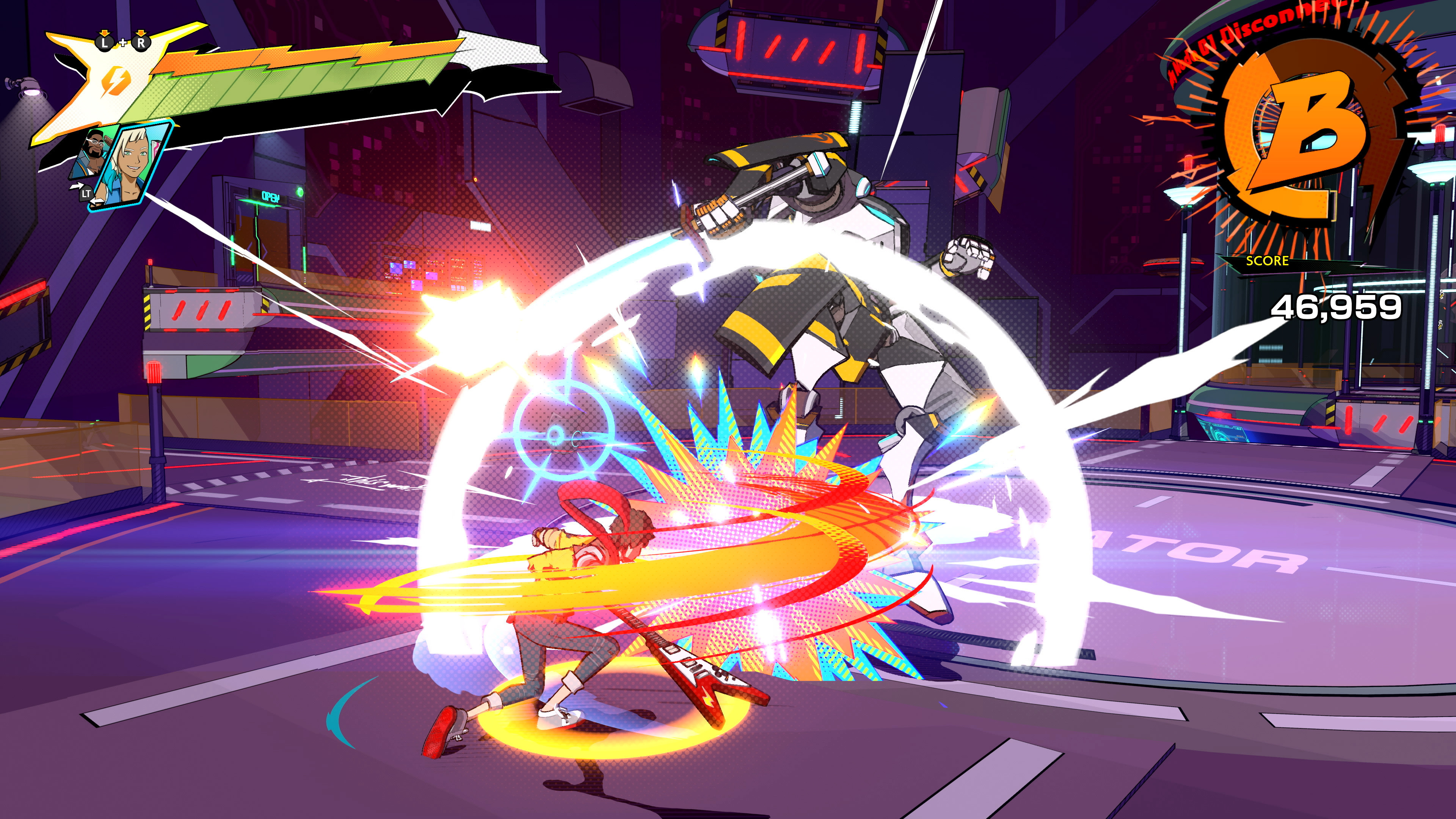
If the game is absolutely playable regardless of the musical score (which, in some cases, is overly overshadowed by ambient sound effects and therefore harder to follow), it is undeniable that fighting to the rhythm is an extreme satisfaction, creating true musical choreographies, expertly captured by the writers even during the game’s cutscenes.
At the end of each fight, we will receive a score based on the points obtained, the percentage of hits landed on the beat, and the time required to eliminate all opponents. Tango’s skill lay in being able to make the gameplay progressively deeper and more intense by introducing new mechanics and new gimmick practically in every level, managing to pack into the roughly 10/12 hours needed to complete the title a non-trivial number of gameplay elements: combos, final attacks, teammate assists, parries, dodges, increasingly menacing enemies, etc...

At the end of most levels, we’ll face the various managers at the head of Vandelay, in boss-fights that are a spectacle of adrenaline and style. Even more important, facing these decidedly more dangerous enemies, we must utilise our most precious ally: timing. Not only to boost our damage output, but also to complete rhythmic minigames that will be essential to progress through the various stages that make up the boss-fights themselves.
By the time you’ve reached here, you might think Hi-Fi Rush is a title reserved for musicians or rhythm game players of exceptional talent. In reality, despite not being a specialist in the genre (though I had the chance a few months ago to train with Metal: Hellsinger), I found the difficulty level decidedly manageable, perhaps even slightly undershooting. Moreover, Tango has nonetheless been careful to include elements to help the more "amusical" players enjoy the game anyway. Still, sciapò.

The end-game, finally, further enhances the title’s quality, increasing its longevity. First, we’ll unlock the highest possible difficulty, which entails a game-over if a certain percentage of hits are not maintained throughout the level (aside from obviously increasing lethality and the number of enemies to face).
Following, we can decide to tackle the Torre del Ritmo, a clear nod to the Bloody Palace from DMC, a time-based mode that is extremely challenging and reserved, as it is, for the most determined and talented players; and for those who still haven’t had enough, there’s the option to recover every collectible lost along the way, unlock various aesthetic elements, complete all the challenges the game offers, and open the mysterious numbered doors hidden throughout all levels, finally discovering what lies behind them.
Technically speaking
We tested Hi-Fi Rush on the following setup:
AMD Ryzen 7 3700x @ 3.60 GHz
Gigabyte RTX AORUS Master 3080 Ti 12Gb
Corsair Vengeance RGB RT 32GB DDR4 3600MHz
LG 34GN850 Monitor at 3440x1440 (21:9)
The version we tested was the Steam edition, as we received a key from the publisher for the Valve platform, but the title was also available on Game Pass from the moment of its launch, shortly after the announcement.
Playing Hi-Fi Rush was a pleasure even from a technical standpoint: the cel-shading is a timeless technique and fits perfectly with the Western cartoon style (but strongly inspired by anime aesthetics, given the project’s Japanese origins) and allows for a very smooth transition from cutscenes to the playable sections, as extremely fluid and consistent is the framerate, locked in my case at the 160fps maximum my screen can produce.
The true heart of the game is undoubtedly its audio: whether in the Italian localization, with a voice acting performance truly worthy of respect, or in the musical score. The soundtrack alternates between "external" tracks, ranging from the big beat of The Prodigy to the industrial rock of Nine Inch Nails, passing through the complex techno of Wolfgang Gartner, and tracks produced within the studio by three renowned video game composers: Shuichi Kobori (MGS 2 and MGS 4), Reo Uratani (ubiquitous across the Monster Hunter saga), and Masatoshi Yanagi (sound designer for Tango).
In conclusion
Hi-Fi Rush is marketed as a budget project, but the only thing that might justify its price of 29,99€ is likely its longevity, which we consider appropriate in this case but generally reduced. For everything else, the title from Tango Gameworks has absolutely nothing to envy with triple-A projects more established and flashy (cough...cough...Forspoken...cough).
Originality, fun, action, a compact and well-executed package that demonstrates the Japanese studio’s maturity, having previously delivered darker titles such as The Evil Within and Ghostwire:Tokyo, yet still capable of offering a light, playful game practically without flaw.
As with Pentiment, probably in this case too there’s something to thank Microsoft’s mum and her mighty Game Pass, capable not only of supporting but even highlighting titles like this, brimming with passion and personality, innovative yet looking back, to that seven-year-old boy, mesmerised by the explosion of colours in Jet Set Radio Future.