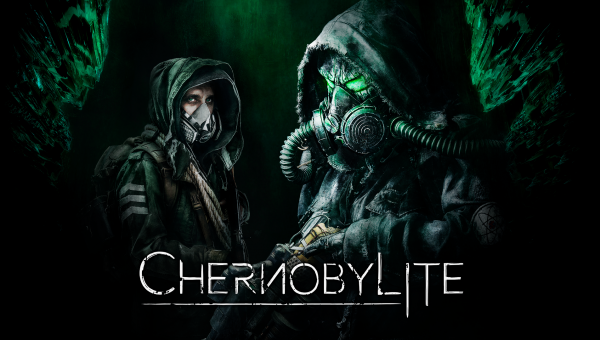
That the team behind TheFarm51 had talent had already been evident with Get Even. However, with Chernobylite, the Polish indie studio seems to have truly pushed itself, finally presenting us with the final version of this non-linear survival horror RPG that emerged thanks to the success of its Kickstarter campaign (over $100,000 raised) and a couple of years of Early Access on Steam. We tested the PC version, but a console release is expected in September for old-gen consoles, while details for next-gen consoles remain unconfirmed.
This content is provided by YouTube. To view it, you must allow external content. Activation may result in data being shared with the third party.
"There was nothing wholesome at Chernobyl"
26 April 1986, 1:23:45, the RBMK nuclear reactor number 4 at the Ukrainian nuclear power plant in Chernobyl explodes. While the Soviet Union, Europe and the world reckon with an unprecedented catastrophe, a physicist employed at the plant, Igor Khymynyuk, must come to terms with another event no less dramatic for him: the disappearance of his girlfriend Tatyana, who was also employed at the plant.
Fast forward to 2016, 30 years after the tragedy, Chernobyl and the nearby city of Pripyat are now the epicentre of the so-called exclusion zone, a 30-square-kilometre Ukrainian area evacuated following the disaster, where abandoned buildings, dense vegetation and pockets of radioactivity create a bleak, deathly atmosphere. And it is precisely within this context that we take our first, uncertain steps, in the role of Igor, returning to the plant with the sole objective of finding Tatyana. During the introductory mission, we will be accompanied by two sinister individuals, more interested in recovering the precious Chernobylite, a material formed inside the reactor following the explosion and possessing incredible potential, than in helping us. The mission, however, collapses when a mysterious antagonist, the Dark Stalker, makes his appearance, killing one of our companions and seriously injuring another. We thus discover that Igor, thanks to his knowledge, has managed to exploit the power of the Chernobylite by creating a device that harnesses its chemical properties to generate wormholes, temporal-space portals, and it is precisely thanks to one of these that Igor and Olivier manage to escape the Stalker.
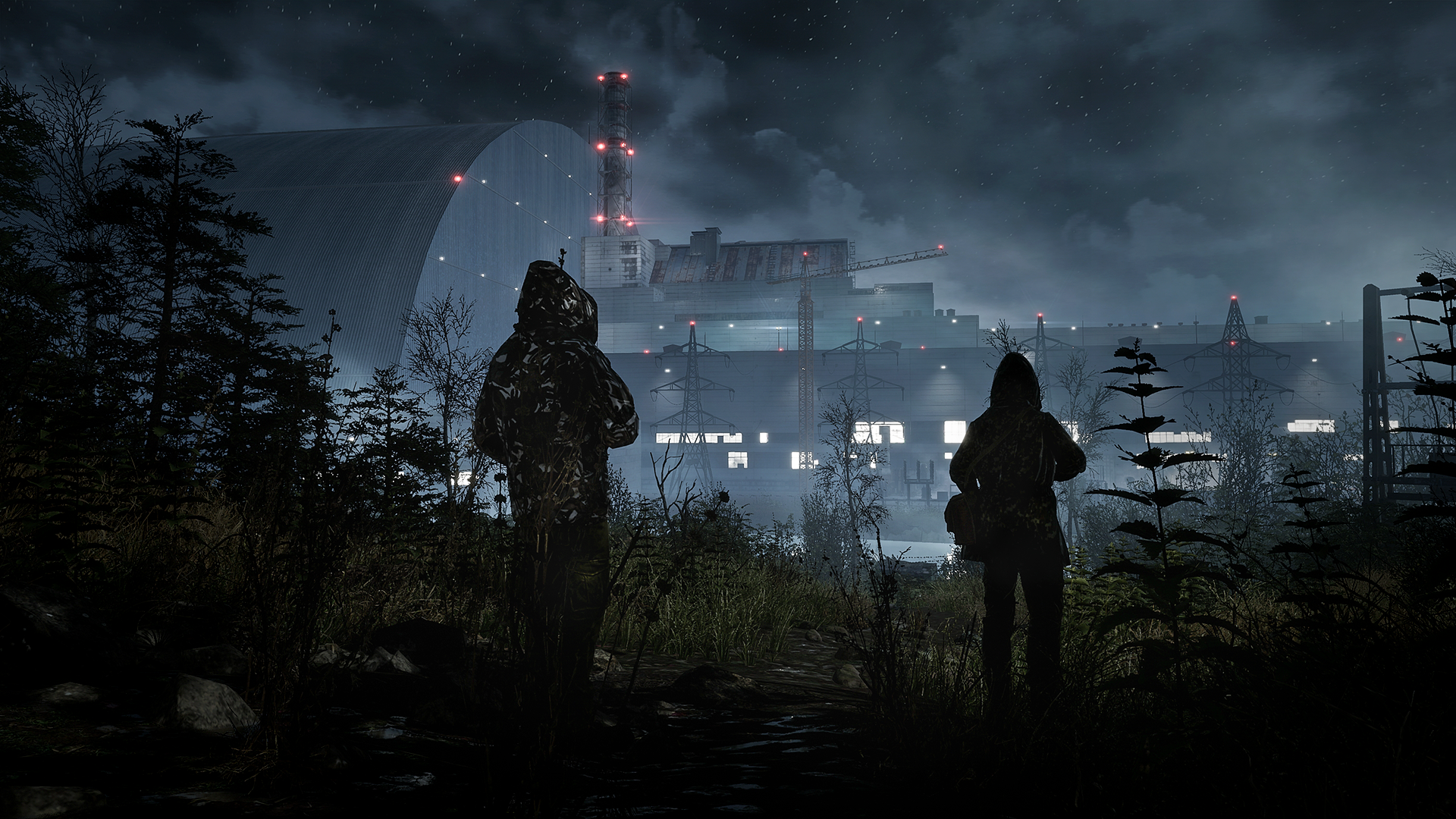
The two find themselves at a depot near the power plant, a true refuge rented by Igor to organize the mission to recover and rescue Tatyana, the protagonist’s final objective and the game’s final mission. Everything we must do during the 14-15 hours of gameplay that Chernobylite offers will be to prepare ourselves to uncover the truth, after years of nightmares, visions, and ominous forebodings.
Routine life in the alienation zone
After hinting at something about the plot, deliberately twisted and complex, we move on to another core pillar of the title, the gameplay. Life in the alienation zone unfolds on a daily basis: in the morning, after waking up, we must decide which missions to undertake personally and which to delegate to our companions (initially only Olivier). Each day will allow us to tackle a main mission to advance the story, or undertake side missions to gather raw materials, food, or medicine to survive and care for our allies. The game map, though not vast and not fully open-world (the total map is divided into various zones as can be seen in the image below), has been meticulously reconstructed, thanks also to the visits conducted on-site by the development team.
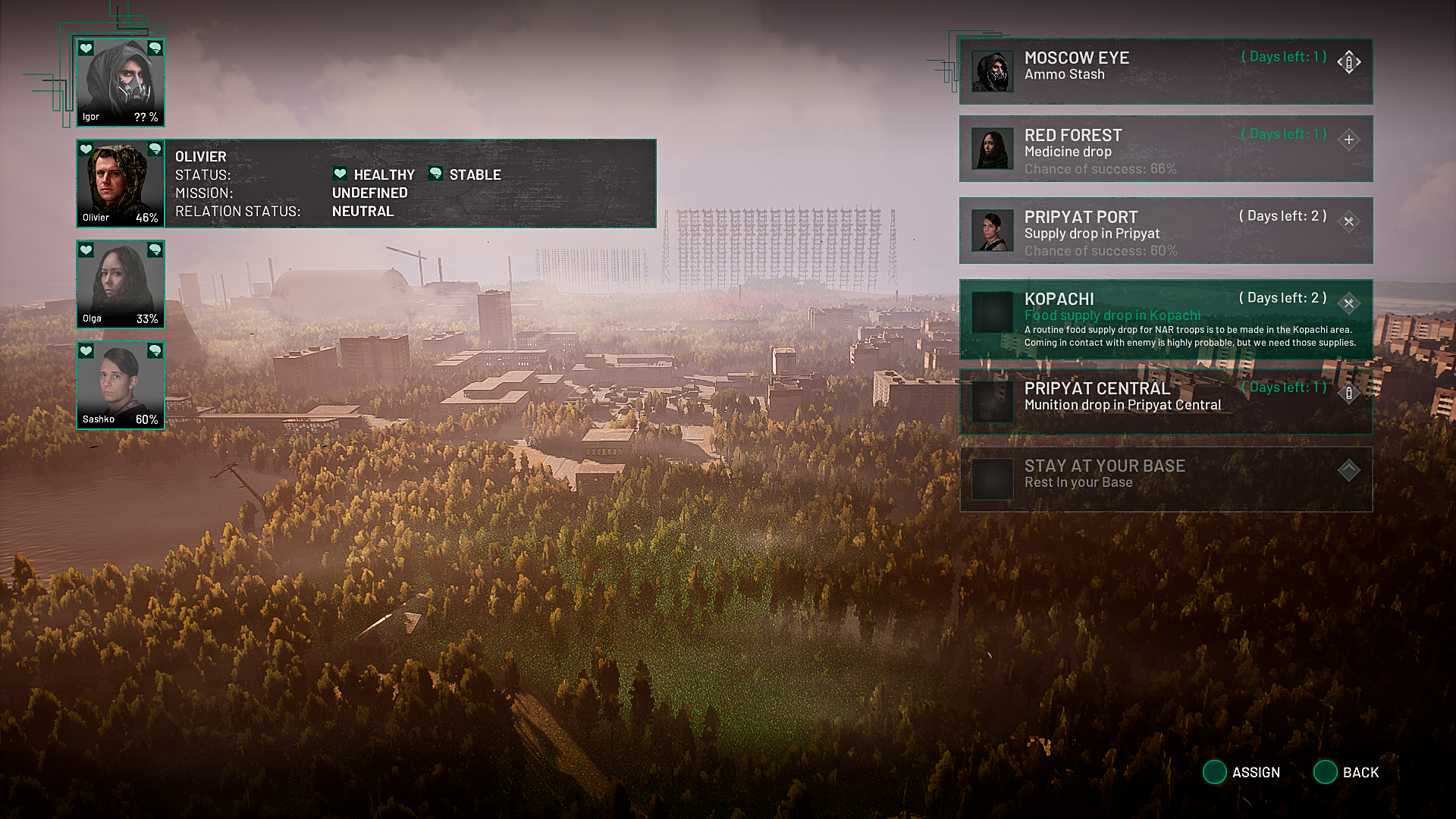
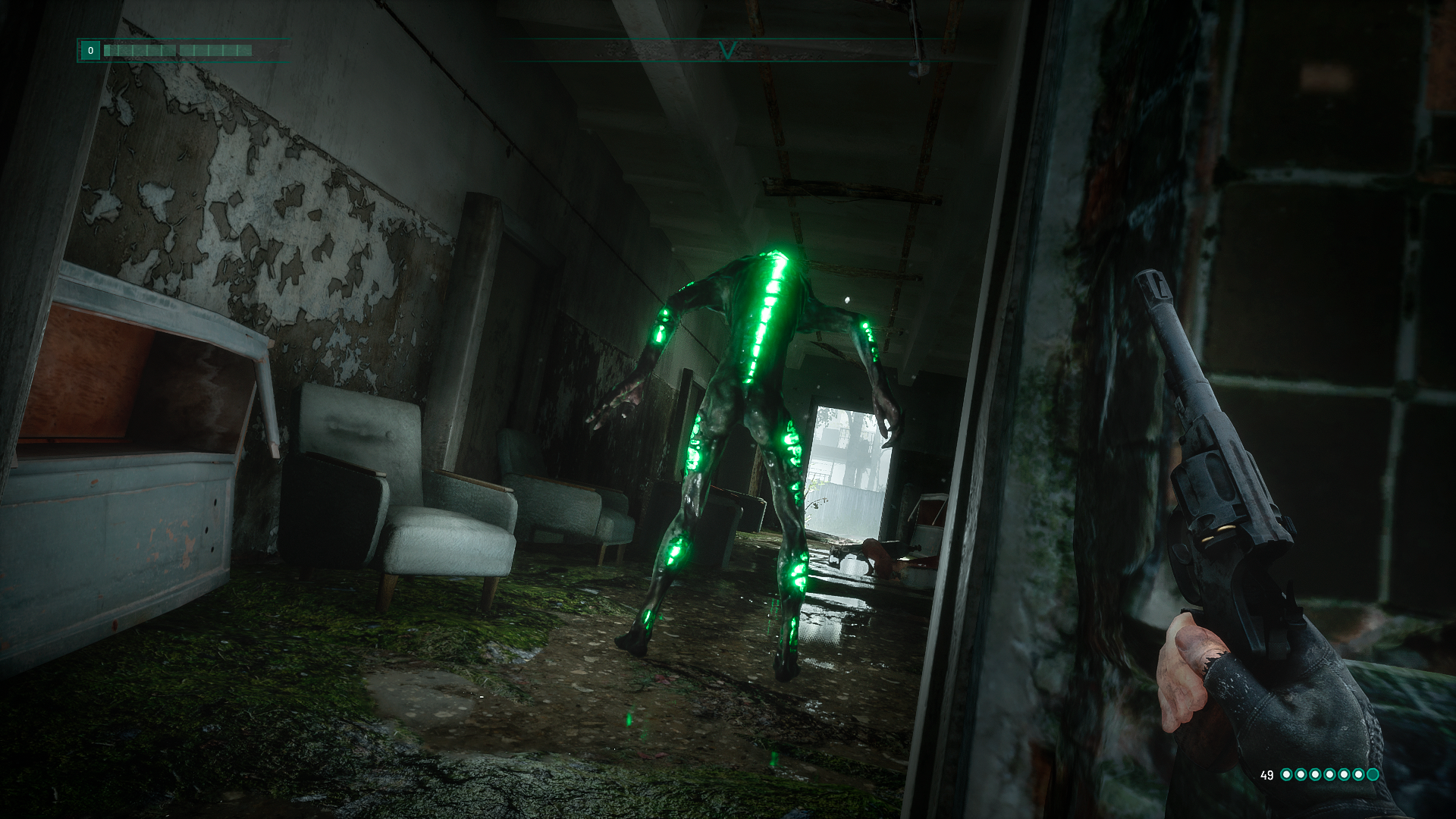
During each mission, we’ll have a main objective marked on the map, and numerous secondary points of interest that we can choose to visit or skip, but which may conceal important clues to help us find our beloved. Apart from the radiation, which we can keep under control at all times via a valuable Geiger counter, we’ll also have to contend with the soldiers of the NAR, paramilitary forces stationed in the alienation zone to exploit the incredible potential of Chernobylite, as well as with mysterious creatures called Shadows, which represent the horror component of the title. Igor is a physicist, not accustomed to killing or dealing with paranormal entities, so his psyche might be affected by every encounter ending in blood or too close to a Shadow. But don’t worry — a sip of Vodka will cure any kind of paranoia, drink to forget, true Gopnik!
We strongly recommend you explore, not only because it’s extremely captivating given the stunning 3D rendering of the alienation zone crafted by the team, but also because recovering resources of every kind will be essential to keep your allies alive and survive yourself. There’s a catch: the longer you spend in the alienation zone, the more likely it is that the infamous Dark Stalker, whom we mentioned at the beginning, will track you down and come hunting, leaving you no other option but to flee at full speed.
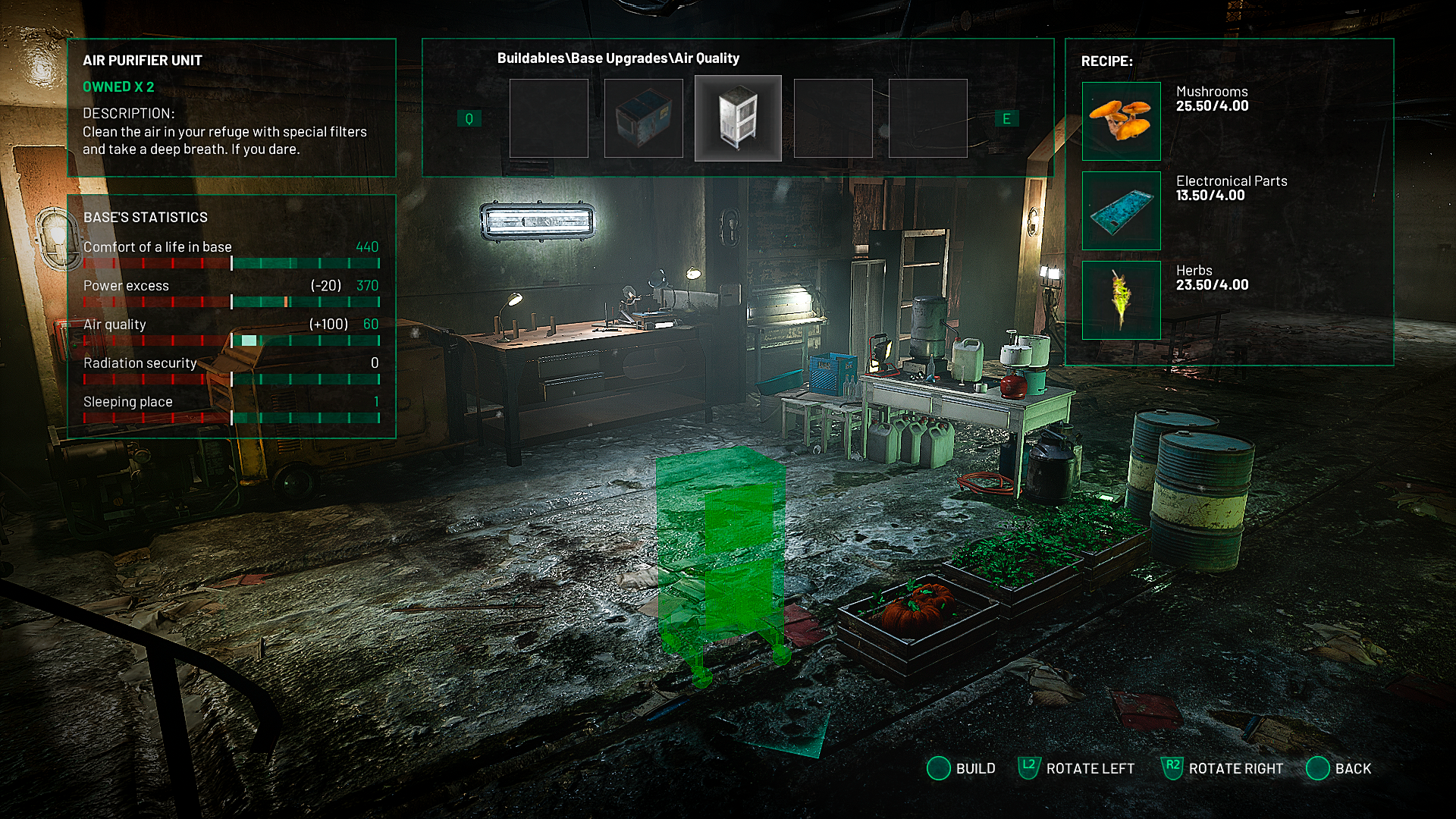
Completed the mission, it’s time to return to the base, where we’ll assess the success or failure of the missions we entrusted to our companions, and where we’ll have to undertake the unpleasant task of rationing food: leaving our companions hungry will have serious psychological consequences, so please be reasonable (see why it’s important to recover as many resources as possible?). After dinner, you’ll have time to devote yourself to the base, building structures to improve living conditions within (such as air purifiers, televisions, light sources...) or to be able craft ever more items, like gas masks, weapon upgrades, medicines, and more. Additionally, by speaking with your companions, you’ll be able exchange experience points earned by leveling up (here’s the RPG component) for abilities to enhance our character. Cute that to unlock them, you’ll need to complete short and simple skill tests, under the critical gaze of our “teachers,” each with their own tricks to share with us. Completing all these activities finally brings the hour of napping for Igor and his companions, and I remind you to build a bed for each resident of the base, because forcing someone to sleep on the floor is never kind or considerate.
This routine runs continuously until the game is completed and didn’t fully convince us: on one hand, the repeated listing of various activities helps us keep track of everything we need to do, on the other hand, over time it inevitably becomes repetitive, especially after surpassing the game’s halfway point.
3.6 Roentgen? Not great, not terrible
We’ve seen how, in Chernobylite, various genres combine to form a fairly successful blend: we have purely stealth phases that can quickly descend into sparatorie di stampo sparatutto if we’re discovered, we have a fairly well-crafted RPG component, with a coherent character development and a good variety of missions in the story, and finally we also have a rich gestionale component. Ah, and there’s also l'horror, with its sporadic, somewhat cheesy jumpscares, but mostly with the persistent atmosphere of mystery and desolation that hangs over us throughout the entire adventure. None of these aspects are particularly underwhelming, but, at the same time, none of them push us to declare it a masterpiece, bringing any kind of innovation. The action phases are good, but the poca varietà dei nemici unita ad una IA non proprio di prim'ordine quickly lose our engagement during the few encounters we’ll have in the alienation zone; the setting is certainly rich with pathos and well-realised, and this inevitably contrasts with the decidedly rougher quality of NPC and object models. The gestionale component is certainly solid and compelling, but with its slightly confusing menus and the almost oppressive tendency of companions to rely exclusively on us for survival, it risks genuinely suffocating players less familiar with this type of mechanic.
Finally, the character-branching component suffers a little from the banality of the character's "skills," but it compensates with the numerous choices and decisions we’ll make along our journey — decisions that will inevitably and definitively shape our path, allowing us to end up with different outcomes, something always very appreciated. The developers have also decided to add a small twist: if we wish to change something in our playthrough, we simply... die. By dying, we’ll be able to go back in time, into a different timeline, to alter the course of events at our pleasure. Keep in mind that everything comes at a cost: most of the resources at our disposal will be lost upon dying, so think carefully before voluntarily and prematurely facing the grim reaper.
Technically speaking
We tested Chernobylite on the following configuration: Ultra Details - Raytracing Active - DLSS Quality:
AMD Ryzen 7 3700x @ 3.60 GHz
Gigabyte RTX AORUS Master 3080 Ti 12Gb
Kingston Hyper X FURY (2x8Gb) DDR4
Resolution 3440x1440 (21:9)
The title performed really well, maintaining consistently high frame rates (medium FPS very high (90-100fps)), with a graphical component that pleasantly surprised us. Despite most missions taking place during the day, the use of a dirty, dark color palette, combined with variable weather and the richness of enclosed, poorly lit environments, truly conveys a constant sense of unease and oppression. It’s true that the title rarely scares, despite its horror branding, but we believe the overall atmosphere is far more convincing than sporadic jump scares (which, anyway, you should prepare for, as they’re present). As we mentioned, however, the NPC and object models failed to convince us — in stark contrast to the quality of everything surrounding them. Nevertheless, one can’t really complain, especially considering the independent nature of the development studio. Absolute praise goes to the omnipresent and perfectly tuned soundtrack, which features a deliberately calm and melancholic tone, but quickly becomes frantic and suffocating during the more action-packed moments. It could quite easily stand alone as the emotional core of the entire work — great credit to the composers. Finally, the title is localised in Italian, albeit reasonably well, but we prefer (and strongly recommend) playing it in its original language, using Italian subtitles.
In Conclusion
Chernobylite is an independent but ambitious title, which by the end of the game has very little to envy compared to more established titles like Fallout or Metro. Although it is also strongly inspired by the S.T.A.L.K.E.R. series, the title certainly maintains its own distinct identity, revealing itself as a varied and captivating experience. We also want to compliment The Farm 51 for having successfully achieved the task — theoretically straightforward but practically increasingly difficult — of taking a title born and grown in Early Access and presenting it, within a few years, in full version at a highly competitive price (currently €29.99) given the title’s intrinsic quality. Of course, it is true that a single-player title is different from a multiplayer one, but the trend of offering incomplete games after years and years of development is unfortunately expanding dangerously even into single-player titles. So, if you are fans of post-apocalyptic scenarios, have enjoyed the HBO mini-series Chernobyl (and if you haven’t seen it, do yourself a favour and go and catch up), or are simply intrigued by the title, give it a chance — we’re sure you won’t regret it.

About the Author