

Box Knight starts with a simple, almost absurd idea: take everything that can make a workplace toxic — managers, hierarchies, unbearable colleagues, performance reviews and workplace stress — and turn it into an action roguelike set in a huge office infested with monsters.
The protagonist isn't a legendary hero. He's an employee wearing a cardboard suit, wielding weapons made from the same implausible material, and begins ascending the building room by room, floor by floor and boss by boss, with an objective as simple as it is effective: reclaiming the office.

Developed and published by We Made A Thing Studios, Box Knight is available on PC via Steam from 25 August 2026 and can be played both in single-player and local co-op over shared screen, with support for Steam Remote Play Together.
I spent around eight hours with the game, of which two were in local co-op, choosing from the start the Hardcore difficulty and reaching past the first tower climb, into the subsequent Elite Mode. Enough to discover a title that initially seems very simple, but which becomes progressively more interesting as it introduces new enemies, weapons and growth systems.
How Box Knight works: fight, grow, and start again
The structure of Box Knight follows the typical roguelite formula. You start from a central lobby, enter the tower, and face a series of closed rooms where you must eliminate all enemies before proceeding.
The combat system offers normal attacks, charged attacks, dodges, ground pounds, equipment-linked abilities, and special moves. Fighting also fills the BUZZ bar, which is used for some of the most effective moves.
By the end of the clashes, one of the most successful satirical touches from Box Knight’s corporate satire enters the scene: the Employee Evaluation. Even as the office is overrun by monstrous creatures, someone continues to assess our performance.
During a run, temporary boosts, resources, and bonuses accumulate, making the character noticeably more powerful. However, when the climb ends, much of what we’ve obtained is lost, and we return to the lobby.
You don’t start from scratch anyway. A significant part of Box Knight is indeed made up of the permanent progression, through which the character gradually becomes stronger and gains new possibilities.
Jeff and the main quest: better not ignore it
In the lobby we meet several characters, but one of the most important is Jeff the Questgiver.

His role is not merely about distributing missions. The main quest of Jeff also serves as the narrative thread of the experience: following it gradually introduces new objectives, activities, and gameplay systems.
After several hours, my advice is therefore to faithfully follow Jeff’s main missions, especially during the first playthrough. Playing entirely on your own is possible, but you risk missing part of the natural progression that Box Knight intends to present with its content.
Jeff is also one of the few characters I’ve happily followed almost all of whose dialogue, precisely because it helps understand what’s happening. Secondary conversations, however, don’t always manage to maintain the same interest, and at times the temptation to skip them comes quite quickly.
The enemies are easy to deal with alone, much less when they work together
The combat begins in a rather accessible way. The first Drone can be faced without paying particular attention to strategy, and for a few rooms one might almost feel as if facing a simple beat 'em up.
The system becomes more interesting when enemies with specific roles are introduced.
The Bog Goblin, for example, prefers to fight at range and its projectiles can be returned to the sender. The Bucket Drone uses the bucket it carries on its head as protection and becomes immune to some techniques, while the Box Drone forces opponents to pay attention to special attacks.
Then come creatures that completely shift priorities during a fight. The Overseer can spawn other subordinates, the Sycophant cares for its companions, and the Rabble Rouser increases the danger of other monsters.

A single enemy remains relatively legible. An Overseer that keeps spawning units while a Sycophant tends to them and a Rabble Rouser boosts them is a whole other story.
It’s precisely in these situations that Box Knight shows the best of its combat system: you can no longer just hit what’s in front of you, but must quickly decide which enemy to eliminate first, check the spacing, and remember immunities and weak points.
Great enemy cards, but where's the beastlist?
Every new creature is introduced via a card that describes its behaviour and characteristics. It’s an effective system because it simultaneously serves as a tutorial and as a humorous presentation of the new "employee".
Exactly for this reason, there’s a sense of missing a conveniently accessible monster list. After a few days of break, it’s not always immediately clear which enemy was immune to a particular technique, and, at least during our test, we didn’t find a clear archive in which to retrieve all this information.
The flying enemies and a readability issue
A particular discussion concerns flying enemies.
At first, I had the impression that some attacks weren’t being registered correctly. But after continuing to play, I realised the key reference point is the enemy’s shadow cast on the floor: you need to align yourself precisely with that position to hit them and knock them down.
Once you grasp the mechanics, it works, but the issue remains in its communication. The perspective can make it difficult to perceive the true depth of the scene and lead you to believe you’re aligned with a target when you’re not.
More than a hitbox issue, it’s a visual readability problem that the game could explain better.
Weapons and items: the spear has become my favourite
During the test, I used all the main types of weapon available.

The initial weapon is the most immediate and probably also the most basic. The Cardboard Claymore of Carving instead delivers heavy, satisfying hits, but suffers from a relatively slow attack speed.
With the Claymore, I've ended up multiple times seeking almost inevitably boosts Attack Speed. When they arrive, the weapon completely changes its pace. When the reward system instead offers bonuses poorly aligned with the build, a run can become noticeably less effective.
It’s a natural consequence of the genre’s random component, but it also highlights that not all upgrades have the same value.
Among those I found most useful are precisely the attack speed increase and the temporary speed bonus gained after a dodge.
My personal preference, however, went to the Spikey Spear of Stabbing. It’s faster, allows you to maintain greater distance, and its charged attack lets you launch the spear directly.
In addition to weapons, there are also specialisations based on fire, ice and lightning. After trying them all, ice and lightning gave me the best feelings, especially when used together. Elemental effects remain useful even as a simple additional boost to the build.
Donny and the META: permanent progression really feels
A key part of growth passes through Donny the Life Coach.

Every time the character levels up, we obtain a META point to invest in its skill tree. The options include damage improvements, defense, dodge, BUZZ, critical hit probability, and numerous advanced techniques.
At the start, several upgrades may seem like simple stat boosts. However, as you continue playing, their impact becomes obvious.
The character acquires more tools, attacks become more effective, and revisiting the early areas with a previously developed Box Knight provides a very satisfying sense of progression.
Among the unlocked abilities, Second Wind proved particularly important.
But one question remains: why not allow a reset of the META points?
Box Knight constantly encourages players to experiment with weapons, elements, and casual builds, but Donny’s progression appears much more rigid. A respec system, even one tied to the payment of a resource, would allow for experimenting with different configurations without permanently compromising the choices made during the early levels.
Prestige: even buying gear helps with growth
Progression doesn't end with the META.
Buying new clothes and helmets also accumulates stars that contribute to the progression Prestige. Reaching certain thresholds allows access from Donny to additional permanent perks, making equipment collection an integral part of character growth.

The system is interesting, but it highlights another possible improvement. The aesthetics and statistics of equipment remain linked: personally, I’d prefer a system that allows you to use the appearance of an item while retaining the bonuses of another.
It would be particularly useful in co-op, where two characters equipped similarly can become hard to distinguish during the most crowded fights.
The bosses of Box Knight: not everyone has the same difficulty curve
The bosses represent one of the main transition points between the different sectors of the tower.
The Alpha Drone is probably what required the most initial adaptation from me. It arrives when the character still possesses few tools and forces you to take seriously the need to master dodging, timing, and reading attacks.
The Head of Disinformation Technology turned out to be more manageable, partly because its large size and relative stillness make its movements easier to observe.
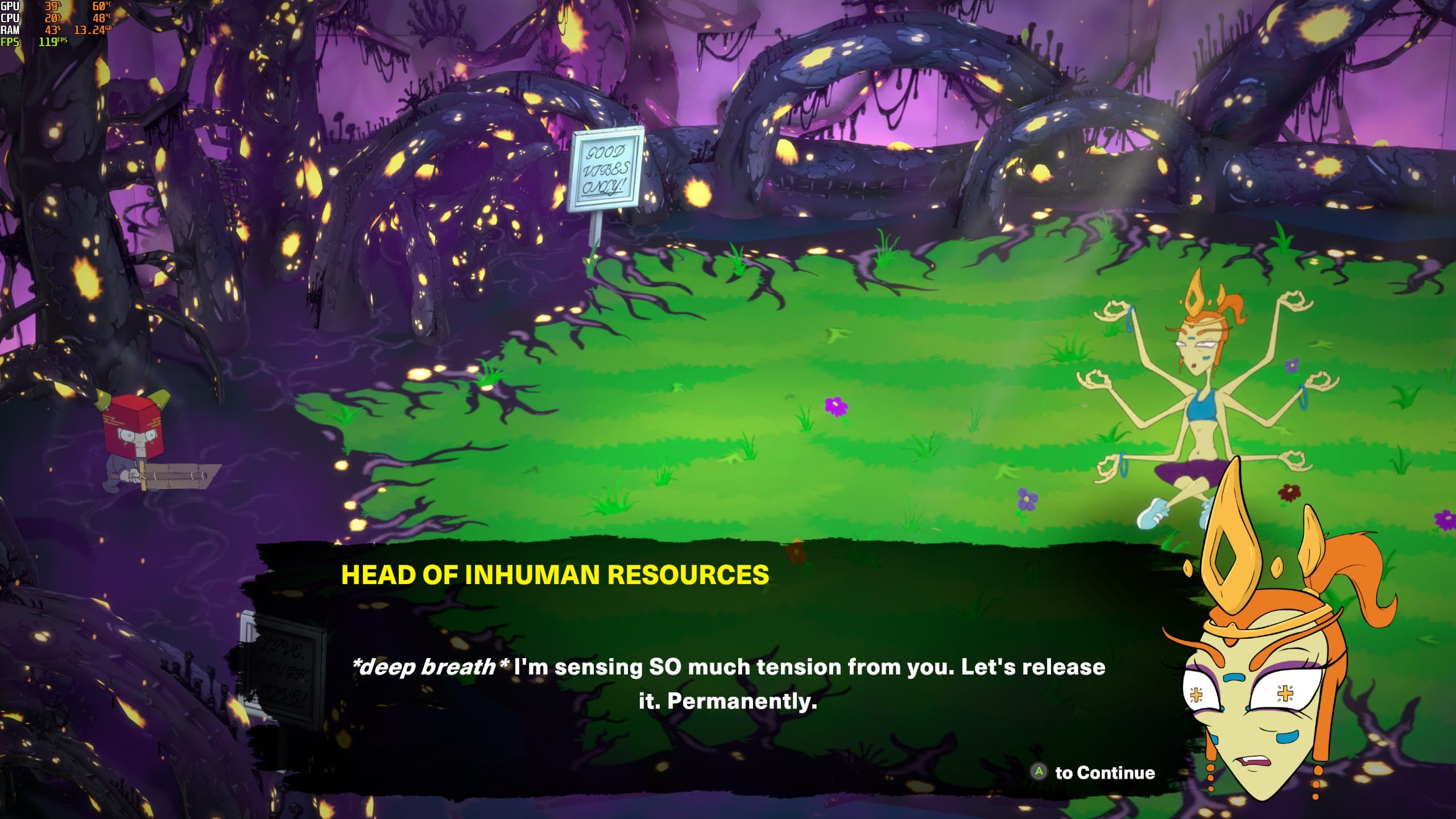
Among those faced in the first ascent, the Head of Inhuman Resources is probably the boss I enjoyed most: challenging at first encounter and, above all, very successful artistically and visually.
The Chief Extortion Officer has a considerable amount of health, but in our case, we’ve reached the confrontation with enough buffs to make it less complicated than anticipated.
The difficulty curve is therefore not always perfectly linear, as the character's strength depends very much on the build constructed during that specific run.
Elite Mode: when beating the CEO doesn’t mean you’ve finished
Warning: the following paragraph contains minor spoilers regarding the progression structure.
The defeat of the CEO does not represent the definitive end of Box Knight.
After completing the first climb, you encounter The First Box Knight and discover that your character is not yet ready to face what awaits. From here, a new phase begins and you enter the Elite Mode.

The first impression wasn't entirely positive. After defeating all the bosses, feeling essentially told "you're not ready yet, start again" risks initially seeming like a gimmick designed to artificially prolong the experience.
The second ascent, fortunately, begins early enough to show concrete differences.
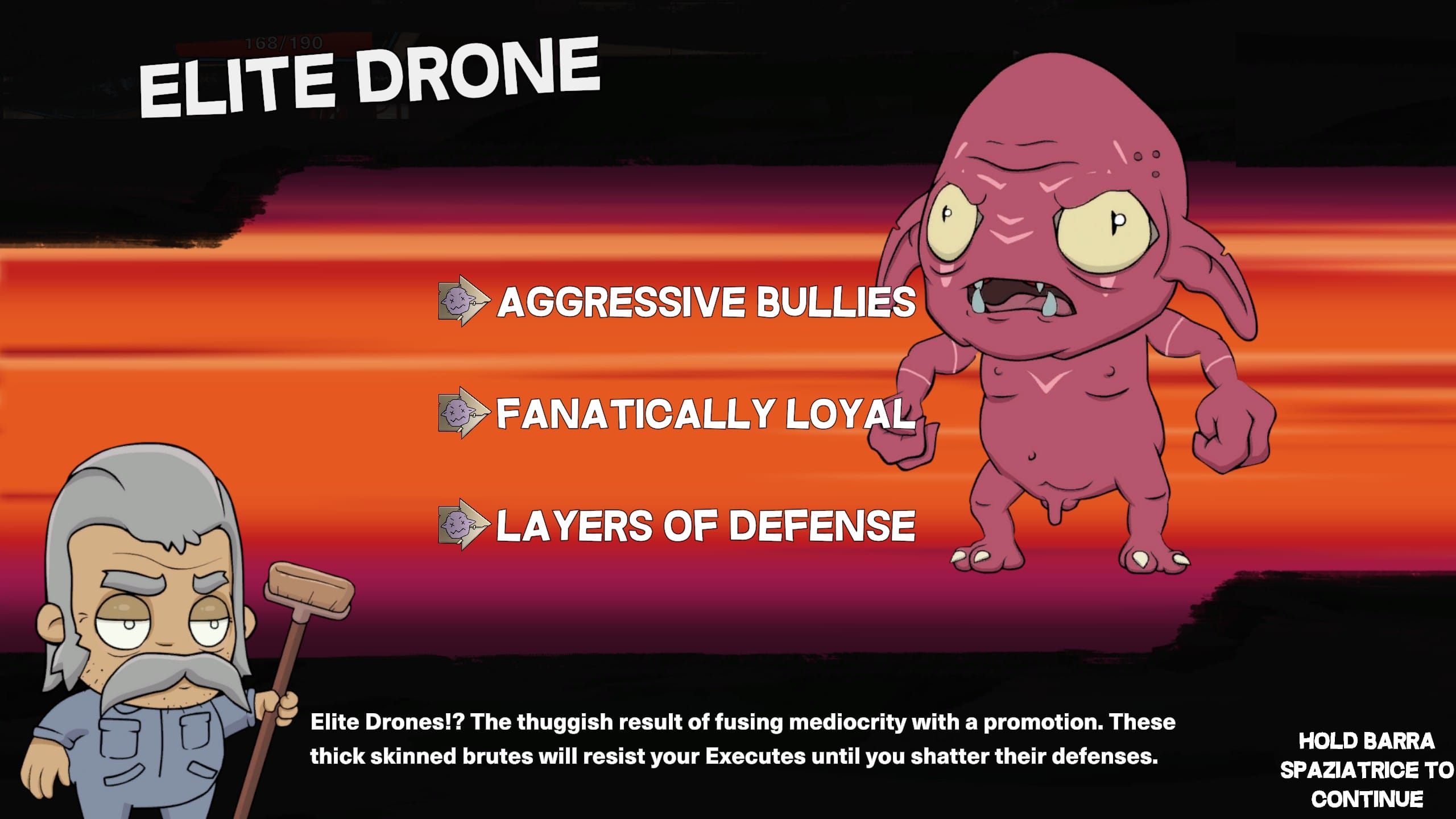
They appear as Elite enemies, more aggressive variants and also new foes. The Sigma Drone, for example, takes the Alpha Drone's structure but transforms it into a faster, more aggressive fight marked by fire attacks.

It is also during this phase that the progress Donny has made begins to bring greater satisfaction: enemies become more dangerous, but simultaneously our Box Knight possesses many more abilities than at the start of the adventure.
The difficulty of Elite bosses is not always increasing. For example, the enhanced version of Inhuman Resources seemed noticeably less dangerous than the Sigma I had faced earlier. Part of the difference is likely also due to the character’s growth and the build achieved in the meantime.
Box Knight in local co-op: the chaos increases, and it works
About two of the five hours of testing were spent in local co-op split-screen.
In due Box Knight increases the number of enemies present in rooms without simply raising their health points. This maintains a high pace and makes battles more chaotic, but also very fun.
During our matches, we have also not encountered an obvious limit to the ability to revive a fallen teammate, a feature that makes the mode sufficiently lenient even when the situation becomes particularly chaotic.
There are, however, some aspects that could be improved.
The second player cannot move freely in the lobby, and when one of the two characters is hit, the red damage effect affects the entire screen. For a moment, it can therefore become difficult to determine which player has actually taken the hit.
Even personalisation deserves some specific attention for the two-player mode. If both players use the same gear, distinguishing them during combat can become difficult. A simple different colour assignable to P1 and P2 would solve most of the problem.
It would be nice to have a small command reminder accessible quickly during split-screen.
The game also supports Steam Remote Play Together, but our co-op review refers exclusively to the locally tested mode.
Graphics and animations: the cartoon has much more personality than expected
From an artistic standpoint Box Knight is one of the project’s most successful aspects.
The cartoon style allows office cubicles, meeting rooms, vending machines, and ordinary office objects to be transformed into a fantasy world without ever losing the connection to the original premise.
It strikes particularly with the amount of animations. The different enemy movements, the effects of attacks, the creatures’ reactions, and numerous environmental details demonstrate a care superior to what one might expect from a superficial glance at the project.
Even as you move from one sector to another in the tower, noticeable changes are present, keeping exploration enjoyable.
The audio department follows the same philosophy. The music remains consistent with the environments and becomes more intense during the boss fight, successfully heightening tension and focus without becoming intrusive.
PC performance excellent, but we encountered a serious bug
From a performance standpoint, the experience was practically flawless: during about five hours of gameplay, we did not encounter crash, stuttering or noticeable performance drops.
Unfortunately, however, we encountered a much more serious problem during an Elite run.
In a room characterised by red walls and resembling a boss arena, the character accidentally passed through the door on the right. The enemies required to complete the fight remain inside the room, and we found no way to return.
Continuing to search for a possible way out, the character eventually fell outside the game area and died. The run ended due to a bug.
It is important to clarify that this was the only problem of this severity encountered during testing. However, it remains a particularly heavy flaw in a roguelike, because a single run can represent a considerable amount of time spent accumulating perks, resources, and temporary upgrades.
Among the small quality-of-life improvements, I’d also add the option to skip boss introductions already faced. They work well the first time, but during subsequent ascents, they inevitably disrupt the pace.
A roguelike that grows alongside its protagonist
After the first rooms, I had the feeling that Box Knight might be a pleasant but rather simple action roguelike.
Continuing to play, the verdict has changed.
The strength of the title from We Made A Thing Studios lies chiefly in its ability to gradually add new layers without making combat unnecessarily complicated. First, we learn to strike and dodge. Then come enemies with immunities and different roles. Followed by new weapons, elements, temporary builds, META, Prestige, and finally an Elite Mode that tests how much has been learned.
The corporate satire also helps Box Knight develop an immediately recognisable identity: it is not merely a decoration applied over the mechanics, but often the enemies’ behaviour turns the joke into gameplay.
There are still several aspects that deserve refinement. I’d like a consultable bestiary, a system for redistributing META points, better separation between equipment aesthetics and stats, some improvements to co-op readability, and above all, the fixing of bugs capable of completely ruining a run.
But after about five hours, two of which were spent on the sofa together, the prevailing feeling remains positive.
Box Knight doesn't reinvent the roguelite, but builds its own identity through an immediate combat system, solid permanent progression, well-differentiated enemies, many animations, and a local co-op capable of further enhancing its chaos.
And there’s perhaps an even simpler indicator.
After losing an Elite run due to a decidedly frustrating bug, the disappointment was immense. But the desire to return to the tower, rebuild another build, and see what lay ahead remained.
For a roguelike, probably, it’s one of the best compliments you can give
Box Knight is an PC action roguelike for, fun and full of personality, which improves noticeably as runs progress. The META system, Prestige, the variety of enemies and local co-op add depth to a combat initially quite simple. Some quality-of-life shortcomings, an uneven difficulty curve and a serious bug encountered during an Elite run still require attention, but the overall result remains decidedly convincing.
About the Author