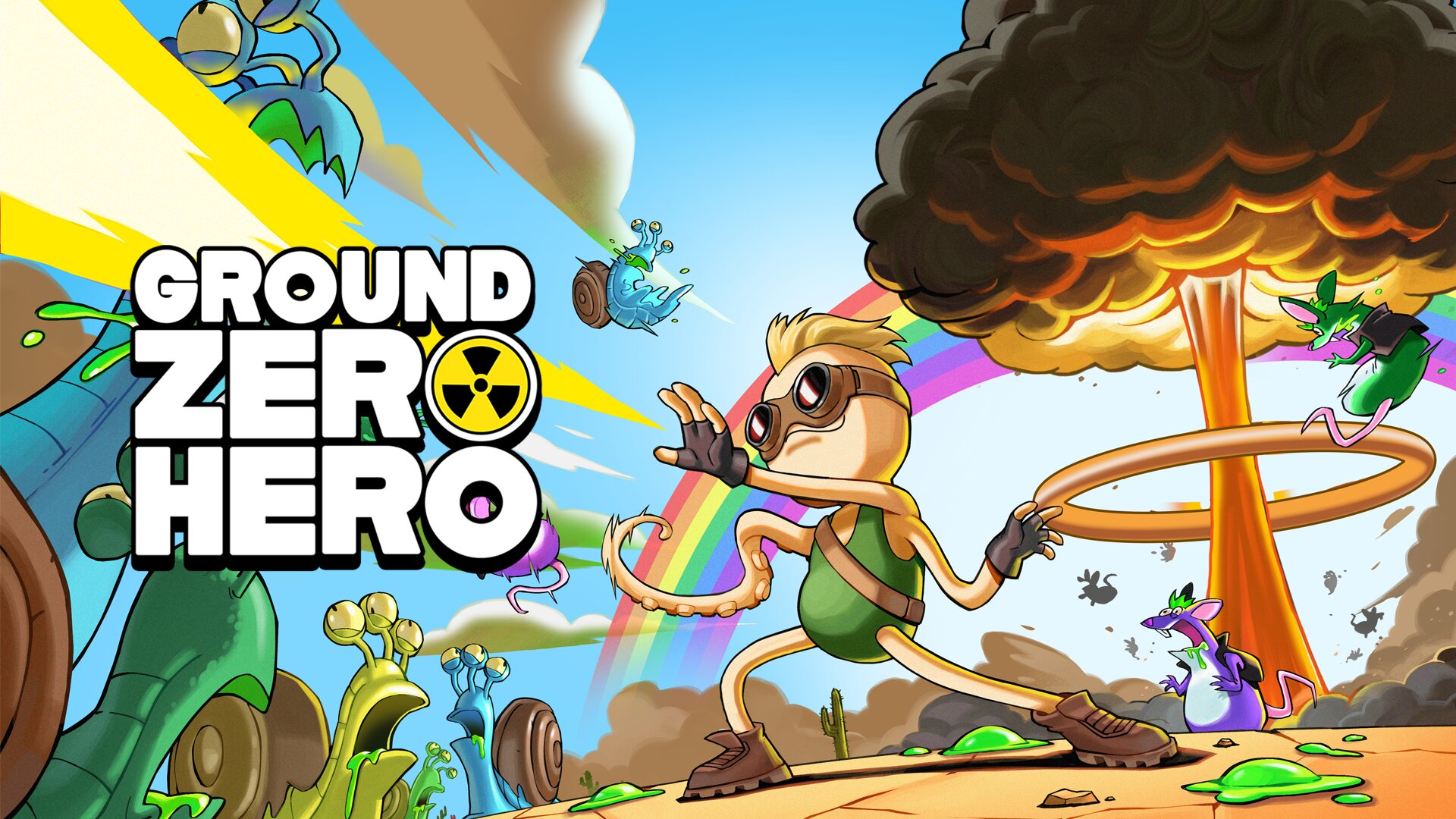
Vampire Survivors. The Simpsons. Rick and Morty. What if we threw them all into the same blender? If you get the proportions right, the result is roughly Ground Zero Hero and also a brand-new drug.
The game, developed almost solo by Rowan Edmondson, starts from a formula now long forgotten — the survivor-like made famous by Vampire Survivors — and dumps it into a barrel of radioactive waste, then covers it with an American cartoon art style completely out of control.
At first glance, it seems everything has already been seen. But after a few runs, it reveals many more original ideas than the initial impression suggests, and it’s curious, because Ground Zero Hero doesn’t hide at all where it comes from. Acclaim officially describes the hand-drawn graphics as a tribute to The Simpsons e Rick and Morty, while practically every review so far has mentioned Vampire Survivors to explain its structure.
Reducing it to "Vampire Survivors with the Simpsons" would be ungenerous.
Here you have candies to collect to stay alive, pinatas to smash with fists, atomic bunkers to hide in during the night, increasingly absurd mutations, safes to break while entire armies try to eat you, rideable cows, mushrooms with at least questionable effects, and bosses that appear only after you’ve turned thousands of creatures into radioactive recyclable material.
And yes... It works like a charm!

A small project behind the return of a huge name
Behind Ground Zero Hero is primarily Rowan Edmondson, an Australian developer who worked on the project for about three years, handling practically everything himself. The publisher is Acclaim, Inc., with Aurakenn Games acting as publisher for the Steam version. And yes, we’re talking about that Acclaim.
The brand that in the 1990s and early 2000s was synonymous with Turok, NBA Jam and countless video game licenses has returned to the scene with a new corporate structure and a philosophy focused on independent projects. Acclaim itself openly speaks of a new era for the brand. There’s something strangely appropriate in seeing Acclaim, in 2026, publish a game with an aesthetic that winkingly nods so much to The Simpsons.
Above all, considering how many yellow-themed family games have passed through Acclaim’s old catalogue decades ago, coincidence? Probably yes, but beautiful...
Ground Zero Hero is available from 20 August 2026 on PC, PlayStation 5, Xbox Series X|S and Nintendo Switch 2.

The story: we've survived the apocalypse. More or less. We keep going
If you’re looking for a deep storyline, troubled characters, flashbacks, and thirty pages of lore about the nuclear catastrophe, you’ve got the wrong bunker.
Ground Zero Hero has a setting, not a proper story. The world has ended. Something exploded where it shouldn’t have. Radiation has turned every form of life into something that, simultaneously, needs a veterinarian, an exorcist and an ARPA technician.
We are Radboy, an improbable survivor who must traverse this radioactive dump, slaughter mutants, and absorb their remains to become, step by step, something even worse than them.
Done. Or nearly.
There are small environmental details, references, absurdities that hint at a larger world, but there’s no real narrative that drives progression.
Here I’ve clashed over whether it’s truly a problem.
On the one hand, Vampire Survivors has taught us very well that you don’t need to know a character’s traumatic childhood to enjoy slaughtering twelve thousand monsters. Ground Zero Hero thrives on rhythm. Die. Upgrade. Start again. Discover a new mutation. Die again. Buy an upgrade. “Last run”. It’s two in the morning. It works.
On the other hand, a bit more narrative might have perhaps reinforced that sense of discovery typical of the early hours. Cutscenes or kilometric dialogues wouldn’t be necessary. Fragments of lore, documents, environmental events, some unlockable information slowly revealed, would be enough to spark that stupidly simple yet effective question: "What the hell happened here?"
Does Ground Zero Hero need it? Probably not. Could you have made money from it? In my opinion, yes.

Vampire Survivors is the father. Ground Zero Hero is the radioactive son no one would invite to dinner
Remove the mutant elephant from the room immediately. Ground Zero Hero is a survivor-like.
The attacks come from solo. We manage movement and positioning, avoid groups, collect what enemies drop, and, once the mutation bar is filled, choose one of three random upgrades offered.
As per the manual Vampire Survivors, the simplicity of the controls shifts the complexity elsewhere. You don’t need to be good at hammering the trigger. You need to be good at knowing where you’ll be in three seconds — and it’s very different.
Who sees the character firing automatically for the first time thinks the game does everything for them. Those who’ve spent some hours in the genre know that the real gameplay lies in trajectories, distances, openings, enemy density, space management, resource gathering, and build construction.
Ground Zero Hero perfectly inherits this principle. But then it starts adding stuff on top of it, and that’s where it becomes interesting.

The candy bar is a stupid idea. So it’s perfect
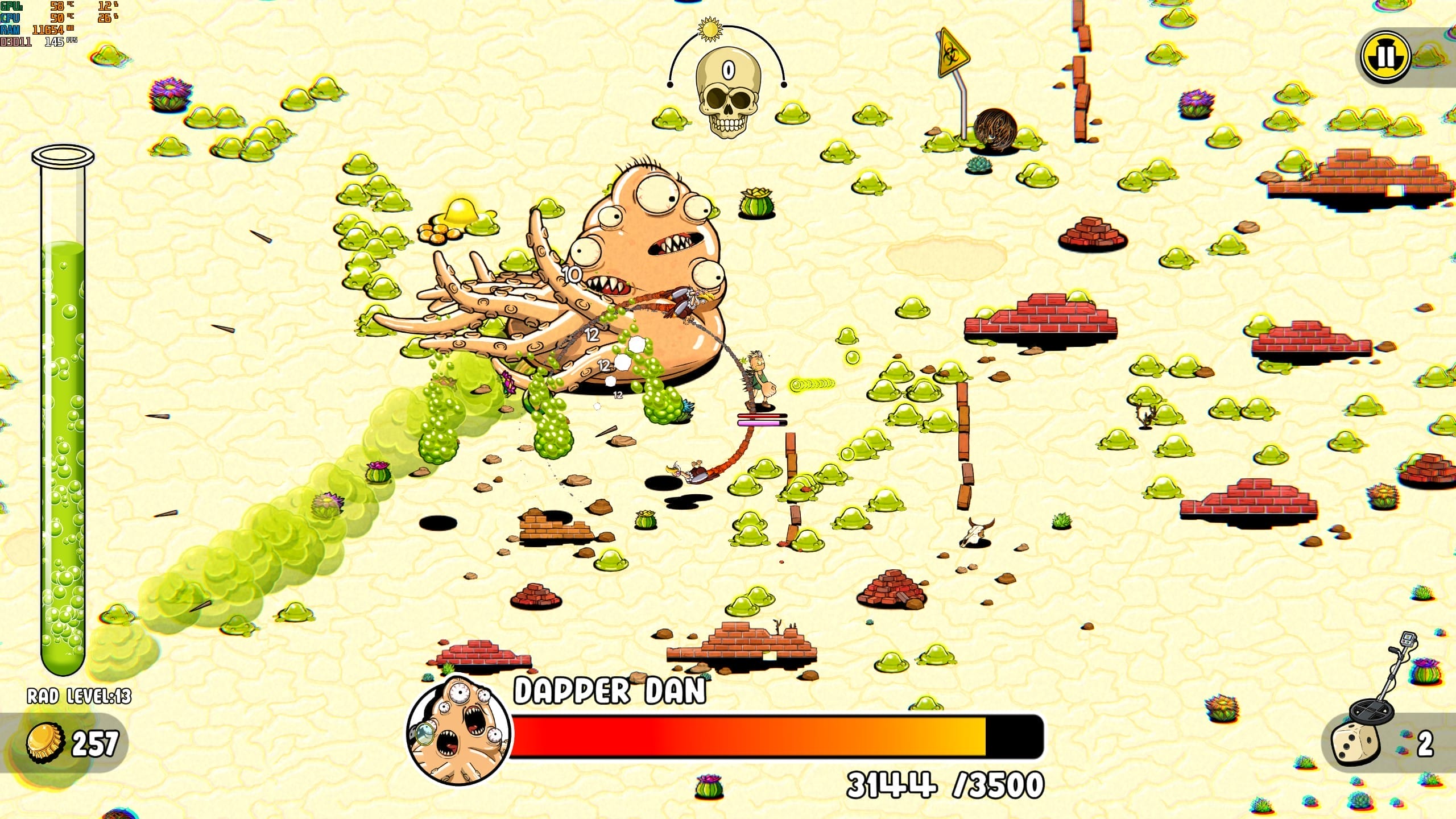
Beyond the usual health indicator, there’s a second metric to keep an eye on: candies.
Exactly so. After a nuclear apocalypse, with hundreds of radioactive creatures that want to rip out our organs, the main problem might become finding some Haribo.
The bar functions like a hunger or energy indicator. When it empties, health begins to drop. To refill it, you must break the piñata scattered across the map, or exploit certain special enemies that drop sweets. The piñata can also contain healing items, money, magnets to attract scrap, and detectors to locate safehouses.
It’s a mechanic that’s far cleverer than it appears. Because it gives a new reason to move. In survivor-like games, you often reach a moment where a sufficiently strong build lets you find a safe corner and let the death machine work on its own. Ground Zero Hero, however, continues to place small reasons to break out of that comfort zone. The piñata is there. The candy bar drops. To reach it, you must cross through that mass of monsters.
Are you going? Waiting? Try going around it? A seemingly ridiculous mechanic becomes a constant strategic small element.

The enemy counter completely changes the perception of the run
This is one of the differences compared to Vampire Survivors that I appreciated more. Instead of relying entirely on waiting for a timer, Ground Zero Hero clearly shows how many enemies remain to end the stage.
Seeing that number drop is a drug within a drug. You’re not simply resisting. You’re conquering the level, one mutant corpse at a time. Some stages require you to reach 10,000 kills before the final boss.
On paper, it seems incredibly intense. In an advanced run, when the screen stops being a screen and becomes a moving carpet of enemies, explosions, radiation, and anatomical parts of dubious origin, that counter begins to plummet — and it’s tremendously satisfying. But above all, it creates a direct link between build efficiency and game duration.
Little damage? The counter drops slowly. A build like a radioactive death machine? Thousands of enemies suddenly stop looking like so many. Progression is visible and I find it much more satisfying than the usual "just hold on for another five minutes".
And then comes the boss
Once the required number of kills has been reached, the run doesn’t end yet.
The final boss fight is here, and it’s another choice I really appreciate.
After minutes spent turning enormous armies into radioactive puree, the game suddenly forces us to focus on a single enemy.
Change the pace. Paths shift. Alter how you read space — and above all, give the run a proper ending.
You didn’t just survive long enough. You wiped out the army. Now you must kill the general.
Some reviews have pointed out that certain bosses feel easier than the massive waves fought just before, and I understand the criticism: when you reach the final battle with a wildly overpowered build, a single target quickly becomes just a pinata with more health points. But as a run structure? I love it very much.
I would increase the aggression, patterns, and complexity of the more advanced bosses. The core idea is correct.
Day and night: sleep or become much stronger?
Another element that clearly distinguishes Ground Zero Hero is its day/night cycle. During the day, you see the usual creatures of the area. Then the sun sets, and the game gently suggests it would be a good idea to look for a bunker.
With the night come much more dangerous enemies: more resilient, more aggressive, capable of turning an apparently under control situation into a radioactive funeral in seconds.
At that point, there’s a choice: reach a bunker, rest, regain some health, and essentially skip the nighttime phase, or stay outside.
The mechanics have now become decidedly interesting. Because the most dangerous nighttime enemies also release enhanced radioactive waste, which significantly speeds up character growth and allows for obtaining new mutations much faster.
So: entering the bunker means safety, while staying outside means risk — but also power (unlimited powereee cit.)
A simple and incredibly effective risk/reward mechanic. At the start, the night is scary, then comes the right run.
The mutations fit well, and the character starts vaporising everything that comes near. The bunker symbol appears, and at some point you no longer think " I need to save myself ".
Do you think: "Bunker? Which bunker?" This psychological evolution of the player is precisely the kind of satisfaction a good roguelite should offer.

The bunker is also a true save point
There’s also a detail that’s far from trivial. The bunker serves not only to skip the night.
It also allows you to save a run and pause it, a feature rather uncommon in a genre typically built around the idea that a match should be completed in a single session.
A small quality-of-life feature that I really appreciate. Especially because certain runs get longer.
It should be said that entering the bunker has consequences: uncollected radioactive resources may be lost. The shelter is therefore not a free “save me” button, but another decision to make during the game.
Ground Zero Hero is surprisingly good at this. Filling a simple gameplay with small decisions.

Mutation Time: welcome to the most fun oncology department in history
By killing enemies, we collect radioactive material. When the corresponding bar is filled, the best moment arrives: Mutation Time.
The game slows down, offering three options, and we can choose whether to take a new mutation or improve one already possessed.
Here, Ground Zero Hero unleashes all its madness. We’re not talking about "+10% damage to the pistol".
We can grow tentacles, develop a giant fist capable of generating shockwaves, fire lasers from our eyes, spit fireballs, lay explosive eggs, grow an electric eel tail, surround ourselves with lethal radiation, summon a bat, and even grow extra limbs.
The really beautiful thing is that the mutations also visually alter the protagonist.
At the start of the run, we seem like a poor soul needing an urgent hospital admission, while at the end we can resemble the reason the hospital was evacuated.
Perfectly coherent with the game world. The more powerful we become, the more ridiculous we become.

The first runs are probably the worst part of the entire game
And here we are with the most important critique... Ground Zero Hero builds a significant portion of its longevity on the progressive unlocking of mutations.
By completing runs, progressing through levels, and achieving objectives, the content that can appear in future matches continuously expands.
Good idea. The problem is when it actually starts to work.
The earliest runs come with a rather limited arsenal, and precisely at the moment the game should have firmly captured the player, Ground Zero Hero shows its least interesting version.
I’m not the only one to have noticed it. Other reviewers have described the early hours as noticeably weaker than what follows, highlighting how the initial mutations seem underwhelming until a larger portion of the system unlocks. An observation I agree with, as with a roguelike, progression must generate desire.
Another run just in case I unlock that thing there.
But you need to be careful not to hide too much of the initial fun behind the first few hours.
I would have given the player a more immediate taste of the madness awaiting them. Maybe an intentionally over-the-top introductory run and a guaranteed Bonkers mutation.
Something that says immediately: "Watch what you can become if you keep playing." Because once you’ve climbed that first step, Ground Zero Hero completely changes its face.
The game contains 19 mutations and each can go completely Bonkers
The pre-launch demo already allowed users to use 14 of the 19 total mutations, starting with five and unlocking nine more gradually. The developer also created an extreme variant, called Bonkers, tied to the mutations.
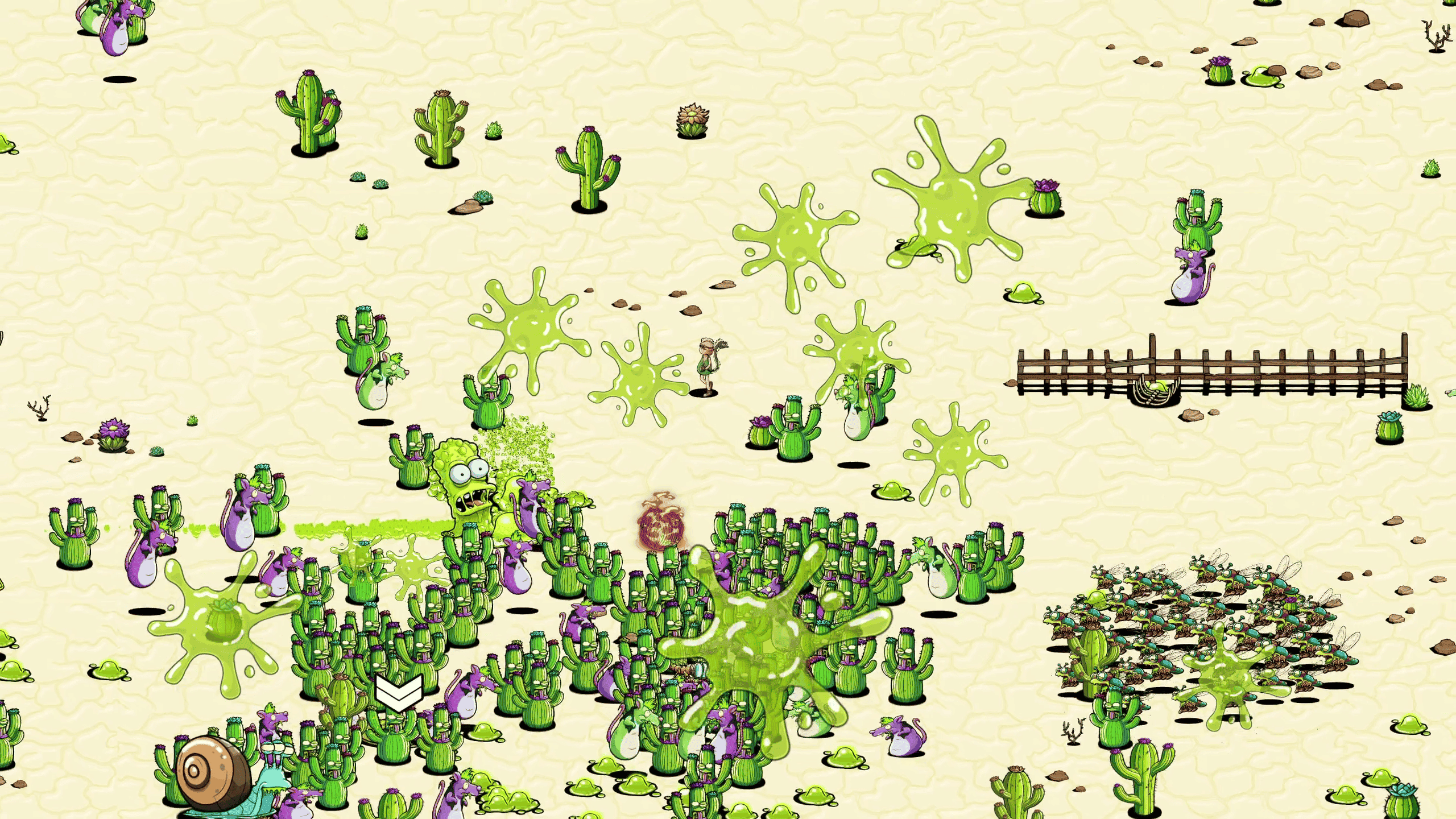
Here comes one of the most fun mechanics. Every attack has a small chance of "Go Bonkers".
When it happens, the ability used becomes, for a moment, a completely out-of-scale version of itself. A tentacle no longer strikes just a few enemies.
Become something capable of mowing down a huge chunk of the screen. A normal attack suddenly turns into an event.
According to Games Asylum, the base probability is 1% per each mutation, and certain permanent traits can then increase that percentage.
It’s a slot machine mechanic applied to the massacre of mutants and it works exactly for the same reason.
Every attack could be the right one, and every second can trigger the effect — and when it starts in the middle of a massive horde...Dopamine.
The same developer has described Ground Zero Hero as a project born to pack as much immediate fun as possible into something deliberately stupid and absurd.
I’d say the goal is absolutely focused.
Safehouses are another small masterpiece of risk and reward
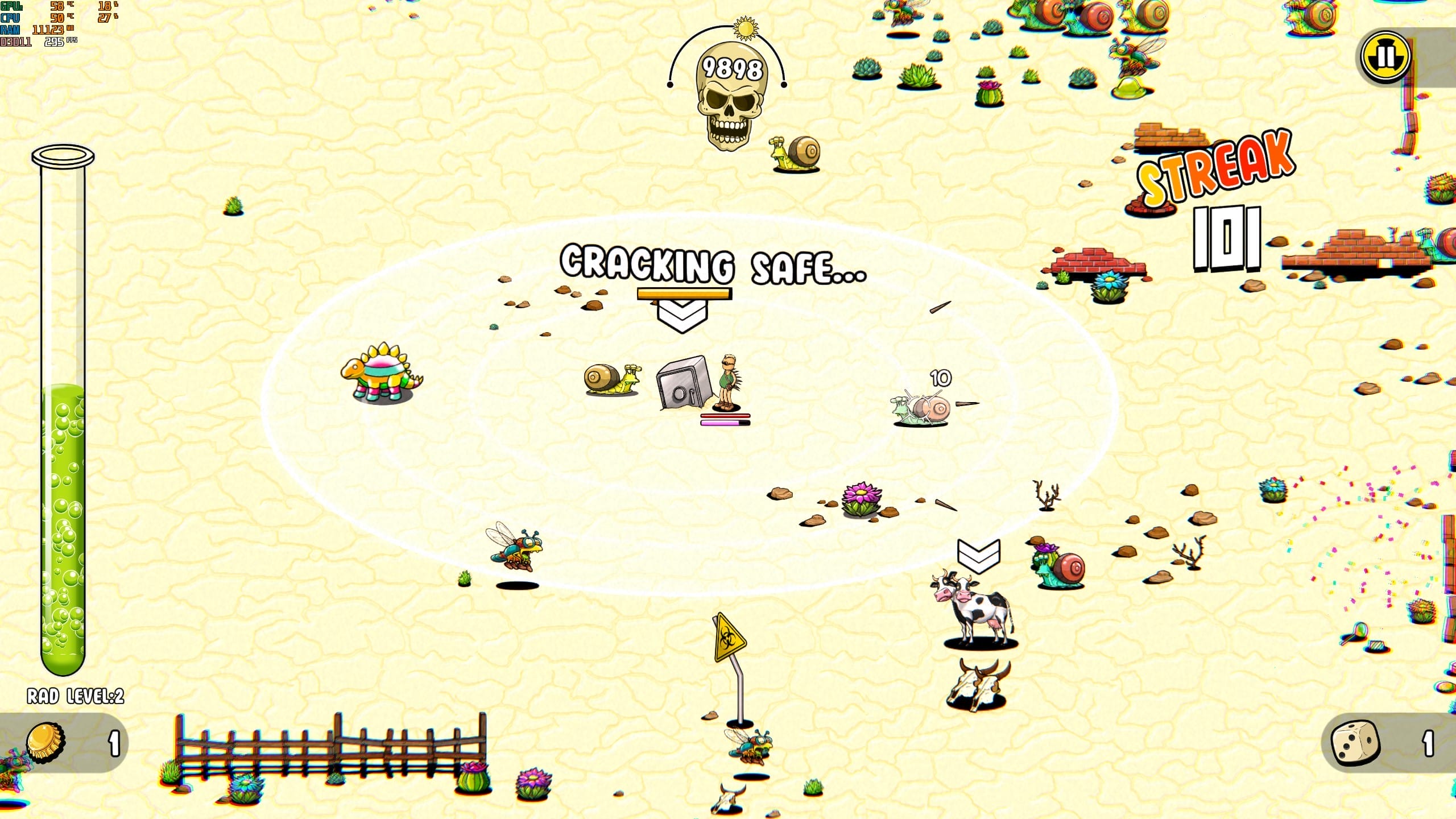
Exploring, you encounter some safehouses. Just touching them isn't enough.
To open them, you need to stay for a few seconds inside an area around them, while, obviously, the entire local ecosystem tries to kill us.
Simple and fantastic. Why do we return to the fundamental principle of Ground Zero Hero: force the player to move and decide.
Am I continuing calmly? Or am I trying to open that safe, risking being surrounded?
Inside there’s the currency for the permanent upgrades between runs, and obviously, after risking the match to open a safe containing just enough money for a marginal upgrade, the natural reaction is: "Never again."
Three minutes later: "Oh, a safe."
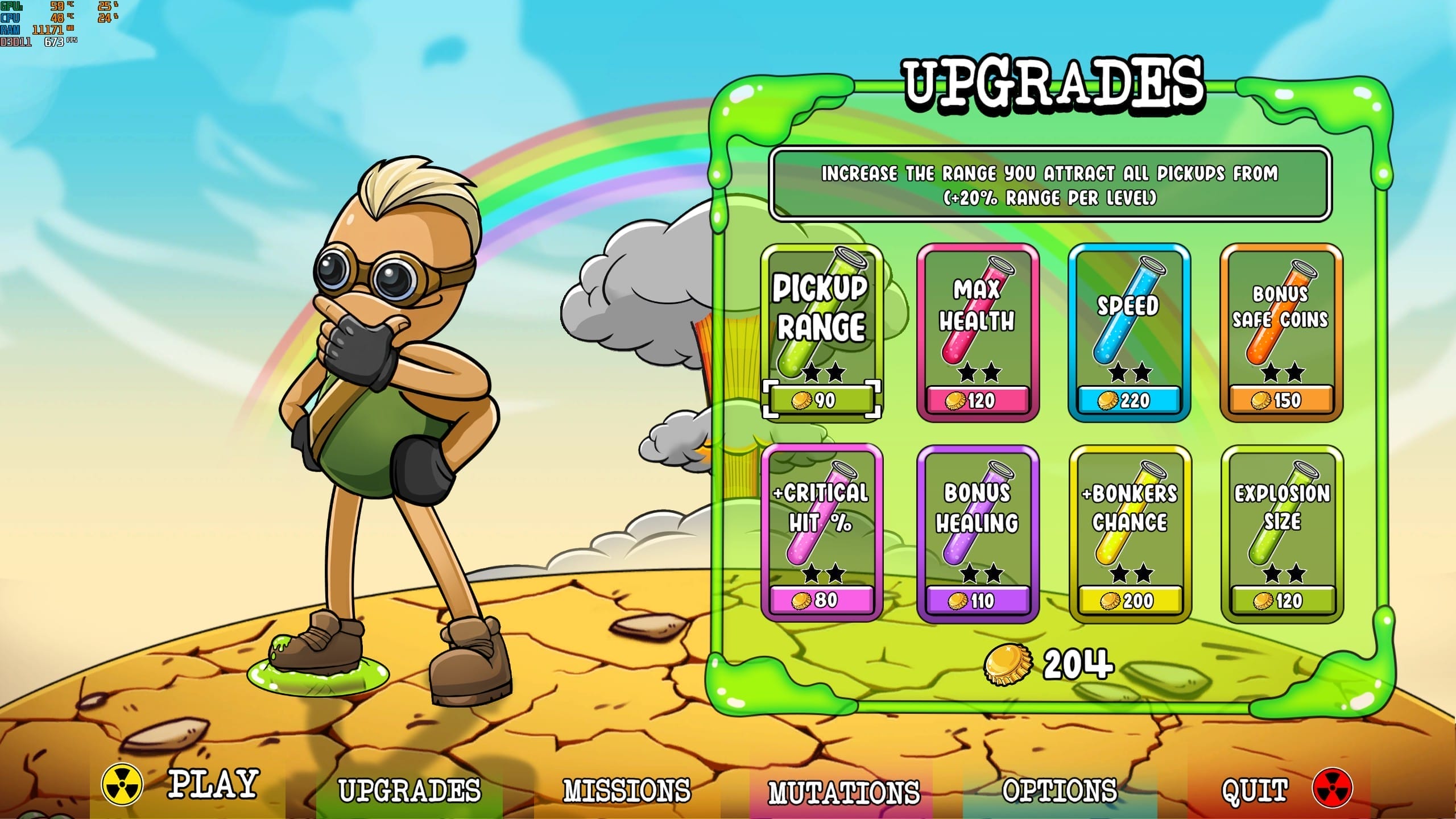
Over 80 upgrades: here begins the true metaprogression
The game claims over 80 upgrades across different progression paths, more than 60 enemy types, 60 challenges, and an Endless mode.
The recovered currency in the safes permanently improves various parameters (Health, regeneration, speed, critical hit chance, explosion effectiveness)
Probabilities linked to the Bonkers system and more. Exactly this double progression is the drug that generates the classic "one more run" syndrome.
Inside the game we build our monster. Outside the game we build the character that will build the next monster better.
If you die, you haven’t wasted twenty minutes. You’ve earned currency. Maybe you’ve unlocked a mutation. You’ve completed a challenge.
You’ve learned something. You’ve opened a new possibility for your next run.

There’s probably more depth than you can see
After several hours, I had a particular feeling. Ground Zero Hero seems to hide more than can truly be appreciated while playing it.
It’s both a compliment and a problem. At some point on screen, there are so many enemies, bullets, effects, explosions, debris, mutations, and objects that you’re forced to stop noticing the details.
You can’t... You must survive, yet something continues to happen at the edges of your field of vision. An object. An interaction. A particular creature. A reference. An event. A structure you might have been able to exploit.
And that question arises: "What have I missed?"
The world is full of interactive elements and random situations.
Unexploded missiles usable against enemies, destructible structures, toxic clouds, mushrooms that temporarily alter perception and slow down action, special items and even mountable creatures.
Among these, there’s also a cow. Because obviously, there’s a cow.
A mountable cow with which to trample a horde of monsters.
Which, at the end, might even explode. I won’t ask any more questions...

And we’re not even alone
In some runs, even more absurd elements appear.
A three-eyed bear can become a temporary ally and launch an attack against enemies.
There’s an object that triggers an electric attack. Other environmental elements generate fire or area damage.
An aircraft can fly through the area, leaving behind dangerous toxic clouds.
They are seemingly minor details, but they help a lot in preventing the map from being perceived as a vast floor on which thousands of sprites run.
The world of Ground Zero Hero participates in the run. Sometimes it helps. Sometimes it tries to kill you.
Sometimes you’re not even sure which of the two things you’re doing. Perfect like that...

Five biomes and an apocalypse that can change colour
Ground Zero Hero traverses five different biomes, starting from the Doomsday Desert, already seen in the pre-launch demo.
Another sector that convinces, but the scenario is different with a different palette.
The settings truly change their tone, moving from desert landscapes filled with mutant cacti to colder zones and increasingly absurd, alien scenarios.
The enemies change, the visual references shift, some environmental interactions are altered, and the colours and atmosphere also change.
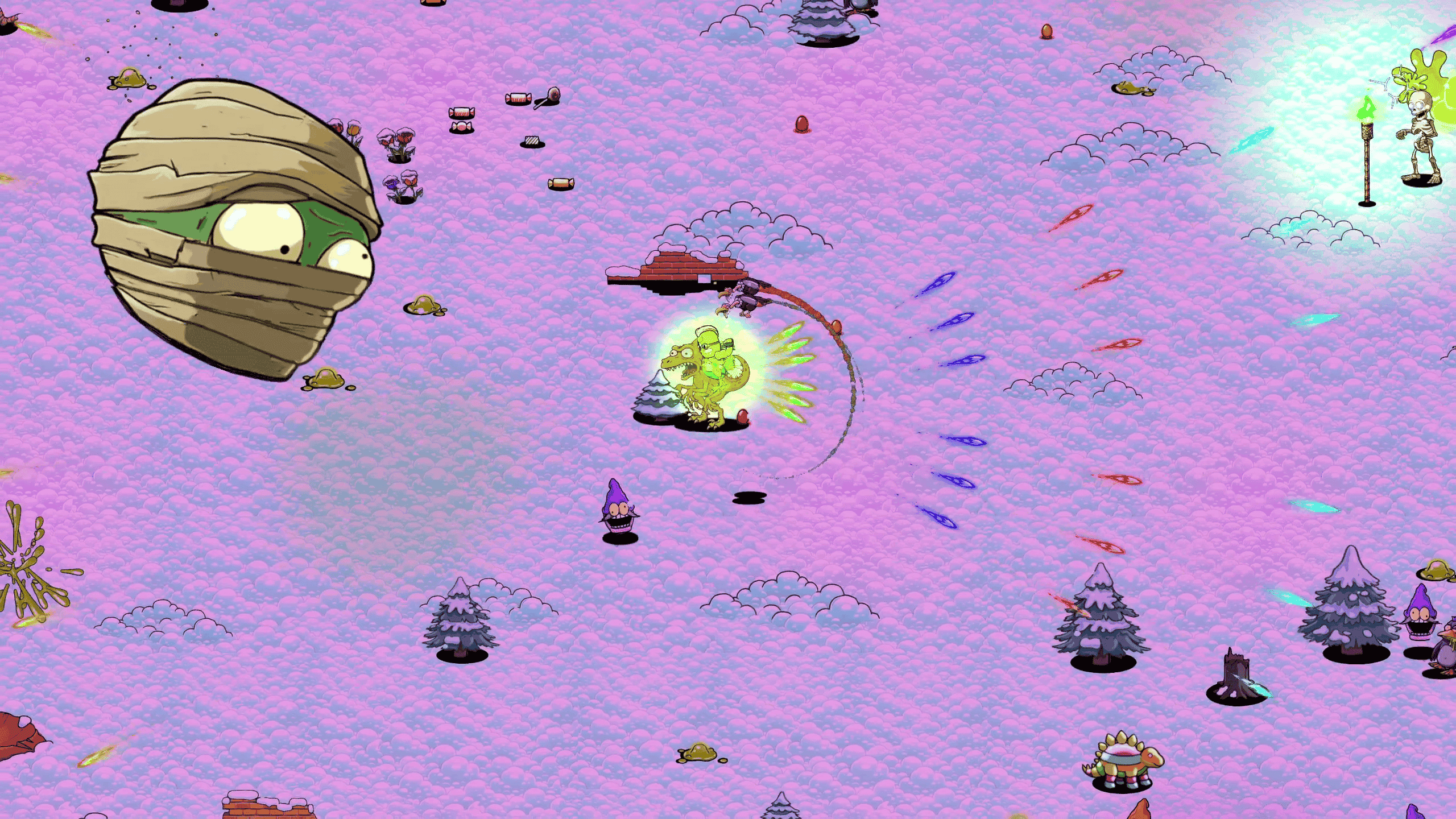
The game remains surprisingly readable despite the overwhelming number of elements on screen at the same time.
With hundreds of creatures on screen, a beautiful graphics engine but unable to distinguish a bullet from a decorative element quickly becomes a gameplay problem.
Here, in most cases, the chaos remains readable.

The Simpsons, Rick and Morty and that feeling of déjà vu
From an artistic standpoint, Ground Zero Hero is simply delicious or disgusting.
It depends on the character you’re watching. The inspiration behind I Simpson e Rick and Morty non è una nostra impressione is explicitly stated in the game’s official communication.
And it’s visible everywhere.
Big eyes, distorted bodies, violently vivid colours.
Anatomies more suggestive than respected.
Characters that might appear in the background of a Rick and Morty episode without triggering any alarm.
But Ground Zero Hero still manages to build its own identity. It doesn’t seem like a Simpson skin slapped onto Vampire Survivors.
After a few hours I started to recognise Ground Zero Hero. Probably the best compliment one can pay to its art direction.

The Easter eggs are everywhere... or perhaps we're just going mad
The more I played, the more I felt like I was constantly encountering references.
Some obvious. Others probably invented by my brain.
But that’s exactly the fun part!
Enemies, names, animations, objects, character designs and situations seem to keep constantly winking at the pop culture, American 90s cartoons, grotesque sci-fi and naturally at the survivor-like world.
Even the post-apocalyptic aesthetic seems to be blending something into the blender, Fallout and X-Men, a comparison that has also appeared in other reviews.
The game doesn't build its humour through endless dialogue but constructs it by showing you a cow with two heads.
A man dressed as a chicken or a crocodile wearing a cylinder who distributes candies just like an alien on a skateboard
And leaving you time to think: "...ok."
Before four hundred enemies enter the scene.
About the man dressed as a chicken...
One of the features that Acclaim considers sufficiently important to include directly in the official press kit is the ability to... give birth to a man dressed as a chicken.
I add nothing else. Certain things must be discovered by oneself.
But when the publisher lists it among the main features alongside mutations, wasteland and dynamic soundtrack, you have to show respect. Absolute respect.
The toxic-doped graphics create addiction
If I had to describe Ground Zero Hero in two words, I’d say: toxic-drug-addled.
In the best possible sense.
The palette appears to have been constructed by combining colours that would normally require ministerial approval to appear together on screen:
Radioactive greens. Purple. Yellow. Red.
Explosions. Particles. Fluorescent debris.
Mutations.
Psychedelic effects.
Everything is moving. Everything is flashing.
It seems everything has taken on something, and strangely, it doesn't immediately become unbearable. Instead...
The graphics fuel exactly that feeling of escalation that underpins the gameplay.
At the start, the scene is relatively calm. Then come the enemies, the mutations, the effects, the night.
Then someone explodes, maybe everyone does.

The animations have more character than necessary
One thing I particularly appreciated were the animations. It wasn’t necessary that many transformations be so elaborate or that certain creatures had those expressions.
It’s one of those cases where you can clearly sense that someone was having fun developing it.
I'm surprised by how much the small animations, mutations, and environmental elements convey the care put into the project.
Ground Zero Hero doesn't want to be elegant, it wants to be recognisable and it succeeds very well.
Audio: 1990s animated cartoon during an apocalypse
I also liked the soundtrack. The sound effects complement the combat escalation well, and the music maintains the same identity above the graphics.
Pure the official press kit speaks of a dynamic soundtrack that changes according to gameplay, and the shift in tone is noticeable in the nighttime stages.
Right choice. The day/night transition shouldn't be read only through the screen's colour but should be felt.
It must come that moment when the game tells you, without opening windows: "Now I’m done."
The audio puts in its own effort. I wouldn’t call it a soundtrack to listen to outside the game, but inside Ground Zero Hero it does its job perfectly.

Is it deep, or have we already seen everything after a few hours?
Here’s the point where the critics seem to split the most. My feeling is that Ground Zero Hero hides a greater depth than its apparent simplicity suggests.
Between 19 mutations, Bonkers variants, over 80 upgrades, five biomes, more than 60 enemies, 60 challenges, environmental elements, day/night cycles, candy management, builds and Endless Mode, there’s plenty of radioactive meat on fire.
Other reviewers have instead perceived the opposite limit: WayTooManyGames, for example, criticised the fact that, with much of the mutations already known, there lacks an additional layer of evolutions and synergies capable of generating continuous new discoveries like in the best examples of the genre. Pure Dead Gaming arrives at a similar but softer conclusion: good longevity, strong appeal of the "one more run", but inevitable slowing of discovery once a large portion of the mutation and biome pool has been explored.
Ground Zero Hero has depth. But not all of it comes from weapon combinations.
Part of it comes from risk management. Stay out at night? Go to the safe? Look for the candies? Sacrifice the safe trajectory?
Which mutation can I enhance? Am I entering the bunker? How aggressive can I afford to be?
It’s a different depth from the almost encyclopedic one achieved today by Vampire Survivors.
But if Ground Zero Hero were to grow in the future, a hidden synergy system between mutations would be the first thing I’d add.
Why it would fit perfectly with its philosophy.

Sixty challenges are another reason not to stop
Beyond the classic progression, there are 60 challenges, important especially for those who need concrete objectives beyond completing the maps.
Some ask players to eliminate specific quantities of certain creatures, while others encourage the use of environmental elements or mounts.
There are challenges tied to bosses, completing wastelands, and even the decision to tackle an entire area without using a bunker.
And here Ground Zero Hero does something intelligent. It pushes you to play differently from your natural behaviour.
If you always head for the bunker when night falls, a challenge might convince you to stay outside.
If you always ignore a certain mount, suddenly you have a reason to try it.
The challenges therefore become advanced tutorials disguised.
And when that’s still not enough, there’s Endless Mode
Of course, there’s also an Infinity Mode, designed for those who, after finishing the main content, just watch the horde and think: “Larger.”
It’s practically the natural endgame for this kind of experience. The campaign and challenges serve to build knowledge.
The Endless serves to see how far that knowledge can be pushed before the computer, the character, or the brain asks for mercy.
There are some flaws
Despite the enthusiasm, Ground Zero Hero is not perfect.
The first criticism we’ve already seen: the early runs are less spectacular than they should be.
To this I add a certain dependence on chance: some combinations arrive quickly, while other runs seem determined to present exactly what is not needed.
It’s the DNA of the roguelite, for sure, but at certain moments the line between "I have to adapt" and "this game was born crooked" becomes quite thin.
What interests me most is the future. Because Ground Zero Hero has a scalable base practically limitless. (mutations, synergies, biomes, bosses, random events, easter egg, absurdity and whatever else you can throw in)
The system is designed to accommodate them.
The real risk of Ground Zero Hero is Vampire Survivors
Not because the comparison penalises it. But because Vampire Survivors has become an enormous monster.
Years of updates, characters, maps, secrets, weapons, evolutions and DLC have built a volume of content that a newly released small project cannot compete with numerically.
So Ground Zero Hero must win elsewhere. It doesn’t seriously try to be “Vampire Survivors 2” but takes that grammar and uses it to tell its own madness.
Conclusions
Ground Zero Hero was a lot of fun.
Not "cute". Not "has potential". I genuinely liked it!
It’s one of those games that after a few minutes seem utterly simple, almost elementary, and then gradually reveal a multitude of small systems that turn that simplicity into strategy.
The base of Vampire Survivors is obvious. And who cares!
Why did Rowan Edmondson build something with such a strong personality atop that base?
Then there’s the graphics. A radioactive trip in which The Simpsons meet Rick and Morty while Vampire Survivors watches from afar, wondering where its candies have gone.
Of course, there’s still room to do more.
After several hours, I don’t feel like I’ve simply learned the loop; instead, I’m haunted by the feeling of still losing something at the edges of the screen while four hundred monsters try to bite me, and I want to go back inside to find out.
For now, I’m still in the phase where every match ends and I think: "Ok. Another one." Then: "This is really the last one." Then: "Right, I’ll just try that new upgrade."
Ground Zero Hero is this.
Mechanics so fundamental they can be understood in thirty seconds, but smart enough to require strategy to master properly.
So much dopamine.
The game was released on 20 agosto 2026 and, at the time of our review on 26 agosto, the Steam version still has a very small community: 39 user reviews, with 82% positive ratings.
The price helps: the listed price is already inclusive and on Steam there’s a launch offer of 15%, equivalent to €8.28 in the euro area, until September 3, 2026.
It’s really hard not to recommend it to fans of survivor-like.
And if Vampire Survivors has already stolen dozens or hundreds of hours of your life... Well. I’m sorry... You’ve just found another problem.
About the Author