

I’ve never hidden my love for Developer Digital and the publisher’s ability to discover and release gems of video game entertainment. From titles that have become cult favourites like Hotline Miami, to pop phenomena like Fall Guys, it’s hard to believe these guys ever miss a shot. And, let’s not forget, they’ve hit the mark again with Loop Hero, the new offering from studio Four Quarters Team. Currently available only on PC, Loop Hero is a Roguelite with RPG, strategic, and deck-building elements. Brutal in its apparent simplicity, yet astonishingly addictive, to the point that the roughly 20 hours I spent playing the full version of the title seem almost laughable compared to the 300–400 hours some users have spent solo nella demo. This is to give you an idea of how satisfying and deep this game can be — but let’s take a closer look at what it actually is.
This content is provided by YouTube. To view it, you must allow external content. Activation may result in data being shared with the third party.
We rebuild the World, pixel by pixel
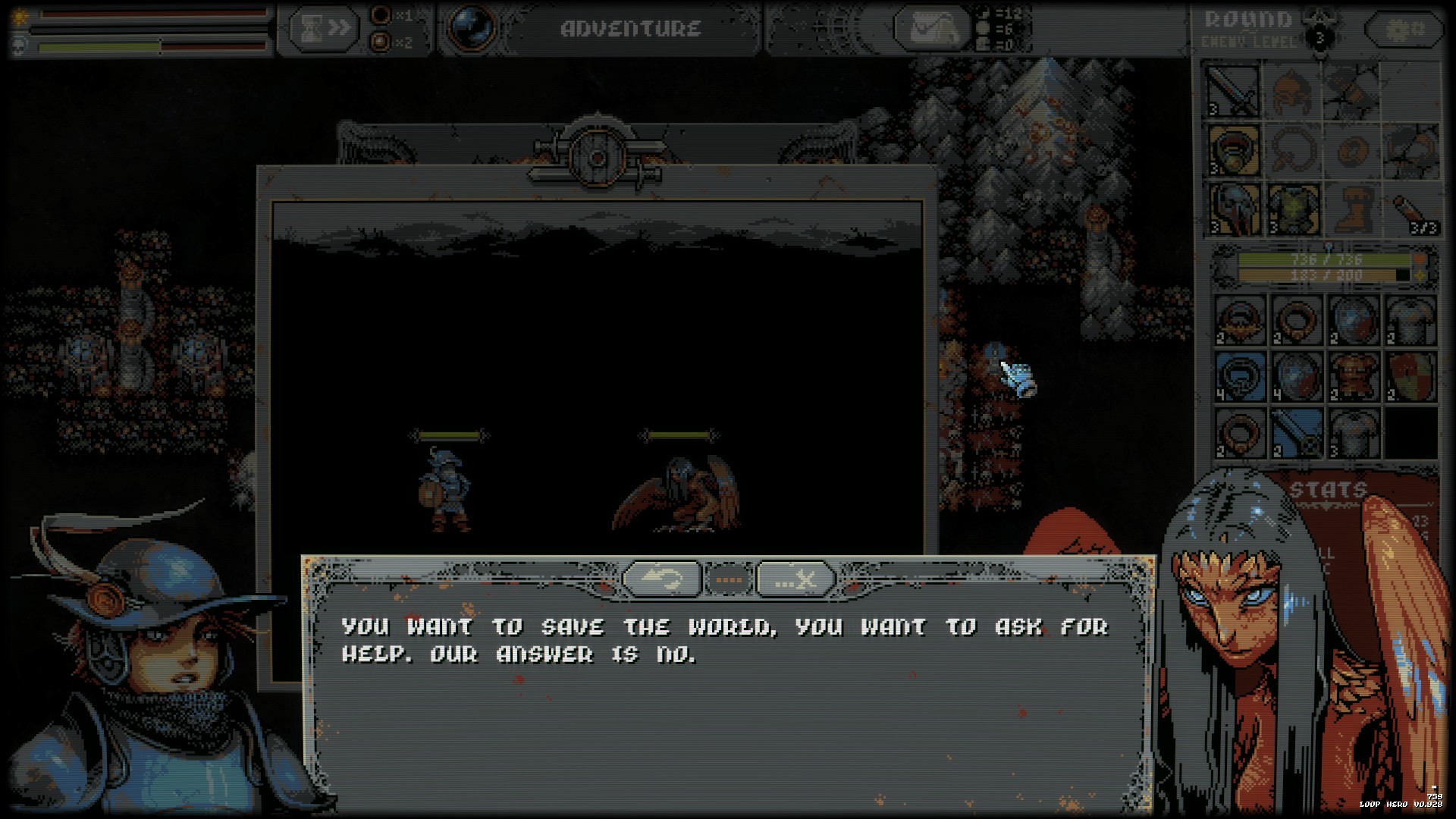
The opening isn’t certainly among the most original: a malevolent Lich has decided to erase the existence of the world as we know it, but fortunately, a Hero is capable of opposing the apocalypse by attempting to rebuild civilisation, restoring order to the primordial chaos that has emerged. Starting from our camp, we’ll find ourselves walking in loop for days and days, encountering monsters of every kind on our journey to unlock the bosses of each chapter of this cryptic story, and freeing the world from the Lich’s cruel threat.
After a short and far too brief tutorial, we’re immediately thrown into the fray — or rather, into the loop, meaning this procedurally generated virtual path that always begins and ends at our camp. Our Hero moves and fights autonomously in this empty “world” that we’ll enrich using the cards we’ll have available. Before each run, we’ll be able to assemble a deck containing a maximum of 15 cards, each representing a biome or a specific structure we can place in the game world, gaining their respective benefits or summoning the monsters that inhabit them. Growing lush meadows will grant us healing at the end of every walking day, building mountains will increase our total health points, constructing cemeteries will allow us to secure valuable resources when passing through that square — but we must factor in the presence of menacing skeletons guarding them. It therefore becomes essential to experiment and discover the various combinations between cards, and the best strategies to achieve the most compatible synergies, learning which encounters are most dangerous and how to exploit monsters’ weaknesses to our advantage.

But if the positioning of cards that grant bonuses seems logical and intuitive, why should we complicate things by placing obstacles on our path? Well, have you ever seen a hero who doesn’t fight? How do you think you earn a living? By killing horrible, grotesque creatures — obviously! In Loop Hero, every monster you slay grants you experience points, useful for unlocking interesting perks along the way, as well as possible cards to add to your hand or equipment to improve your hero. As a seasoned game master, our job is simply to craft an adventure that perfectly fits our hero — not too easy to prevent him from arriving unprepared for the final boss, not too difficult to make him die prematurely.
If, in fact, our favourite character dies before completing a full loop, we will lose 70% of the resources gathered during the run — not insignificant if we consider the effort and time required to accumulate them. At every loop, we will therefore face a dilemma, a bet with ourselves: succumb to greed and make another lap risking death, or retreat cautiously to our village carrying everything we have collected? A choice that has proven, to put it mildly, highly anxiety-inducing and has led to numerous curses...re-thoughts.
Another round...
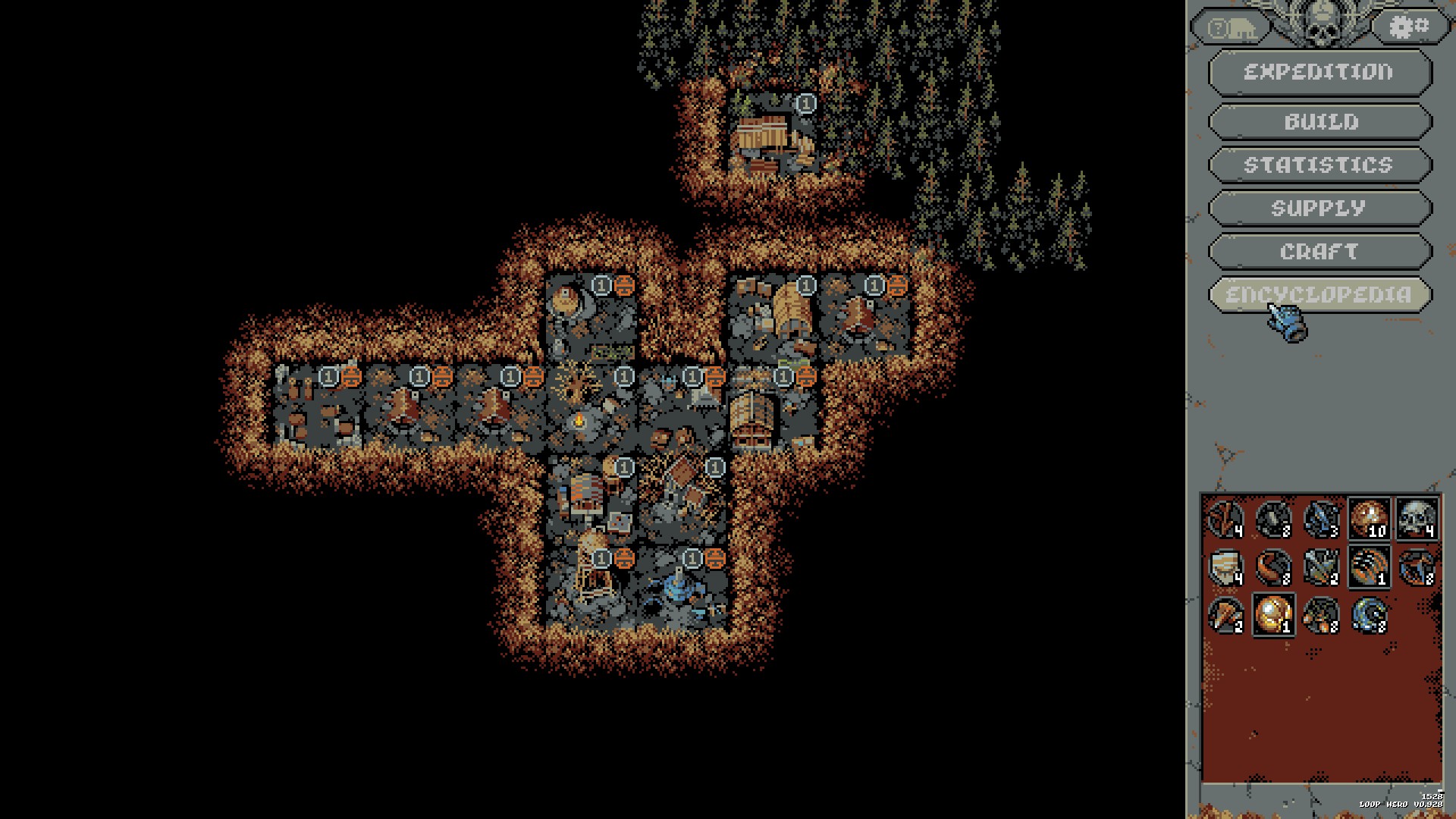
Even the most courageous and unyielding hero needs a break. In Loop Hero, once a run (voluntarily or not) is completed, we return to our camp — a sort of small village constantly expanding, inhabited by the few survivors of the cataclysm. Using the resources gathered in the loop, we can build new buildings or improve existing ones: for example, building the Gymnasium unlocks the ability to gain perks by raising our Hero’s experience; the Crypt, on the other hand, allows us to unlock one of the three classes currently available in the game, the Necromancer. Alongside the Roguelite and strategic elements, there is also a management aspect — essential for progressing in the game, since some buildings will grant us new cards for our deck, significantly expanding our tactical possibilities.
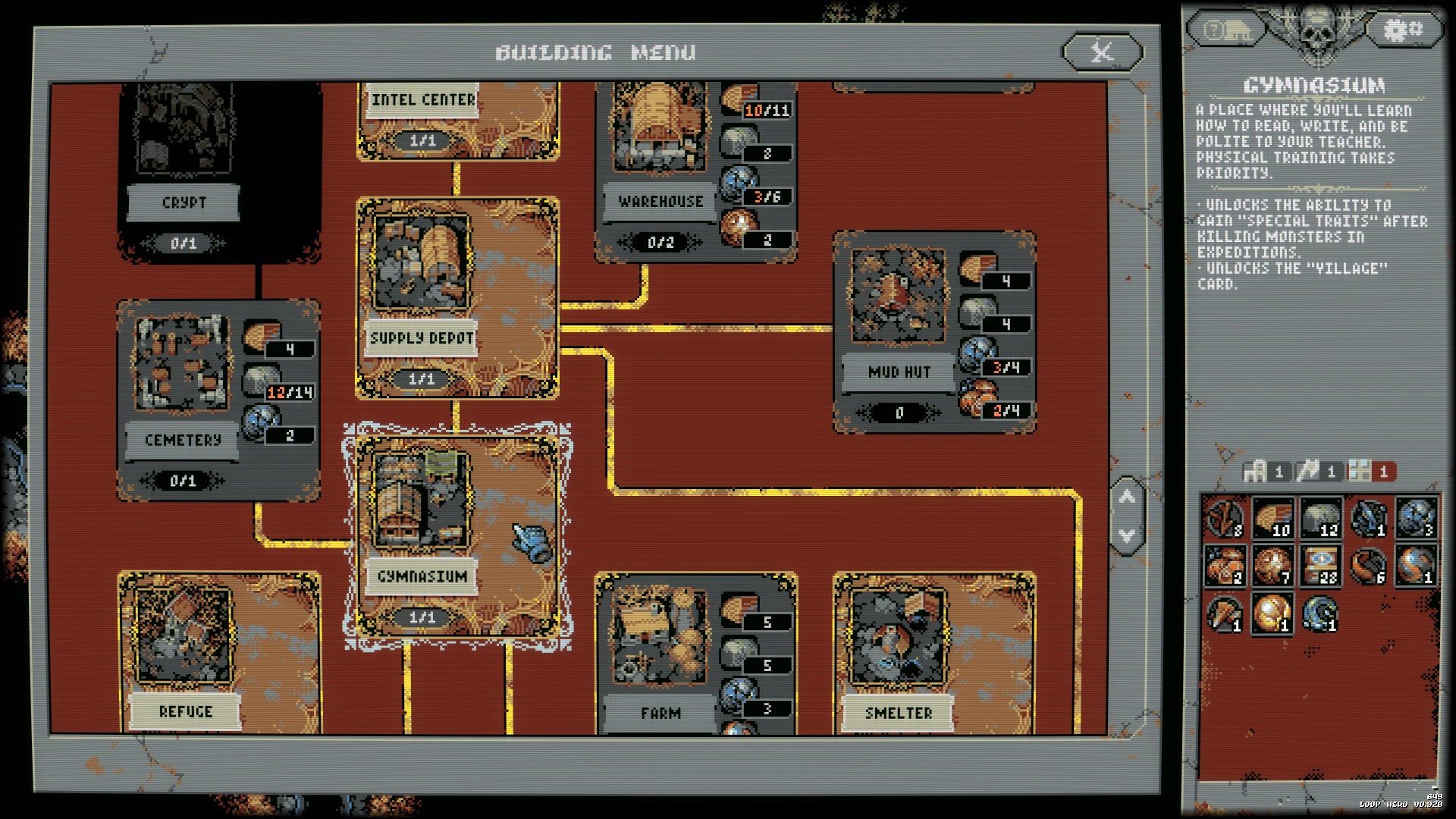
If it’s true that some buildings require a significant amount of farming and grinding, it’s equally fair to say the game is built around that — an endless cycle of loops orchestrated by us, to maximise resource gathering and, consequently, our chances of defeating bosses and completing the four chapters that currently make up the game. As time passes, things become a bit more tedious; we start identifying strategies that are far superior to others, and things grow a bit more monotonous. The opportunity to experiment with the various classes and their unique traits certainly helps alleviate this problem: among Warrior, Thief and Necromancer, I definitely preferred the latter. Its special feature lies in exploiting almost entirely skeletons and ghoul summoned from death to fight alongside it, making combat against multiple enemies decidedly more manageable.
Regarding the combat, well, one can say very little, as it is entirely automated and based simply on our character’s statistics — a feature that clashes considerably with what most Roguelike titles have conditioned us to expect up until now: games like Hades, Dead Cells, Enter the Gungeon base their core gameplay on combat frenzy and the skills required from the player to overcome each stage. Conversely, in Loop Hero, all of this takes a back seat, making the gameplay certainly more passive but no less exhilarating. Moreover, this style of play fits perfectly with the habits and needs of players who prefer long runs spanning several hours, as well as those who are content with quick, hit-and-run sessions, which is why we’re certain that Loop Hero will soon be available on mobile devices.
Technically speaking
We tested Loop Hero on the following setup:
AMD Ryzen 7 3700x @ 3.60 GHz
Gigabyte GTX 1080 8Gb
Kingston Hyper X FURY (2x8Gb) DDR4
Resolution 3440x1440 (21:9)
Given the retro-inspired graphics and art style, we didn’t have any trouble getting the title running — though it’s locked at 60fps (not that we’d expect anything higher). While we didn’t encounter any truly bizarre bugs, it was still pleasing to see how the developers have been busy releasing as many hotfixes as possible to ensure a smoother, problem-free gaming experience for the rapidly growing playerbase. Alongside the graphics that seem to have come straight out of an Amiga, there’s a 16-bit soundtrack that’s tasty, but, compounded by long gaming sessions, it eventually grows tiresome — and I’ve personally replaced it with my Spotify playlist. A minor annoyance regarding sound effects, sometimes a bit too “crude” and unpleasant, even though they’re contextualised within the era the game emulates.
In conclusion
Loop Hero is a title that surprised and won me over, one that manages to refresh a genre I love — the Roguelike — though I admit it’s become a bit stale and repetitive lately. The team at Four Quarters Team have managed to build a deep and complex work... sometimes even a bit too much! Despite not being free from flaws, such as the “dryness” of the tutorial or the latent repetitiveness that becomes apparent after around ten hours, Loop Hero is certainly a game worth having in the shelves of all fans and non-fans alike, given its absolutely competitive price (14,99€). We hope the developers remain active and cohesive with the community as they have shown in this post-launch, perhaps delighting us with some new classes or new cards that can further expand the possibilities this dreamlike experience offers.
About the Author