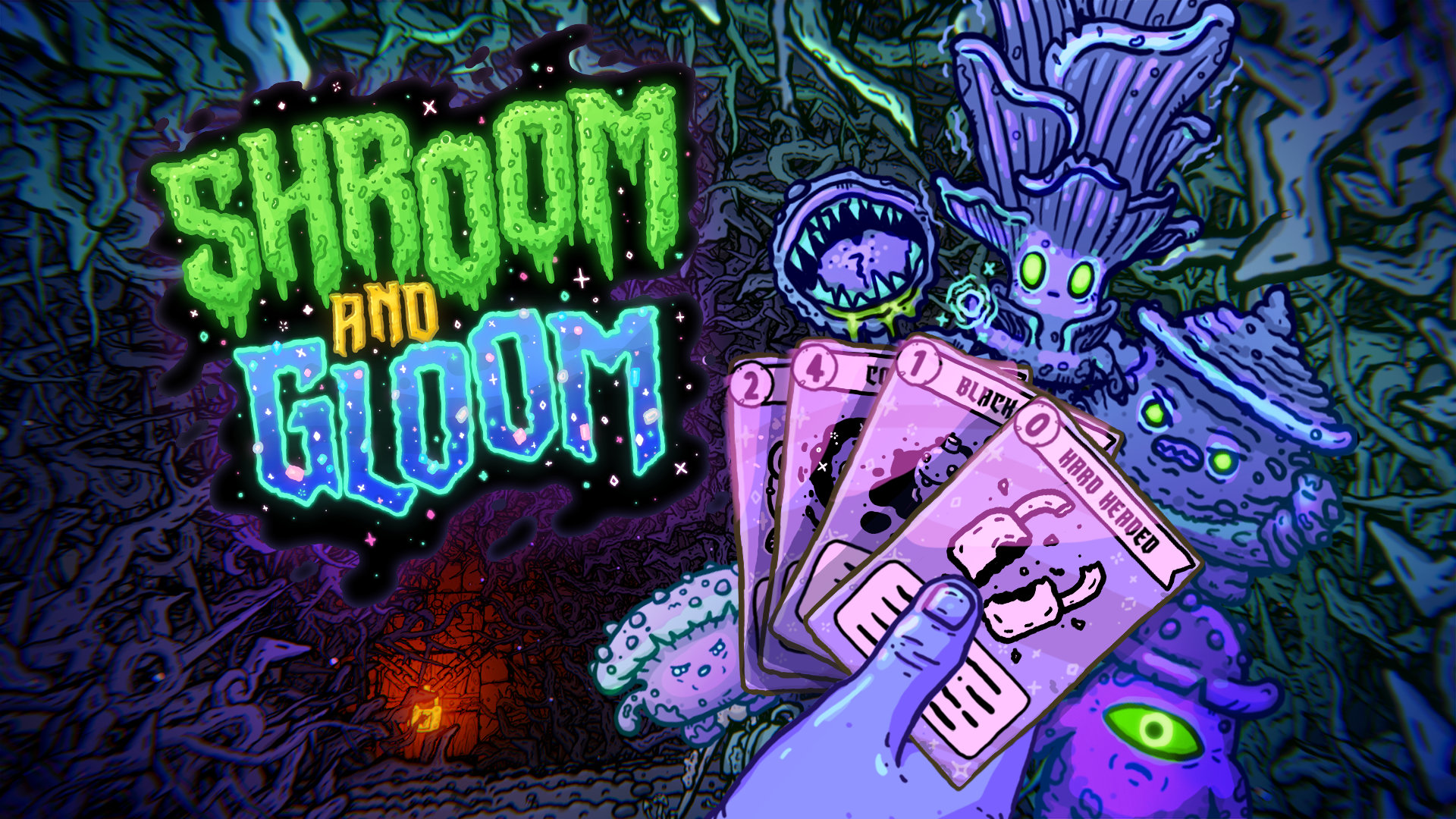
There are questions humanity has carried around for centuries. Are we alone in the universe? Does free will exist? Was the egg created before the chicken? Team Lazerbeam has decided to focus on something decidedly more important: what would happen if Slay the Spire were a first-person dungeon crawler populated by psychedelic mushrooms and allowed us to eat our enemies to regain health?
Finally, someone had the courage to ask it.
Published by Devolver Digital and available via Early Access on Steam, Shroom and Gloom is a deckbuilder roguelike that takes very little time to show that it has something different to tell. Not necessarily because it revolutionises the genre’s foundations — anyone with hundreds of hours spent on Slay the Spire, Inscryption and similar titles will immediately recognise many familiar elements — but because Team Lazerbeam takes those foundations, covers them in mould, draws them by hand, passes over them with some substance probably illegal, and finally builds around them a double deck system that works damn well. The result is one of those games capable of initially drawing attention with a wildly out-of-the-box art direction, only to hold it down thanks to something far more important: the gameplay
This content is provided by YouTube. To view it, you must allow external content. Activation may result in data being shared with the third party.
Two decks is megl' than one
The concept around which practically everything in Shroom and Gloom revolves is both simple and intelligent: instead of using a single deck for any activity, we manage two completely distinct decks. The first is dedicated to combat and contains everything needed to massacre the local mycological population. Attacks, effects, combos, and various amenities with which to turn a pleasant walk through the woods into a fungal genocide. The second deck, instead, is used during exploration.
Shroom and Gloom don’t leave us facing the classic 2D map composed of selectable icons. The dungeons are traversed first-person along pre-determined paths, moving physically through hand-drawn corridors and rooms. During these moments, cards come into play capable of opening doors, uncovering rewards, modifying other cards, or interacting with what we encounter along the way.

See a suspicious X on the ground? Pala.
A locked chest? Key.
A frog? Well, obviously, you lick it. Don’t ask questions.
It’s precisely the distinction between combat deck and exploration deck that gives the structure its own personality. We’re not simply choosing which room to face next, but deciding how to use resources that could profoundly affect the rest of the run. Exploring longer may allow us to further improve the deck, but every detour comes at a cost, and inevitably there comes a moment when we must ask whether another boost truly justifies the risk.
The answer, naturally, is almost always yes.
And that’s how you will die.
Today a card, tomorrow an abomination
If the double deck represents the most immediately recognisable idea, it’s the growth of cards that transforms Shroom and Gloom from “a very nice deckbuilder” into something that seriously risks eating up several hours of your life. Team Lazerbeam wants the cards to grow — literally. A meagre starting card can be enhanced, modified, and evolved until it becomes a statistically grotesque and completely disproportionate abomination compared to the virtual cardboard piece we started with. The effects begin to chain together, multipliers rise, one card triggers another, and suddenly what was inflicting vaguely offensive damage to the opponent just five minutes ago is wiping out half the ecosystem. It’s that particular kind of satisfaction that the best deckbuilders know well.
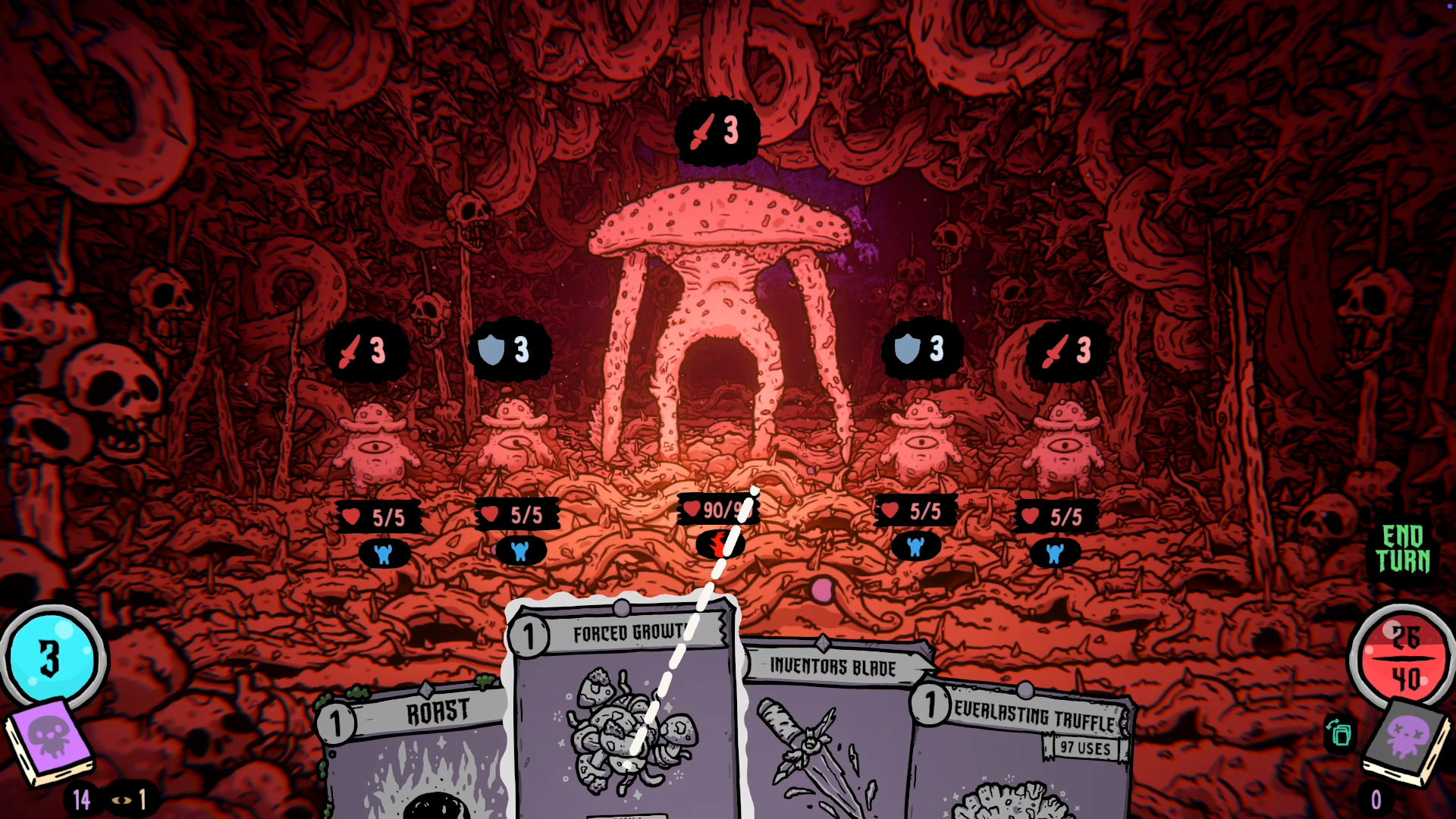
Small number becomes big number. Happy neuron.
Yet Shroom and Gloom manages to avoid, at least for now, one of the genre’s most common traps: making everything unnecessarily cryptic. Synergies do require attention, certainly, and in the early games you inevitably have to learn the game’s language, but card mechanics remain generally understandable and, above all, readable. True depth comes when you stop taking any card that is gently offered. Why not, more cards don’t necessarily mean a better deck? In fact, eliminating the less interesting initial options becomes just as important as adding new ones, and building an efficient deck means learning to say no—even in front of the prospect of an apparently very interesting toy.
How do you remove cards? By licking a frog, naturally. I told you not to ask questions.
The most dangerous fungus is the one you didn’t plan for
The strategic component works mostly because Shroom and Gloom doesn’t seem particularly interested in handing us victory. The meta-progression exists, but it doesn’t follow the typical roguelite philosophy, whereby after enough attempts, stats and permanent upgrades inevitably turn even the most distracted player into a war machine. Here, you unlock cards, characters and above all, information.
The world remains progressively more readable, and the knowledge gained from previous runs allows for better planning of the next, but an exceptional build can still be dismantled by a sequence of bad decisions. And it’s a feature we’ve appreciated a lot. Shroom and Gloom wants you to think not only about the card you’re about to play, but potentially about what will happen five, ten or twenty moves later. The reward doesn’t come simply from possessing a powerful combo: it comes from having deliberately created the conditions for that combo to exist.
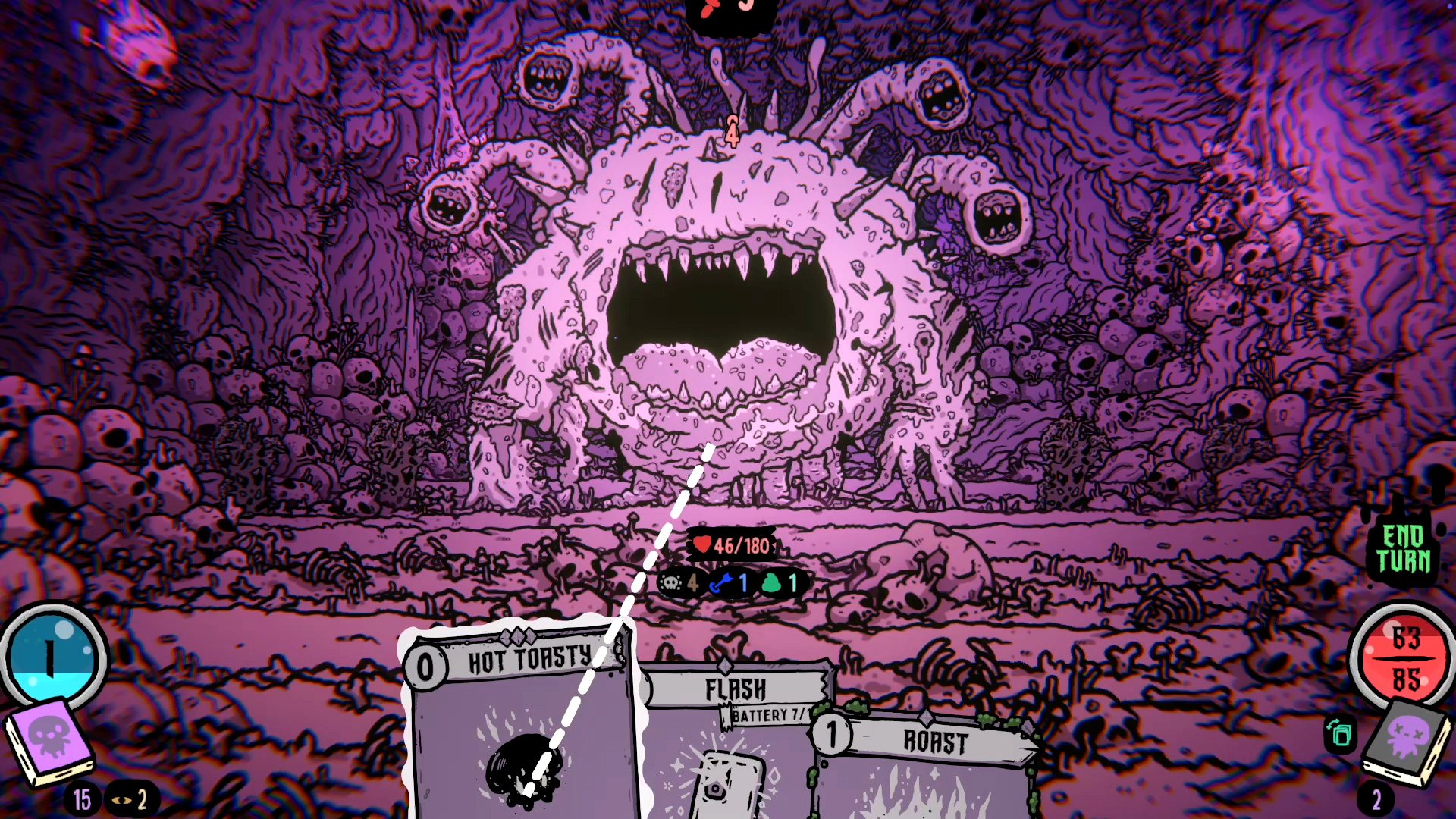
Even the characters contribute to gradually expanding this complexity. The first approach is relatively simple and ideal for learning the rules, while subsequent ones introduce increasingly specific gimmicks. The Lunch Lady, for example, builds much of its identity around food and can exploit this to progressively increase its power. The Janitor, on the other hand, plays with cards progressively stained by negative effects before cleaning them and exploiting this cycle as part of its own strategy.
They’re not just skins with a couple of different stats: they change the way a run is interpreted.
And that’s exactly what we want to see from a deckbuilder.
Don't eat that mushroom. Or perhaps you should...
Then we get to the healing system. Normally, in a card game, we’d expect blocks, shields, potions, or some other utterly mundane invention crafted by mentally stable individuals.
Shroom and Gloom prefer an alternative approach: kill the enemy. cook it. eat it. Problem solved. Several effects allow you to roast, skewer, or transform the unfortunate victims into usable food to restore health. Some even end up inside a pot to create potent soups. It’s perfectly consistent with the rest of the game. Food isn’t merely a red button labelled “heal”. It can become offensive resource, survival tool, build component, and even integral part of certain characters’ identities. Here too, that sense returns — that every system was included not only because it amused someone during a development meeting (even if we imagine it happened) but because it could meaningfully interact with everything else.
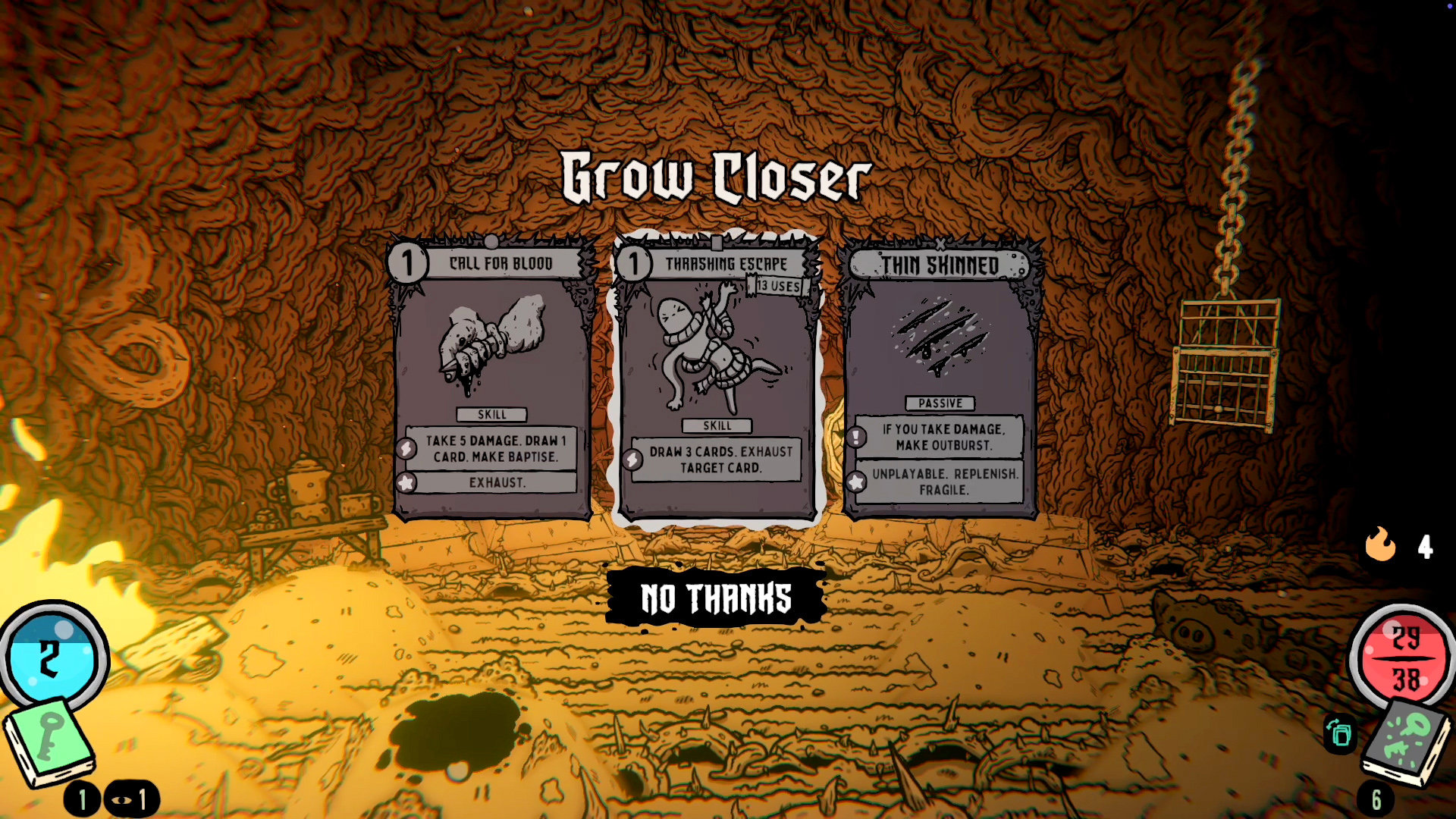
The difficulty, at least in its current state, seemed challenging but rarely unfair. When you lose, you often manage to identify the decision that began the slow descent into disaster.
Of course, this doesn't stop you from insulting the monitor. We're still human beings.
Inscryption after a bad food poisoning
And then there’s her. The art direction.
Probably ten seconds of Shroom and Gloom are enough to tell if aesthetically it might appeal to you. Hand-drawn illustrations and animations are inserted into three-dimensional environments, creating a strange contrast that seems to sit somewhere between a children’s illustrated book, Inscryption, and a 40-degree fever after eating something found under a log. It works magnificently.
Every card seems designed with its own personality, mushrooms manage to be simultaneously funny and slightly unsettling, and the environments possess that psychedelic tone capable of feeling surreal without becoming visually incomprehensible. It’s a style grubby, colourful, grotesque and instantly recognisable. Above all, it doesn’t appear to have been built simply to produce interesting screenshots on Steam.
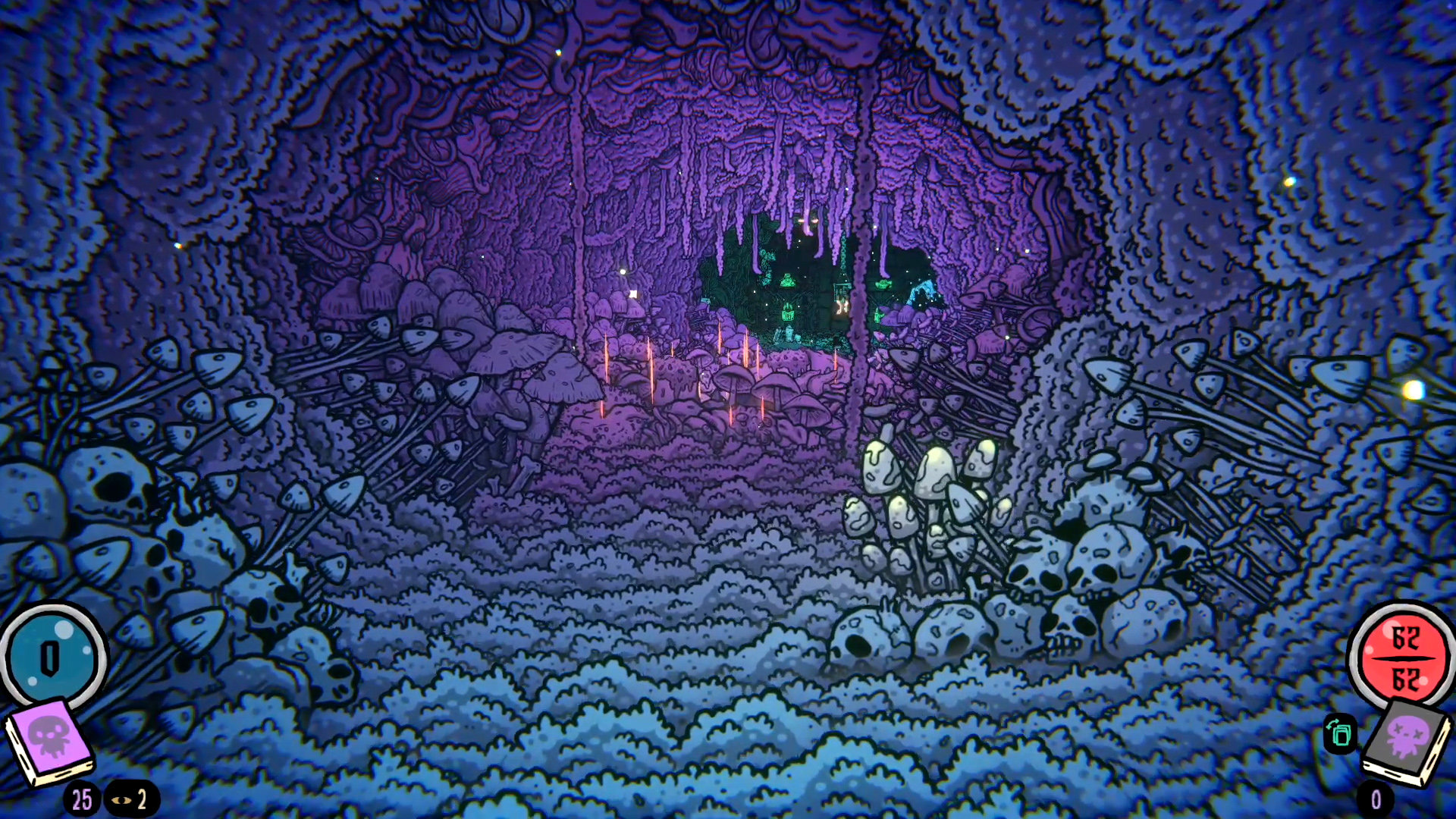
The transition between exploration and combat is natural, and the first-person perspective succeeds in giving physicality to what, structurally, remains fundamentally a card game. Truly entering rooms, seeing enemies ahead of us, and moving through corridors designed like massive illustrations makes exploration far more immersive than the classic sequence of map nodes.
And considering how difficult it is today to create the next roguelike deckbuilder without immediately seeming like the next roguelike deckbuilder, it’s no small achievement.
Technically speaking
On our system equipped with NVIDIA GeForce RTX 5080, AMD Ryzen 7 9800X3D and 32 GB of RAM DDR5, Shroom and Gloom does not clearly represent a particularly demanding benchmark, and the experience proved smooth. After all, despite the use of 3D environments, the bulk of the visual impact comes from art direction and illustrations rather than the intention to burn the GPU. More interesting, however, is the discussion around controls. Mouse and keyboard remain the best solution at the moment. Controller support exists and it’s already possible to play almost entirely this way, but the Early Access still feels present in some interactions and when consulting certain contextual information.
Curious situation also on Steam Deck. Although the title may be flagged as unsupported, in practice it’s already possible to play it decently, and, in terms of structure, Shroom and Gloom fits magnificently on a portable device.
The problem isn’t so much getting it running, but ensuring the interface and control system are completely comfortable without mouse and keyboard. And it’s probably one of the aspects on which Team Lazerbeam should prioritise during the Early Access phase, because a deckbuilder like this on Steam Deck is practically legal digital cocaine.
In conclusion
Shroom and Gloom arrives in Early Access with something that many titles manage to build only after years of updates: a clear identity. It doesn’t reinvent the roguelike deckbuilder genre, and frankly, it doesn’t need to. It takes familiar ideas, recombines them through a genuinely meaningful double deck system, and builds around card growth, exploration, and resource management a highly satisfying loop. The ability to gradually transform insignificant cards into monstrous creatures capable of fueling increasingly absurd combos works brilliantly. The double deck prevents the exploratory phase from becoming merely a walk between fights, while the culinary system is so absurd it initially seems no more than a gag — until it reveals itself as an essential part of build construction. Above all, Shroom and Gloom doesn’t forget that a good roguelike must make us feel intelligent when things work and perfectly responsible for our own deaths when they don’t. It’s precisely this sense of control, combined with the ability to plan ever more elaborate combos and interactions, that makes every run sufficiently different to justify the next one. Naturally, we’re still in Early Access. Controller support needs more work, the variety available today must continue to grow, and after many runs, some elements inevitably begin to lose part of their surprise factor. But the foundations are there — and they’re damn solid. Team Lazerbeam has managed to build one of those games where “I’ll just do another run” quickly becomes a phrase with no relation to reality. You end up, without realizing it, late at night after having licked three frogs, eaten fourteen sentient mushrooms, and spent the last ten minutes studying a card in an attempt to understand how to increase a multiplier by 600%.
Devolver Digital, once again, seems to have found exactly the kind of madness we expected Devolver Digital to publish.
About the Author