Blossom: The Seed of Life is a terraforming survival open-world game set on Marte, in which a small robot must bring life back to a dead planet. In this review of Blossom: The Seed of Life on PC we explain why the beginning might make you run away and why, after overcoming the first drill, it can become a wonderful opportunity.
Blossom: The Seed of Life, a small robot to revive Mars
We take on the role of Blossom, a small red robot tasked with bringing life back to a dead planet: raising pressure and temperature, melting the ice, growing algae, moss, grass, shrubs, and finally forests.
The game is developed by Pebbledust Games, i.e. by a single developer, İlkan Çelik, known in the community as Thorin, and is published by Pretty Soon. It launched on Steam on 9 March 2026 for around 17 euros, and can be played solo or in online co-op, and also runs on low-end PCs. Instead of food, there’s energy: Blossom needs to be recharged, and going dry is the real risk.
Behind Blossom lies a truly small project: Thorin wrote and coded everything himself, with the Polish publisher Pretty Soon handling publishing, localisation and quality control. The soundtrack is by Ascendant, licensed by Synphaera Records, and is one of the points most appreciated by players. In about five months, the game has surpassed the 35,000 players, has been verified for Steam Deck and from 31 August 2026, can be played in co-op for up to four players, thanks to the free update "Together on Mars".
We took it to the end credits in about 20-25 hours and the final feeling is that of a game that, after a truly stumbling start, can become a wonderful opportunity.
The first hours: a prologue worth redoing
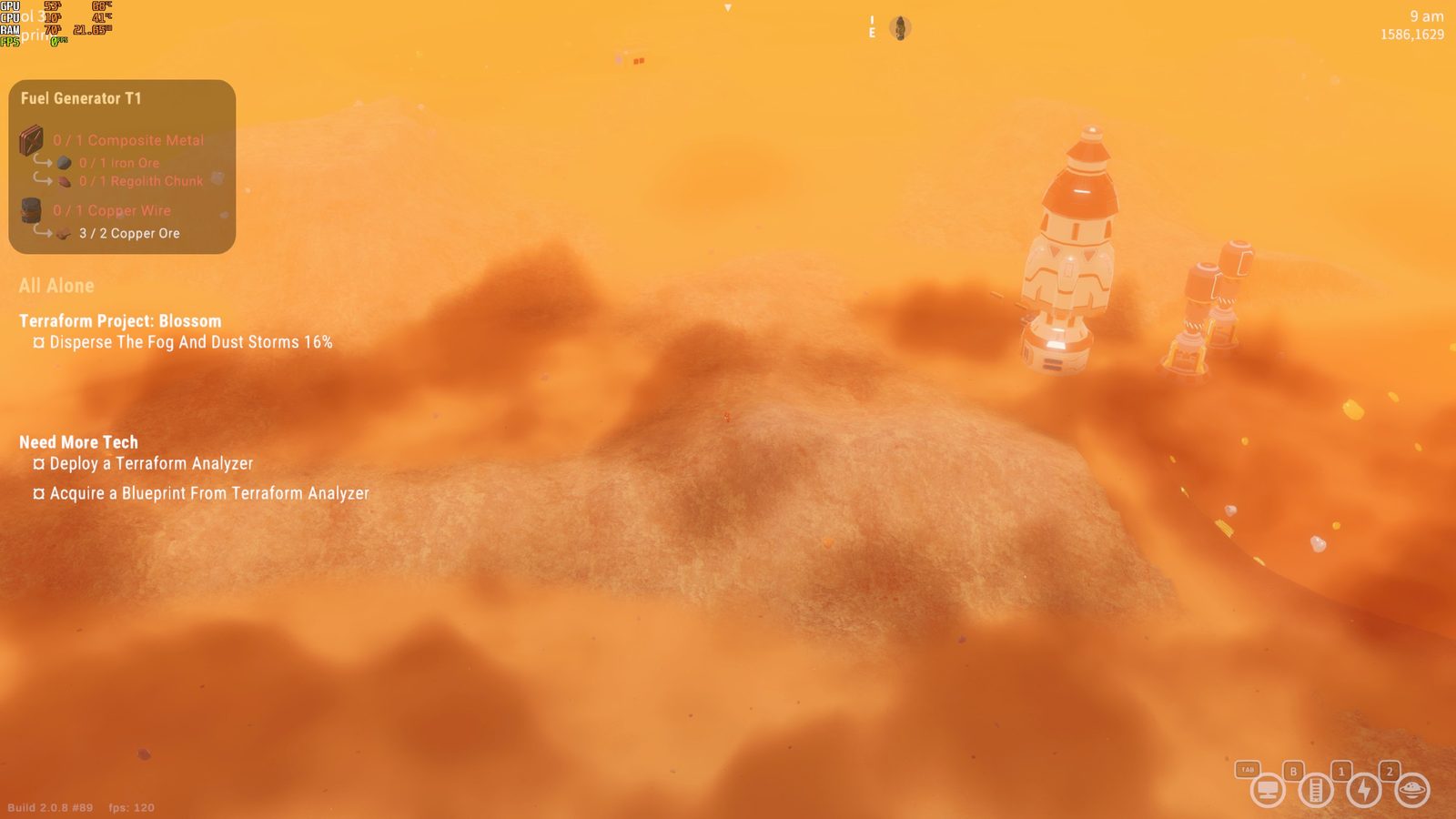
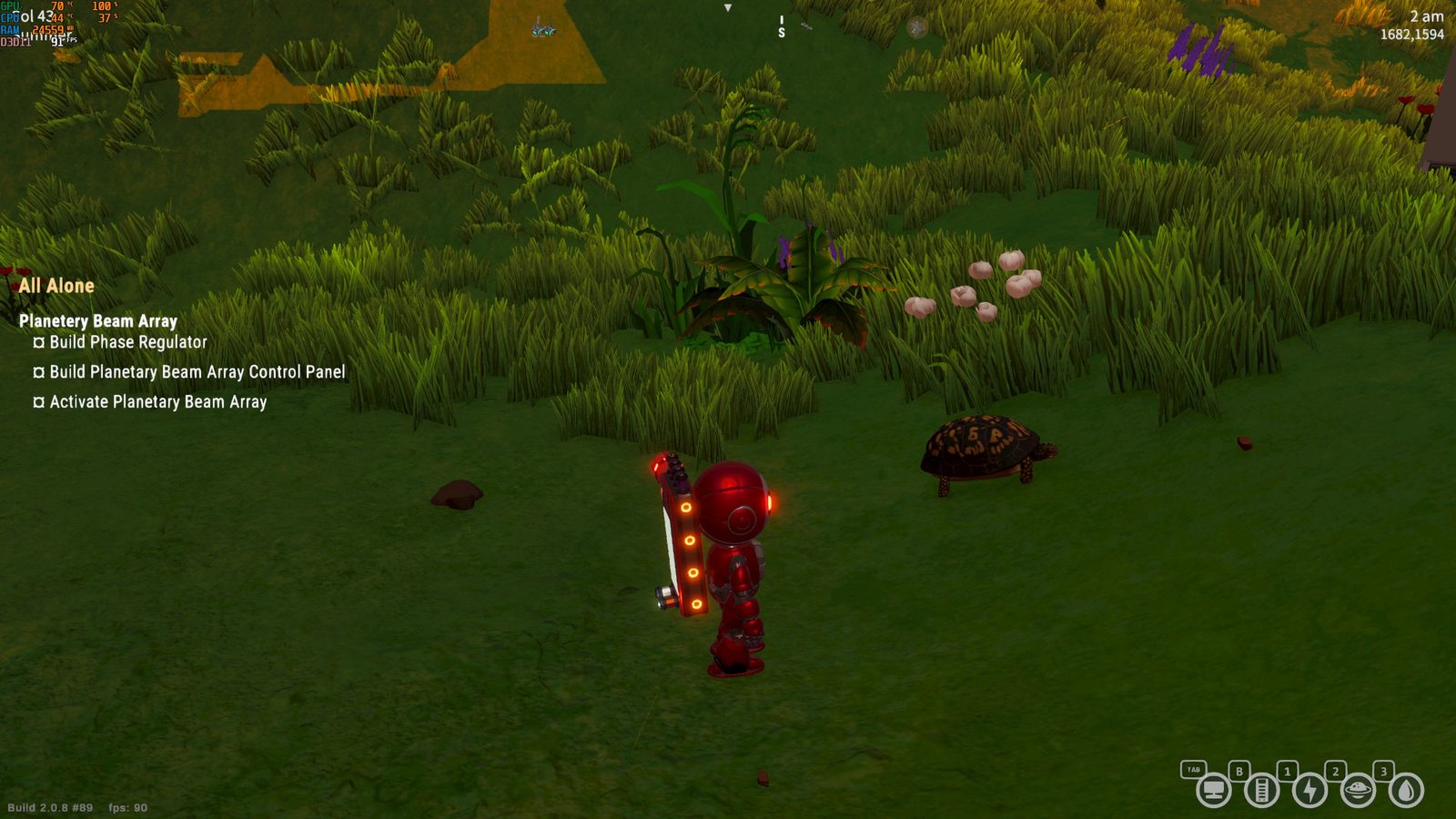
The start is the real Achilles’ heel. The player doesn’t grasp the initial dynamics or the objective: you end up on a red, dusty plain, with only a few informational cards and sparse guidance. The game seems too bare. It’s clearly a deliberate choice, but it needs to be explained and guided, otherwise the risk is that players will mistake it for a poorly developed title. Too bad, because after less than an hour, you risk losing the desire to continue.
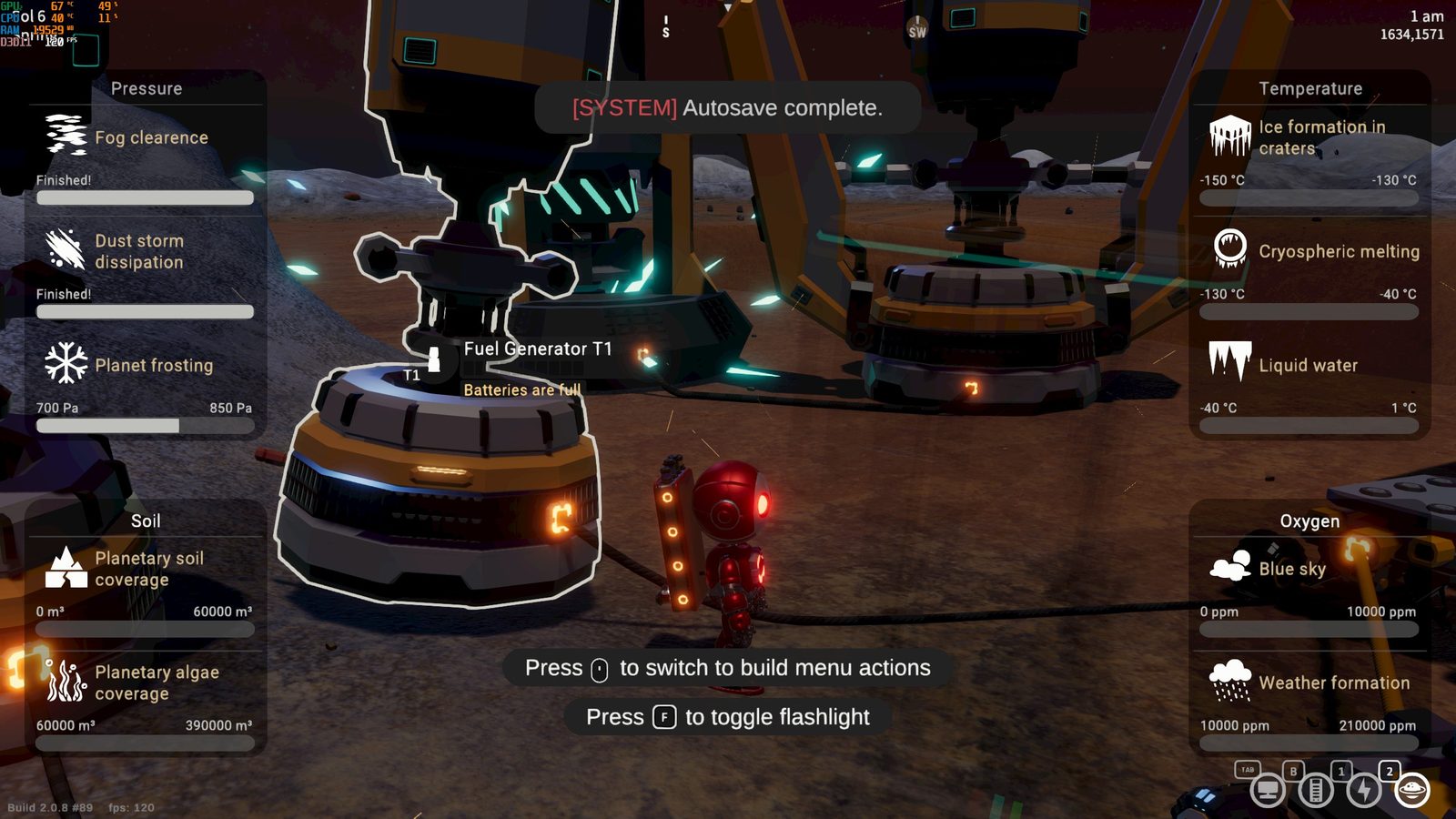
Then comes the turning point: the building of the first drill. From that moment everything changes and Blossom becomes a game to love from start to finish. The pressure rises, the fog and the dust storms thin out, unlocking new machinery becomes a virtuous cycle. The further you go, the more you understand the fantastic idea and the concept behind it.
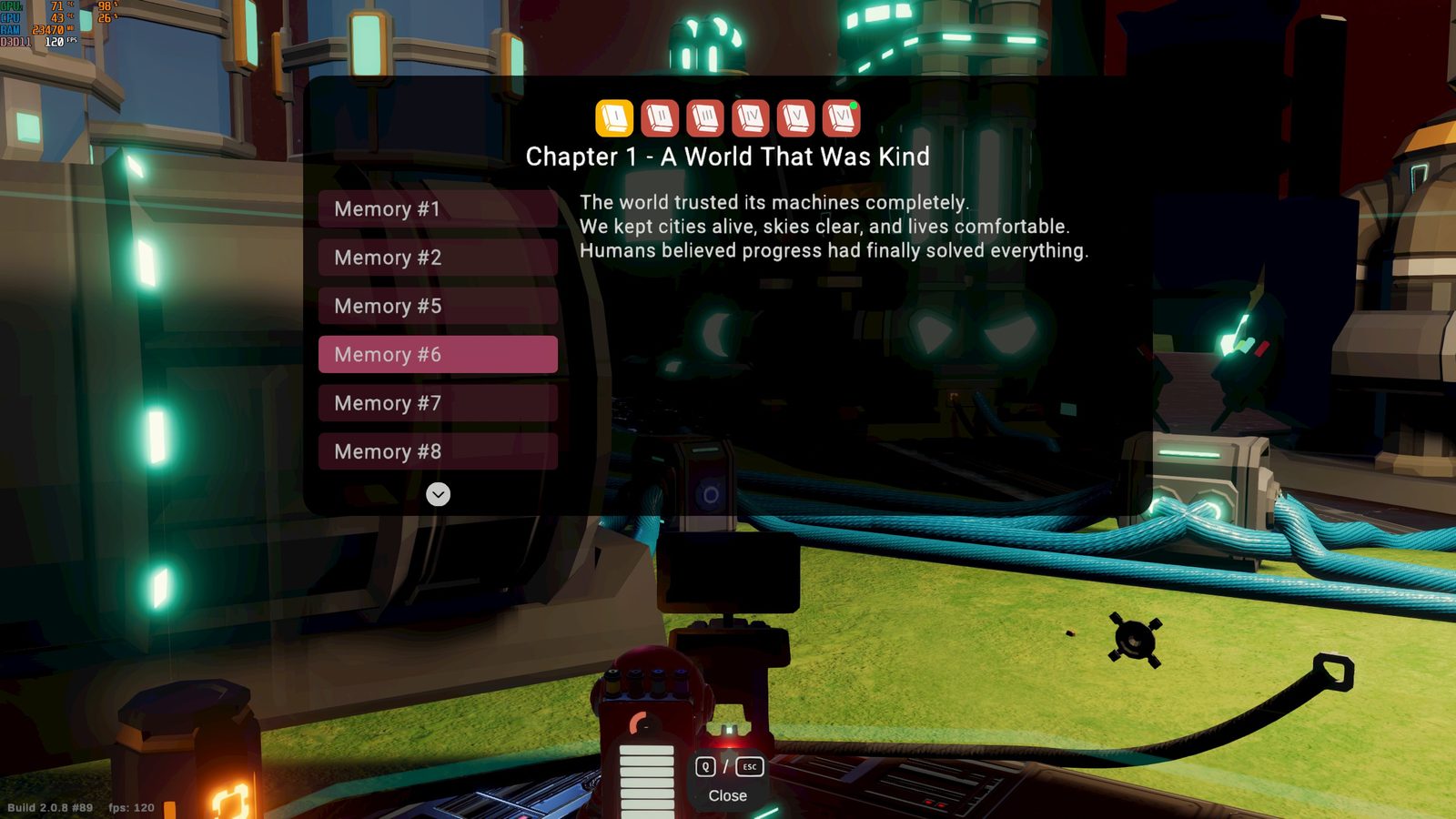
The story follows the journey without intrusion. Blossom collects 52 memory fragments divided into six chapters, from "A World That Was Kind" to "The Beginning," and gradually discovers what happened to humans and Earth. Each manual entry is written in the melancholic voice of the robot: "I can draw energy from other machines. They give me a bit of their power, and I carry it with me. Like a hope borrowed."
The chapters have titles that already say a lot: "A world that was kind", "The warning", "The fall of order", "The final plan", "The end", and "The beginning". They tell the story of a humanity that blindly trusted its machines, a scientist who looked at the sky longer than anyone else and stopped sleeping "because time was ending", and finally the desperate plan to send thousands of robots where humans could not go. "Then the sky burned", notes Blossom, who wonders if the pain she feels is a malfunction. Even death is integrated into the narrative: when Blossom runs out of power, she reawakens at the base, and the compass marks the locations where "her old bodies remain, silent signs of the errors she has survived".
The finale, without revealing anything, is touching and closes the loop with a few lines of text on a black background. A rarity in the genre: unlike many infinite survival sandbox games, Blossom has a real conclusion.
Gameplay: from rock to forest
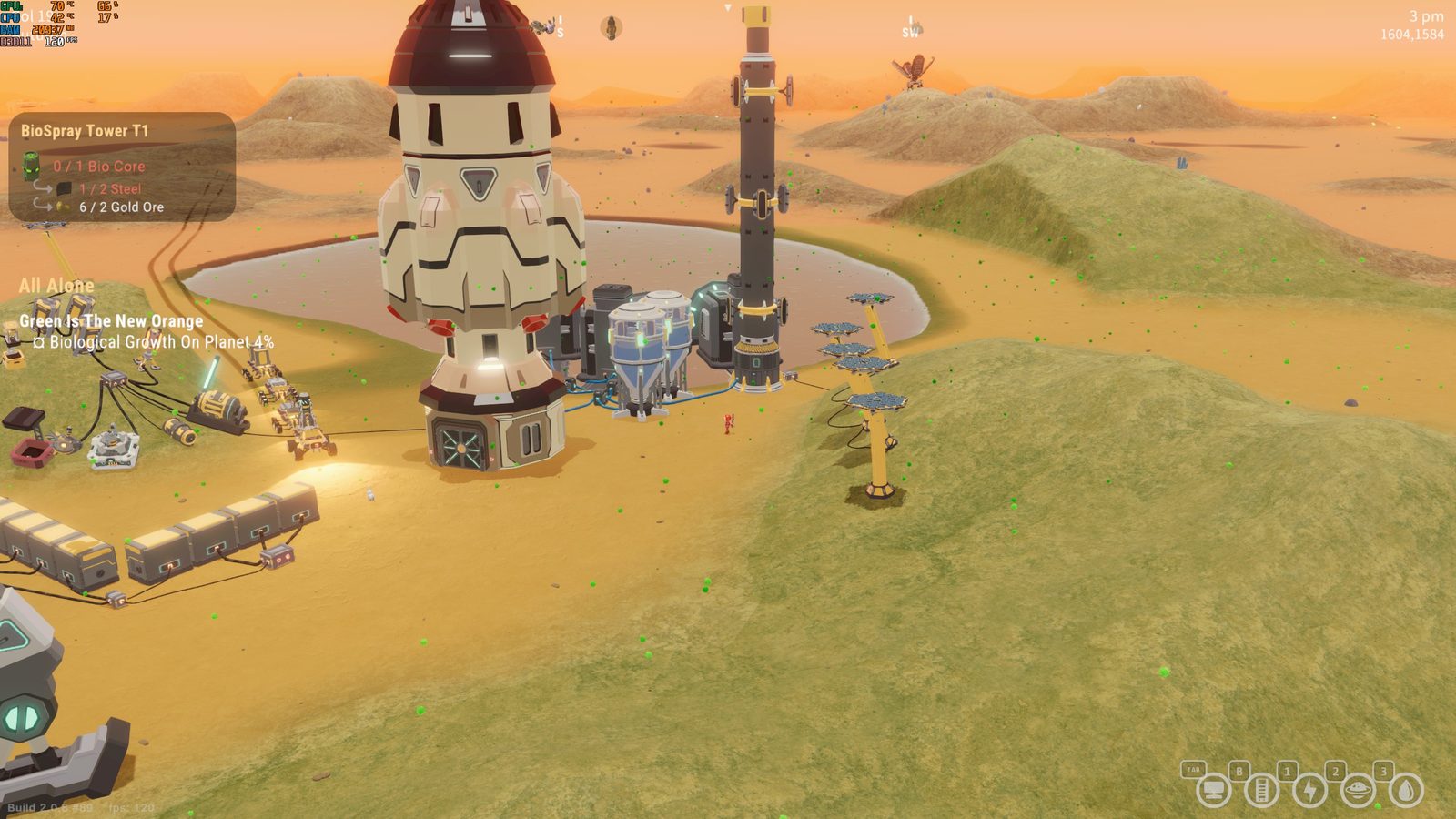
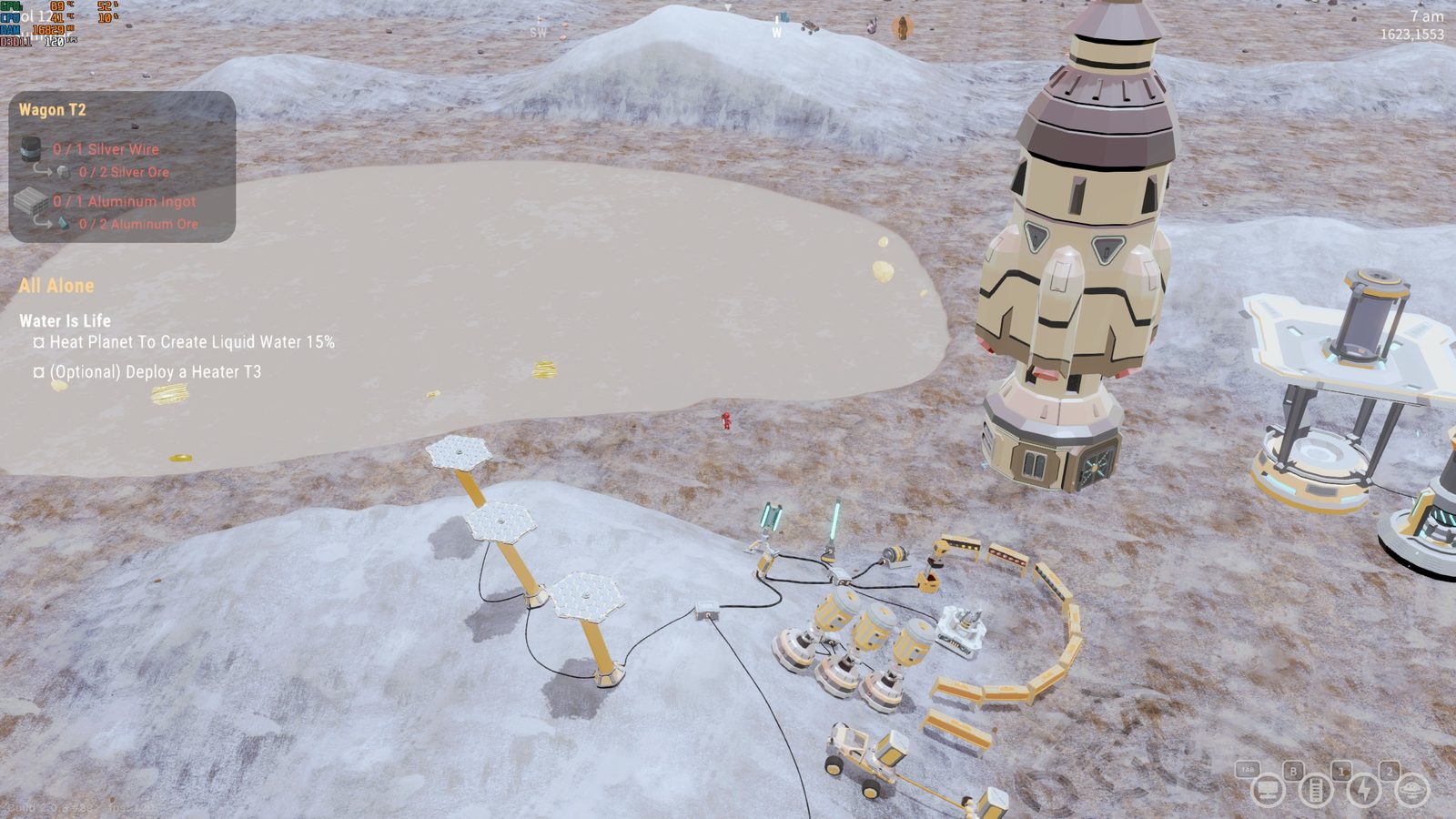
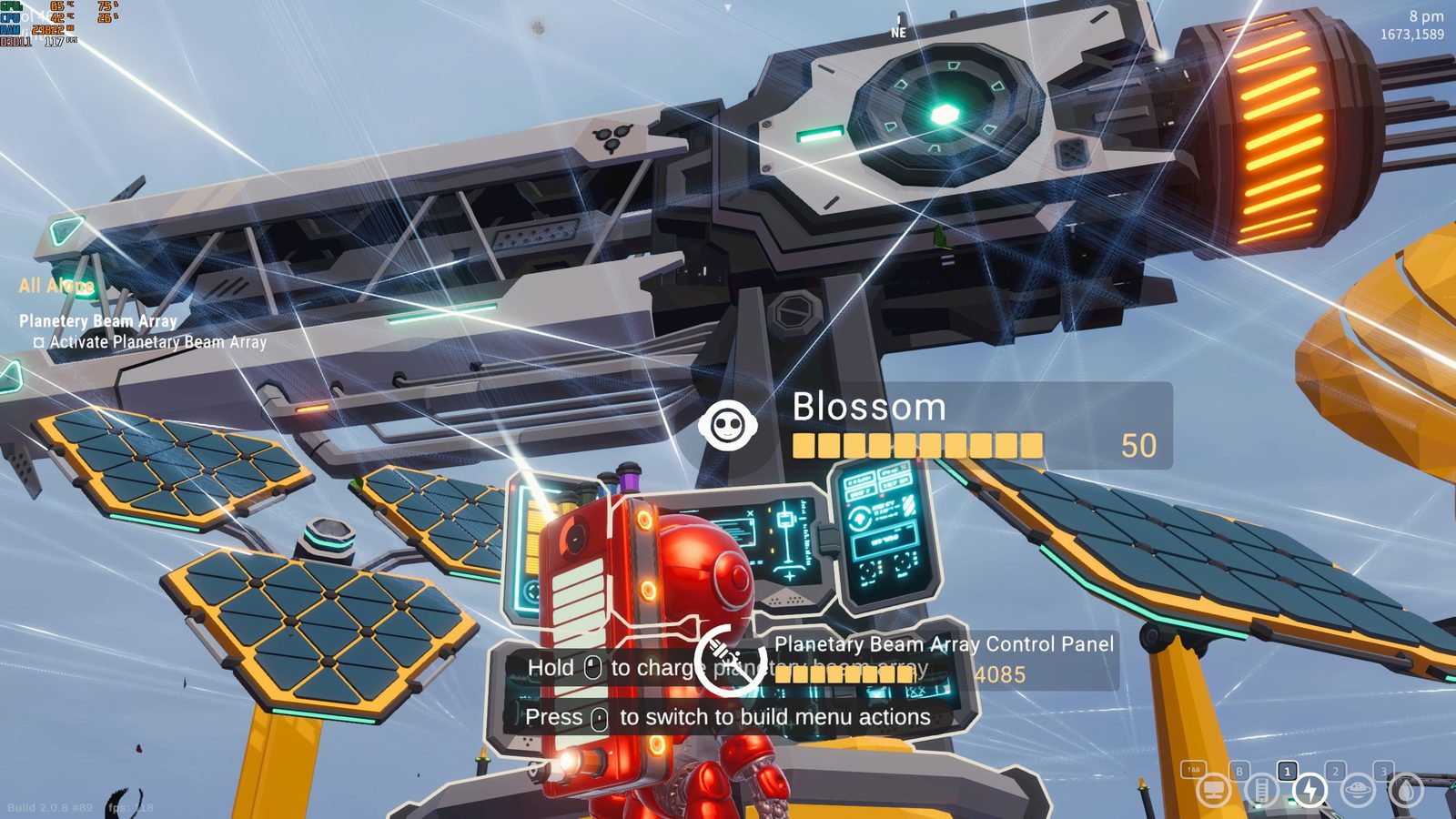
The terraformation proceeds in five phases: pressure, temperature, soil, oxygen, and life. Each phase has its own stages, measured in pascals, degrees, cubic metres of soil, and parts per million of oxygen, and each stage unlocks new machinery. You start with batteries, drills, and storage, then progress to fuel generators, solar panels, wind turbines, steam turbines, heaters, and water pumps, eventually reaching sprinklers, BioSpray Towers, Genetic Colliders, embryo incubators, and the massive Planetary Beam Array. The landscape changes before our eyes: fog thins, ice forms in craters and then melts, lakes appear, algae grow, grass emerges, flowering trees bloom, and finally, a blue sky returns.
The resources to be extracted are numerous, from iron and copper to titanium, tungsten, and uranium, and are refined into ingots. As the story progresses, the animals also appear: insects such as bees and butterflies, birds, small animals like frogs and salamanders, and finally large mammals, from deer and wolves to tigers, bears, and elephants, each with their own requirements.
The energy is the resource to keep always in mind. Walking, running, using the laser miner or activating the boost consume battery, and Blossom recharges by drawing power from the other machines. New projects are obtained from the Blueprint Disk, recovered among the wreckage and installed on the back of the printer. The backpack, however, is extremely small: it starts with just four slots and reaches eight, and it is one of the most frequent criticisms even among players on Steam.
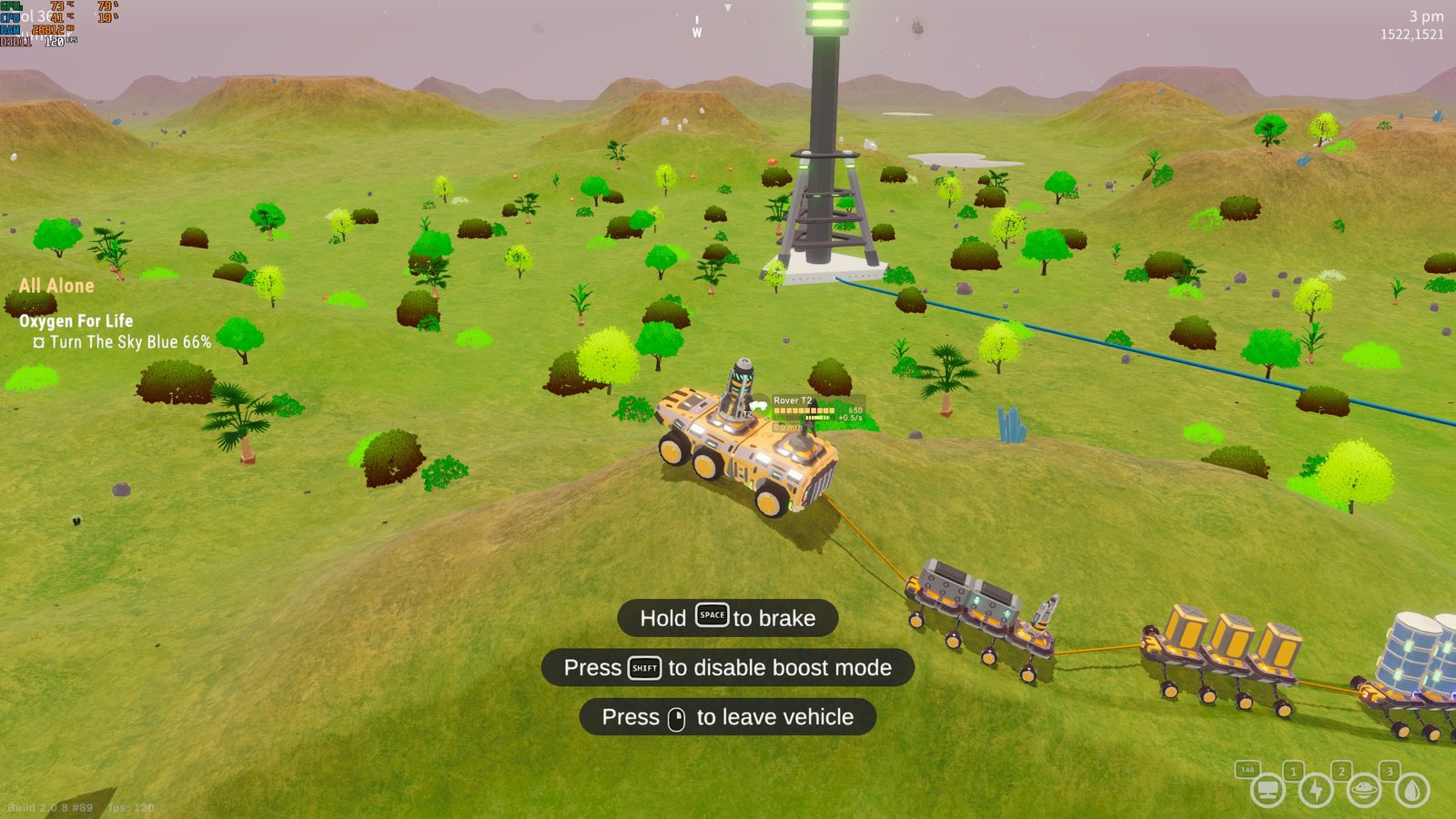
The vehicles are modular. Modules for scanning, storage, batteries, and laser mining can be mounted on the rover, while wagons for materials, water tanks, and even refining modules attach behind: a well-organized convoy can become a mobile base. With updates, the hovercraft with its call platform, wireless poles to bring power without cables, and an Automation card with crafting and automatic refining stations have arrived. Those seeking a different challenge can choose between creative mode, a lighter survival difficulty, and the toughest Brutal and Hardcore modes.
To move around, you build rovers to which you attach carriages to transport materials and water. Unfortunately, there’s no indication anywhere of how many carriages can be connected to each rover. The drones collect and store resources autonomously, but they cannot carry them directly into the backpack or the carriages. There’s also no way to upgrade a machine to a higher tier without disassembling and rebuilding it.
Halfway through the match, the pace slows almost too much with the production of oxygen: it seems as if the only thing possible is to wait. Even trees and sprinklers should be clarified: how much oxygen do they produce? Are plants, shrubs, and trees the same? As it stands, it’s unclear.
The pace, in fact, divides the community. On the Steam forum, some complain about the progression being too fast, with the planet frozen in an hour thanks to two drills, while others find it slow and repetitive. Thorin explained that the speed depends on how many machines are built and at what level, and that he prefers this system over a simple timer to wait. The point, for us, is that halfway through the game, there are no activities to fill the waiting time.
Finally, the range of the automatic storage needs to be reconsidered. Being unable to use resources beyond a certain distance, including the printer, becomes frustrating. The risk is that the player will build everything around the printer, abandoning style and order.
For a maniac of order and optimisation like me, it’s a punch in the eye.
Interface, water and energy: too grubby
The interface is the second major issue. Almost the entire system needs to be reconsidered: from the double-click to save, through interaction with cables, down to the ability to know how much power a machine consumes before plugging it into the mains. Clearer warnings would also be needed when Blossom’s energy is running low. The pin system is very useful, but it allows only one object to be attached at a time: too limiting.
Water extender e power extender are nearly impossible to manage from the build menu. Either you’re too far away and can’t interact, or too close and keep getting snagged on the wrong pipes or cables. Other reviews confirm this: it’s easy to select the wrong object, and the same button that connects pipes destroys them. The water switch, meanwhile, is practically unusable, as it only interacts with inlet and outlet connectors.
The water in the tanks should follow the principle of communicating vessels, yet it remains trapped. If you remove a tank, the water disappears with it and cannot be transferred to another. It would be useful to be able to link the tanks within the wagons, with a single outlet, as already happens with the current.
Most notably missing is a general control panel for electricity and water, which would allow users to quickly understand consumption and production, as seen in Factorio, Satisfactory or Astroneer. Planet and energy overlays help, but they’re not enough.
Finally, I still don’t understand what advantage modular construction and living units offer, as they resemble those from Subnautica but don’t seem to have a clear purpose.
Bug, graphics and optimisation
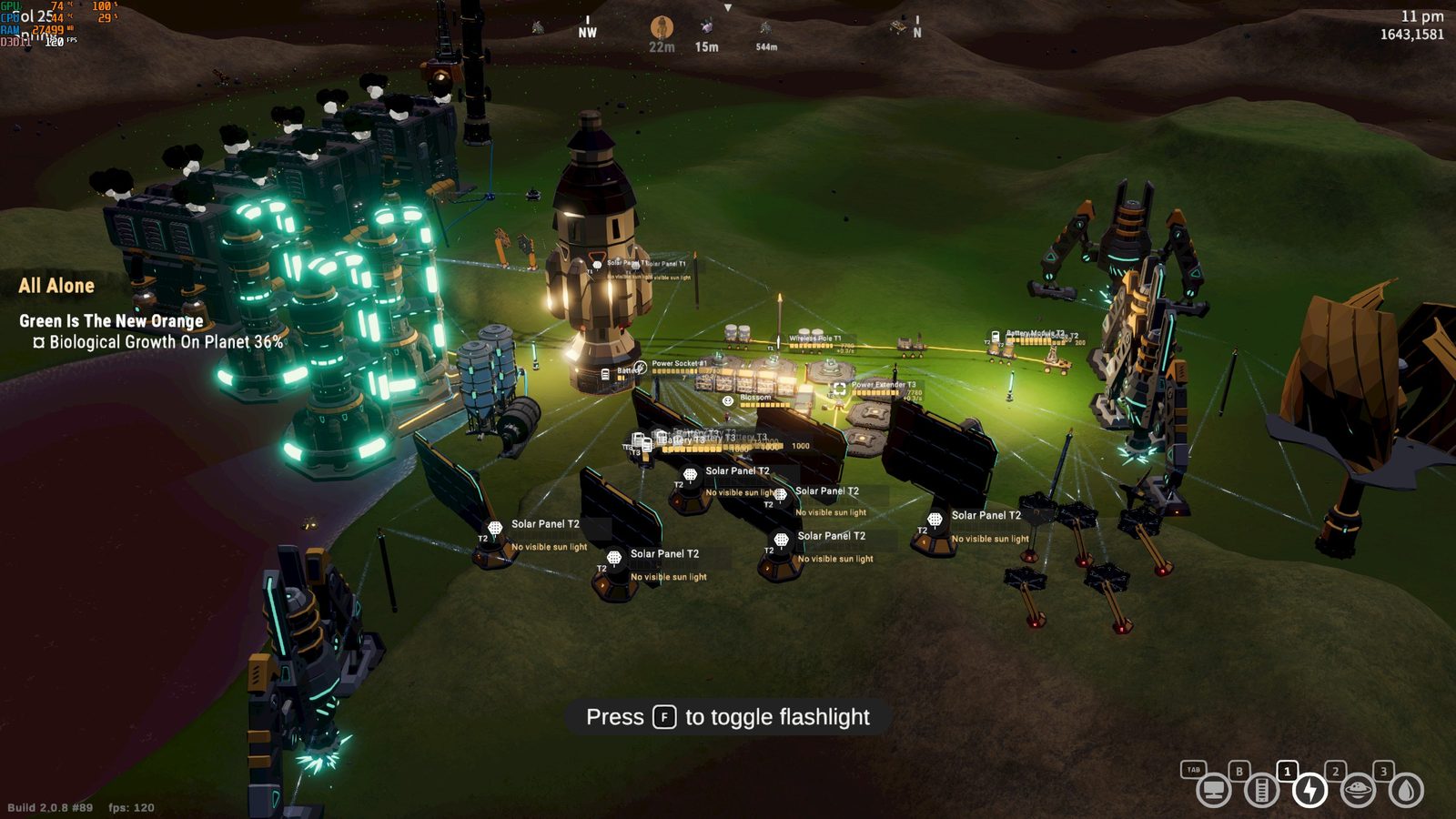
The visual style is simple, colourful and clean, and the sight of the planet coming back to life, with flowering trees and lakes, delivers great satisfaction. Yet visual glitches and object penetration do occur, especially when objects are close to each other. It’s worth noting, however, the automatic repositioning that activates in these situations. The jump needs to be completely reworked: gravity isn’t calibrated to make it genuinely useful. Finally, the animal animations are truly poor.
The space stations are the most delicate point. They are dark and poorly lit, and even after bringing in the power, it would be logical to re-activate at least the lighting. On the second mission, the one in which you must "transfer water to the station," several players got stuck: the final door won’t open even after inserting the six seeds into the sprinkler. Additional clarity is also needed regarding the opening of those doors that allow us to collect various seeds.
On the performance front, the game starts very well, with fixed 120 FPS. After the release of the final birds and then the land animals, it steadily dropped to around 42 FPS. Occasionally, things stabilized again, but towards the end, with so many animals and plants, the FPS were truly scarce. Optimization for very crowded worlds needs improvement.
PC system requirements for Blossom: The Seed of Life
| Minimum requirements | Recommended requirements | |
|---|---|---|
| Operating system | Windows 10 64 bit | Windows 11 64 bit |
| Processor | Dual core 2 GHz | Dual core 3 GHz |
| Memory | 4 GB RAM | 8 GB RAM |
| Video card | 2 GB VRAM | 4 GB VRAM |
| DirectX | 11 | 11 |
| Space | 3 GB | 4 GB |
A note for Italian readers: Blossom: The Seed of Life is not in Italian, neither in the interface nor in the subtitles. The game contains little text, but the manual pages and memory fragments are in English.
Updates and co-op for Blossom: "Together on Mars"
One of Thorin’s greatest merits is its consistency: since launch, dozens of patches have arrived, often more than one per day in the first weeks, and many directly address the issues we’ve encountered. The positioning grid, for example, has partially resolved the chaos of free building, and the “Unstuck” option saves Blossom and vehicles when they become stuck.
| Date | Update | Main updates |
|---|---|---|
| 31 Aug 2026 | Together on Mars | Free online co-op for up to 4 players, compatible with existing saves |
| 18-19 May 2026 | 1.4.0 and 1.4.1 | Positioning grid, terrain flattening mode, platform to summon the hovercraft, adjustable stick dead zone |
| May 2026 | 1.3.x | Automation card with automatic crafting and refining stations, Power and Water Switch, wireless poles, Wagon T3, Brutal and Hardcore modes, casual biomes after the oxygen phase |
| 13 Mar 2026 | 1.1.0 | Recycler, solar panels and connectable turbines, revised storage and drones, compass for the Seed of Life |
| 11-12 Mar 2026 | 1.0.11-1.0.13 | Unstuck option, adjustable grass density, disassembled machine parts that return to the backpack |
| 9 Mar 2026 | Launch and first hotfix | Available on Steam and fixes for storage, refineries, and corrupted saves |
The co-op deserves its own discussion. A save and the "Open Co-op" option in the pause menu are enough to open your world to three friends, without restarting. Terraforming, bases, automation, energy and water networks, story, and recipes are shared, while each player has their own backpack and can personalise their suit with 18 colours. In Hardcore mode, if one player dies, the match ends for everyone and the save is deleted. Thorin called this update "the biggest and most demanding" of the game: he spent about five months working on it, and tested it with his wife, who, in the meantime, built her own outpost in another region of Mars.
What do critics and the community say?
On Steam, Blossom is "Very positive", with an 87% positive rating from over a thousand reviews. In the past 30 days, the rating has dropped to "Overwhelmingly positive" (73%). The press agrees with us: the game's core is compelling, but its interface and controls need fixing.
| Publication | Rating | In summary |
|---|---|---|
| Gaming.net | 8/10 | Flexible and full of secrets terraforming, light survival and satisfying progression |
| Output Lag | 8/10 | Visible changes in real time and a relaxing survival experience, but a confusing interface and poorly explained systems |
| Impulse Gamer | 3.6/5 | Relaxing and full of personality, but tubular controls and camera frustrating |
| The Gaming Outsider | 6/10 | A 'Satisfactory in compact format, with a touch of solitude': tiny backpack and disordered construction |
| Smashpad | Promoted | A relaxing game with a real ending, but slow final stages and drops to 30-40 FPS with dense vegetation |
Among players, the most frequent comparisons are with Astroneer and The Planet Crafter: Blossom is seen as more simple and immediate, with faster terraforming. Praise goes mostly to the relaxing atmosphere, the music, and the value-for-money ratio, as well as a very active developer on Discord. Criticisms, however, largely align with ours: bugs, too-small backpack, performance drops, a camera that doesn’t rotate and can be annoying, unintuitive vehicles to drive, and the lack of an initial tutorial. Many requested co-op, and were satisfied.
Blossom: The Seed of Life worth it? Our verdict
Blossom: The Seed of Life is a game worth waiting for. The first hour risks driving many players away, as the interface, water and energy management, and optimization still have quite a few rough edges. But after the first drill, the concept reveals its full strength: watching a red, dead planet transform, step by step, into a green world teeming with life is a rare satisfaction. It can truly become a marvelous drug.
Who do we recommend it to? To those who loved The Planet Crafter or Astroneer and are looking for something more compact and relaxing, with a story and a real ending. To those who want to share terraforming with friends, now that co-op is available and free. And to those with a non-powerful PC or a Steam Deck. Better wait, however, if you’re after the logistical depth of Factorio or Satisfactory, or if you can’t tolerate underdeveloped interfaces.
With the credits, you can also sense the “family-run” nature of the project: a developer, a tester with the same surname in quality control, thanks to the wife, and a dedication to the daughter. It’s a very pleasant thing. The game ends in about 20-25 hours, at a price around 17 euros.
The overall verdict is certainly positive. Beautiful, beautiful: with a new intro and a redesigned interface, it could become a small genre classic to be fondly remembered for years.