I’m the classic player who, facing a list of tasks in a management system, slips into an agonistic trance. The first chapter had built much of its own allure around this managerial madness: an apparently infinite chain of activities, where one thing led to another, which led to yet another, until the original reason we’d started the game had become merely a distant memory. Graveyard Keeper 2 picks up exactly from this philosophy and decides, for better or for worse, that the solution was to add even more things to manage. Lazy Bear Games doesn’t merely reprise the old graveyard with a few extra graves. The sequel expands farming, automation, progression, city management, and even combat, gradually evolving into a sort of medieval Factorio for people who find it perfectly normal to use reanimated corpses as labour. The result is a bigger, prettier, and in several respects improved game than its predecessor — but also one that seems to have developed a certain allergy to simplicity.
"It'll be the usual more of the same sold at full price", I told myself, firm in my prejudices, I wouldn't fall for it... and yet. This game is literally digital crack, designed with surgical precision to snare every single molecule of dopamine from our nucleus accumbens (apologies, professional deformation ndr.). But beware, because the detox will be painfully painful.
This content is provided by YouTube. To view it, you must allow external content. Activation may result in data being shared with the third party.
There once was a skull named Larry
The beginning immediately clarifies that Graveyard Keeper 2 has not lost the particular sense of humour of the series. We awaken in a dungeon without knowing exactly how we got there, are informed by a fairy that it’s time to save the world, and shortly after, we retrieve a talking skull from a stone coffin that suspiciously resembles the old Gerry.
But now he’s called Larry.
And yet, apparently, we’re not even the same scavenger from the first game, despite seeming to be him and retaining enough familiar memories to make the whole situation even more absurd. In short, normal administration. Fortunately, you don’t need to have completed the predecessor to follow the new story. References are provided, and those already familiar with this universe can read certain situations with different eyes, but the game offers enough context to allow even a newcomer to quickly grasp their role in the world: take over the Inquisitor’s lands, manage the cemetery, contribute to rebuilding the city, and possibly avoid a zombie apocalypse destroying the local real estate market permanently.

A guiding us remains that particular dark humour, deliberately stupid and often grotesque, which had characterised the first episode. Cannibalism, corpses, zombies and terrible moral choices are treated with the lightness of a conversation at a bar, and not all the jokes necessarily work in the same way, but the identity remains intact. Perhaps something of the narrative chaos guaranteed by Donkey in the first episode is missing, but characters, writing and above all the unexpected full voice acting manage to give the sequel far more character than one would expect from a management tool that allows you to calmly discuss the industrial use of the dead.
Another one and then I stop
The real problem with Graveyard Keeper 2 is that stopping isn’t that simple. The structure continues to be built on an almost irresponsible amount of interconnected systems. We fix the cemetery because we need a specific resource, but to obtain that resource we must upgrade a station, so we need materials, which require a technology, which requires experience in another discipline, which might require a completely different activity. By this point, two hours have passed and the gravestone we wanted to fix is still broken.
Few things manage to recapture the same satisfaction of watching a series of initially disordered processes slowly transform into an efficient machine. Every small improvement seems to have a consequence on something else, and practically any activity produces some form of progression, creating that dangerously addictive “I’ll just do this last thing” effect that inevitably ends up devouring entire evenings. The sequel also improves several aspects that were annoying in the first chapter. Technological trees are more interconnected, making it harder to ignore entire progression sectors, while the separation between perks and technologies and the introduction of Inspiration pushes players to experiment with different activities rather than rushing vertically down a single branch until every available node has been exhausted.

Even agriculture assumes a greater weight, and corpse management feels less suffocating than in the past. Anyone who remembers organizing their days literally around delivering a body and the constant need to grow carrots will likely appreciate that some of the old rigidity has been softened. These are small changes, but together they make daily life much more pleasant.
At least until Graveyard Keeper 2 decides we’re having too much fun.
Everything everywhere all at once
The sequel has a major problem: it loves to put gates in front of progression. One of the main culprits is Fede, a resource already valuable in the first game and now used practically as if it were the official credit card of the Middle Ages. It’s needed for research, to activate certain fast travel points, and to buy personal progression. And to get more Fede, we naturally have to hold sermons, which in turn depend on the city’s gratitude — which my father bought at the market...
The idea of forcing the player to interact with multiple activities is not wrong. In fact, the new skill system specifically avoids allowing players to ignore half the game by focusing solely on the most efficient path. The problem arises when the same rare resource becomes necessary simultaneously for too many progression components, forcing players to delay activities not because materials or abilities are missing, but simply because we must wait for another weekly window.

A particularly emblematic example concerns personal skills. To use advanced technologies, we must meet requirements distributed across different trees, and after completing the initial free progression, further levels may require Faith as the unlock currency. This means that even fundamental activities, such as working with more advanced materials, can remain locked behind a system that doesn’t always convey the feeling of doing something interesting.
Even the fast travel can feel unnecessarily fiddly. Fast travel points must first be unlocked and can only be used by physically reaching one, rather than allowing us to teleport directly from the map. Taken alone, it’s not a devastating issue, but it adds to a series of minor annoyances that, in a title already built around dozens of repeated activities, end up weighing down the experience.
The work as civil... and biological death
The automation is probably the update that most significantly alters the pace of the adventure. Moving forward, Graveyard Keeper 2 increasingly takes on the structure of a Factorio-lite, inviting us to turn zombies into a workforce capable of powering our production lines while we focus on more important matters. Theoretically, this is precisely what such a game needed, in practice...
Zombies require adequate skills to operate different stations, and the game isn’t always particularly good at explaining how the system works. You end up receiving new workers, placing them proudly near a station, only to discover that our long-dead employee still lacks the professional qualifications necessary to cut a board.
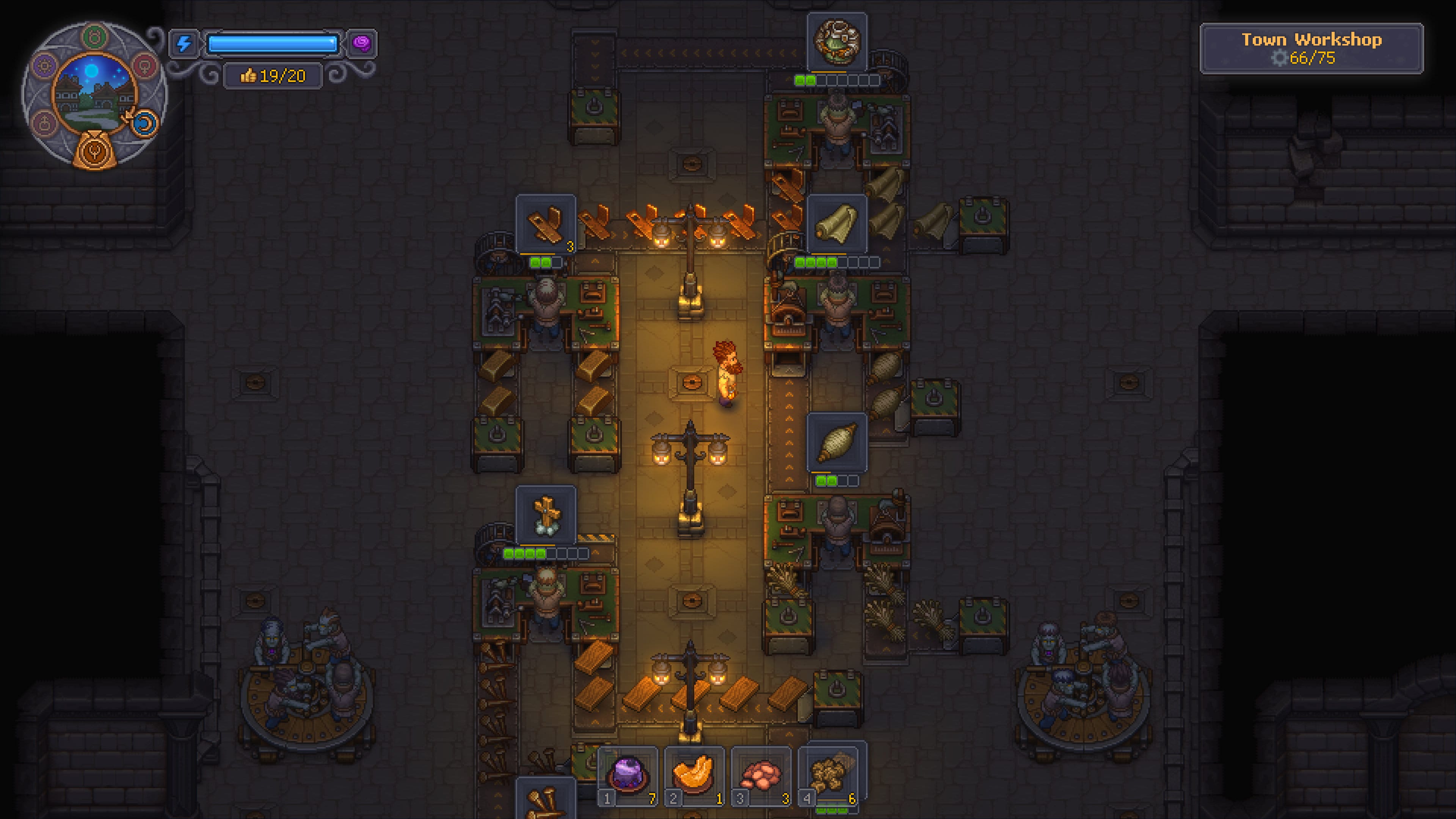
Reminds you very much of the current world of work, nèvvero?
The presence of so many systems running simultaneously is not helped by tutorials that often merely introduce a concept without delving into it sufficiently. Population values, lab functions, zombie progression, civic gratitude, and varying resource levels are presented very quickly, but there’s no true compendium that organises what we’ve learned in a coherent way. It gives rise to one of the game’s most evident contradictions: Graveyard Keeper 2 wants us to automate everything, but doesn’t always give us the tools to understand immediately how to do it.
Our little Isengard
Zombies are not only used as labour: this time we can also arm them and deploy them against the hordes threatening the city, introducing a strategic component that adds further variety to a structure that already hardly seems to lack things to do. At some point, watching our undead emerge from production lines to be equipped and sent into battle, it’s hard not to feel for a moment like Saruman standing over Isengard, gazing upon his own army. Of course, the Uruk-hai probably had a better organised human resources department.
The combat doesn’t suddenly transform Graveyard Keeper into a musou: the fights generally turn out to be quite simple, and the game gives you all the time needed to prepare, gather resources, and assemble a force strong enough to overcome battles without too much trouble. The real enemy, in this case too, is not the horde facing us, but the logistics required to face it.

Our zombies are in fact simultaneously workers and soldiers, so assembling our small Isengard army often means temporarily dismantling the production chains we spent a considerable amount of time organizing. Once the battle is over, one must remember who was working where, what equipment they had, and what their previous role was. And since we can’t simply rename employees “Mario - Stonebreaker” or “Giuseppe - The Best Carpenter”, one risks wasting precious time getting each back to their assigned position (in other words, the PTSD hits the player rather than the soldiers).
It’s a problem that quite well represents Graveyard Keeper 2 as a whole: it starts from a good idea, implements it fairly effectively, and then, almost incapable of staying put, builds a couple of additional steps on top that end up making everything unnecessarily mechanical.
I don't have enough problems, let's add madness
As if managing a cemetery, rebuilding a city, farming fields, organizing zombie labour, upgrading skills, and running a theological economy weren’t enough, the sequel also introduces the Insanity. Certain events, injuries, and activities such as autopsies can increase it, gradually reducing the maximum available stamina. Food and rest can help contain it, but particularly high values require more careful management.
Taken individually, it’s a sensible system, coherent with the atmosphere and potentially interesting. The problem is always the same: it arrives in a game that already has a huge amount of variables to control.
At a certain point, Graveyard Keeper 2 seems almost afraid that the player might spend five minutes without monitoring something. Energy, Faith, gratitude, skills, technologies, zombies, production, cemetery, crops, resources... madness is, in fact, around the corner. The depth is one of its greatest strengths and at the same time the source of nearly all its problems.
You therefore need to learn quickly one thing: don’t rush. Many technologies and activities are still tied to the narrative progression; there are no real timers forcing you to complete everything immediately. Trying to optimise every single system from the very first hours is probably the fastest way to turn an extremely engaging game into an unpaid side job.

Technically speaking
On the presentation front, the step forward compared to the original is evident. Animations, sound design, and overall production quality appear more refined, but it is chiefly the small details that sell the idea of a world built with care. The wheel of days that changes indications based on available activities, the visible fish in the water, the characters’ outfits, and a seemingly insignificant number of small elements all contribute to bringing to life an environment that, despite the sheer quantity of systems present, retains a strong personality.
Particularly successful is also the voice acting, which adds considerable character to lines already deliberately over-the-top.
Not everything is perfect when it comes to the interface and quality of life. Clothes take up space in the inventory, some linked stations have a range of action that’s far too limited, buildings already placed aren’t always manageable with the freedom we’d like, and even seemingly insignificant activities can feel less convenient than their predecessor. Crafting also presents a few curious choices. Some productive recipes require more manual attention, paradoxically reducing comfort precisely in a section that makes automation one of its core features.
In conclusion
Graveyard Keeper 2 is simultaneously an excellent sequel and a perfect example of how greater depth doesn’t automatically mean more fun. Lazy Bear Games improves several aspects of the original, significantly expands agriculture and management, makes technological progression more engaging, introduces a much more important automation system, and wraps it all in a more refined production, with entertaining characters and that dark sense of humour that continues to distinguish the series from any other pseudo-medieval management game. There’s always something to improve, a production to optimise, a building to complete, or a technology close enough to convince us to delay the game’s release once again.
The problem is that Graveyard Keeper 2 rarely knows when to stop. Some progression gates seem to exist more to slow things down than to enrich the experience, automation comes with a surprising amount of micro-management, and tutorials often can’t keep up with the mountain of mechanics the game keeps throwing at us. Even the introduction of combat and zombie military management adds variety, but simultaneously interferes with those production chains we spent hours organising.
Yet it’s hard to quit.
Why perhaps we’re just short of the technology we need. Then we must collect a bit of Faith. While we’re at it, we could fix the axis production. At this point, it might as well be time to improve the oven. But we need more zombies, and since there’s a sermon tomorrow, we could wait another day.
Then we look at the clock.
Four hours have passed.
The gravestone we were supposed to fix at the start of the session is still broken.