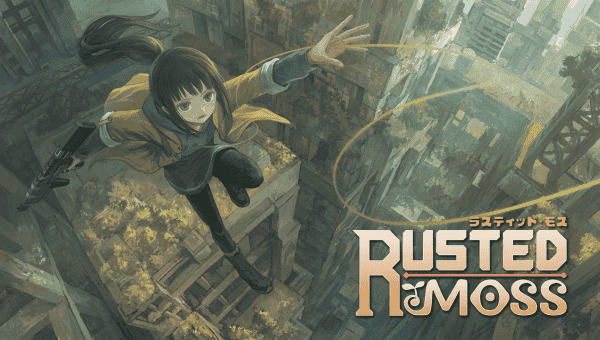
Rusted Moss is a metroidvania twin-stick shooter in 2D conceived by three friends, Faxdoc, Happysquared e Sunnydaze, and published by the oldest Japanese indie publisher, PLAYISM. In the now vast landscape of metroidvania games that have flooded the market — especially the independent scene — Rusted Moss stands out not only for its extremely polished 2D graphics and highly inspired setting, but also and above all for the use of a mechanic, if not revolutionary, truly original for the genre: the rampino that follows the laws of elastic physics. It’s not a conventional rampino at all, but rather a kind of bungee cord that completely redefines the very concept of metroidvania, now cemented in time, amplifying the importance of movement and offering the player countless opportunities to experiment — and, unfortunately, also sources of frustration.
This content is provided by YouTube. To view it, you must allow external content. Activation may result in data being shared with the third party.
Rusty brush
The narrative aspect features a non-linear storytelling style primarily based on dialogue that unfolds when interacting with various NPCs during exploration of the expansive game map. Additional lore fragments are also present, discoverable by locating and activating hidden terminals scattered throughout the map. A narrative approach that, on one hand, proves captivating and encourages players to continue seeking more information, on the other risks over-fragmenting the narrative for some, as it often requires exploring lengthy map sections to unlock the next narrative clue. The same terminals could easily remain undiscovered, concealed in secret rooms difficult to access, depriving less frequent explorers of key elements that contribute to the game’s story and lore.
We find ourselves in a post-apocalyptic world where two peoples are in constant war: the Humans and the Fates, the Little People. The humans have managed to extend the Age of Man beyond its natural limits, keeping the Fates at bay thanks to their powerful iron-infused weapons. The metallic world the humans have built is now in full decline; rust weakens the infernal machines born from human madness, and the Fates are ready to strike back. The last defence of the human people consists of witches wielding stolen magical power, to fight the Fates on equal terms. Yet every age is destined to end, and the humans have cradled within their womb the one who would bring them to surrender.

Fern is a changeling, of fae origin but raised by humans. Accompanied by a mysterious dark spirit named Puck, Fern is determined to bite back the hand that fed her, end the human threat from within, and allow her people to repopulate the ruins of this world. And we... well, we’re here to help her do it.
Swing and shoot
By now, I must apologise to you, readers, because I’ve lied to you. And I’ll tell you more: I’ve also been fooled myself. At the first launch of Rusted Moss, aware that I was facing a twin-stick shooter, I prepared myself with the controller in hand, only to find myself facing a screen that advised me to play using mouse and keyboard.
Total shock.
Addentrandomi però nel gameplay diventa subito chiaro il perchè di questo consiglio (che a mio parere è più un obligation): playing Rusted Moss requires an extreme level of precision, not so much in combat, but during exploration with the grappling hook, a precision that is certainly not achievable with a controller stick. "And then why call it a twin-stick shooter?" you may ask.
...because you can shoot in all directions, not just the eight classic ones. It seems clear that there's a need to reconsider the manual for video game genre classifications.

After this pathetic prologue, we get straight to the point: is Rusted Moss difficult? I’d say above average. Do you die a lot? Like in a souls-like, more or less. Is everything frustrating? Enough, but you have no idea how much dopamine you get when you manage to overcome a particularly tough stage — or even a boss fight. Pure ecstasy. Said that, the game is still well-structured, with numerous save points scattered across the map that act as respawn points if Fern runs out of health. The backtracking is partially present and, after all, is intrinsically part of the genre to which Rusted Moss belongs, but the presence of teleportation portals mitigates the boredom of having to face stages you’ve already seen.

Although combat and movement are well fused and complementary, as every proper Metroidvania demands, in Rusted Moss I found that the second component — the more purely platforming one — was clearly dominant over the first. Learning to manage the ramp, to anticipate its behaviour and exploit it to your advantage not only in combat but also during simple exploration can make a truly enormous difference. The game’s longevity can be significantly affected by your innate or acquired skill in navigating between levels: it ranges from 10 to 20 hours, with obviously longer times for completionists and obviously shorter ones for speedrunners, who even have a dedicated mode that removes all “unnecessary” components to finish the game in the shortest possible time.
As for difficulty, there’s a standard mode that will require constant adaptation to the increasingly challenging level, and a Flexibility mode that lets you adjust the “toughness” of the Rusted Moss experience to your own skill and patience levels.
Magical bullets
Although Fern is fundamentally a fairy and enjoys the magical abilities of her kind, she certainly doesn’t shy away from the creations in which humans usually invest more effort and ingenuity: weapons. From the very beginning of our adventure, we’ll be armed with a powerful firearm, a semi-automatic rifle capable of loading a shot and then releasing a lethal volley of bullets. This dangerous little gadget will be with us in the early hours, but soon it’ll be joined by pistols, sniper rifles, pump-action rifles and whoever has more, shall have more. Each firearm has its pros and cons, but all can be easily used in combat: for example, Fern can compensate for the short range of the pump-action rifle by getting close to the enemy with the grappling hook, and she can also retreat to avoid counterattacks and finish off the foe with a well-placed sniper shot.

Obviously, everything is easier to say than to do, because the surrounding environment itself presents a danger: among sharp ledges, lethal pits, and falls into empty space, our HP won’t have to fear enemy projectiles alone. At worst, one can always try to escape by returning to the previous stage or blindly jumping into the next, but fighting can be useful, as it allows Fern’s mana bar to recharge, mana that can be spent to heal at the moment or used to equip other items from our arsenal, such as grenades.
Personally I still found the pace at which upgrades and new items were delivered too slow, as well as many improvements and "trinkets" (because I’ll never say "chincaglieria" in my life) hidden behind rooms and paths that appear optional but are often deliberately difficult, making you want to smash the controller (even if you’re playing with mouse and keyboard, imagine how angry you’d get).

On that note, it was sadly amusing to see how some simple rooms and corridors along the way to the Boss Fight turned out to be intrinsically more complex than the Boss Fight itself. To be fair, however, almost all the Bosses were excellent to face, thanks to a combination of gimmicks, aesthetics, and optimal locations in most cases.
Technically speaking
We tested Rusted Moss, thanks to a kindly provided key from the publisher, on the following setup:
AMD Ryzen 7 3700x @ 3.60 GHz
Gigabyte RTX AORUS Master 3080 Ti 12Gb
Corsair Vengeance RGB RT 32GB DDR4 3600MHz
LG 34GN850 Monitor at 3440x1440 (21:9)
It’s pointless to say that the title didn’t even give our build a little nudge, but Rusted Moss nonetheless proved to be a technically solid and polished title. We adored its technical side and the really well-executed pixel art. Little touches like Fern’s idle animations or her expression change when she fires have genuinely warmed our hearts, reminding us of those good old days (and the good old money) spent at the Metal Slug coin-op. The soundtrack doesn’t miss a beat and blends perfectly with the melancholic and decadent atmosphere of most scenes.
In conclusion
The work of Faxdoc, Happysquared e Sunnydaze may not possess the necessary elements to be considered art, but certainly is an act of love. Love for gaming in general and for the metroidvania genre in particular. Rusted Moss incorporates all the core elements of the genre (let’s momentarily set aside the confusion over the twin-stick shooter question) and adds an intelligent new twist with the “physics-based” ramp, forcing the player to completely rethink their approach to platforming. Whether you’re a player eager to master every mechanic in the finest detail or a more casual gamer, know that Rusted Moss will not beg for your effort and frustration, but will also reward your dedication generously.
About the Author