In recent days, while playing the charming and relaxing visual novel Witchy Life Story (about which I’ve already spoken HERE), I also stumbled upon another visual novel, but with a completely different tone. Thanks to the team at Stride PR, who provided me with a key, I was able to discover, out of nowhere, what will, in all respects, be one of the top three titles on my personal TOP 10 of 2023. Well, yes, I’m spoiling it right away, but Slay the Princess, a tragicomic visual novel blending horror with a dash of dating sim, developed by Black Tabby Games (creators of Scarlet Hollow), literally conquered me, monopolising my thoughts over the past few days even outside of gameplay sessions. I’ll therefore tell you about it, hoping to do justice to highlighting all its positive aspects as thoroughly as possible, without obviously ignoring those (few) flaws that are undoubtedly present. Please, however, pay attention to the lines below.
Note: Slay the Princess is a title that, by nature, should be played as much as possible in blind, with no prior knowledge of its contents. This will therefore be an atypical review, in which I will try to write as little as possible to avoid spoiling the experience for anyone interested in the game but who has not yet played it, and to try, why not, to further fuel their curiosity in this way. I cannot, however, guarantee a completely spoiler-free reading, since certain mechanics must necessarily be mentioned at least to justify the enthusiasm for the game towards those who write this. Read at your own risk and peril.
This content is provided by YouTube. To view it, you must allow external content. Activation may result in data being shared with the third party.
You're on a path in the woods...
So we’re here... ah yes, we’re along a path nestled in the forest, and at the end of the trail, perched atop a soft hill, stands a cabin. Inside, in the cellar, a princess is imprisoned.
Our job is to kill her.
If we don’t do it, the world will end.
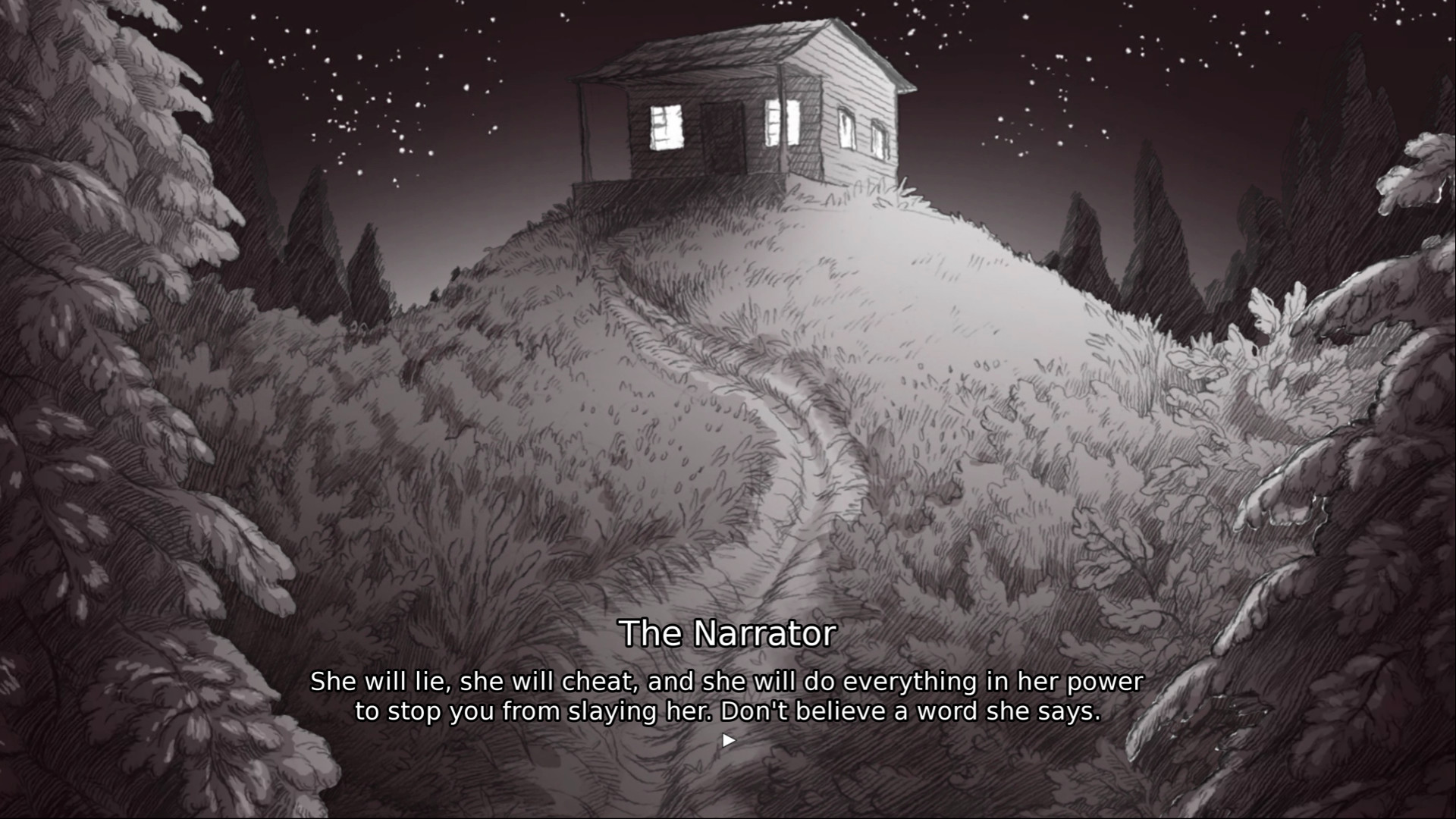
To say it outright is the Narrator, a voice-off-camera masterfully portrayed by Jonathan Sims (who, incidentally, voices all the other male characters in the game, including the hero himself, a performance that is absurd), who immediately becomes evasive and evasive in response to our requests for clarification, natural given the paradoxical and antithetical nature of the situation vis-à-vis traditional fairy tale conventions. The princess is not, in fact, imprisoned in the tallest tower of a fairytale castle, but rather in the basement of a dilapidated cottage nestled in the woods; our task is not to rescue her from the clutches of a villainous knight or a fire-breathing dragon, but to be her own executioner; and the princess, notoriously an innocent and defenseless figure, represents in this distorted fairy tale a catastrophic threat to the entire world.
From the very start, we are confronted with a miriade of possible response or action options: we could try to gather more information about our mission, but as mentioned, the Narrator will make ears for trade; we could outright refuse to carry out the cruel task and turn away, only to discover that the path taken in reverse still leads us to the cabin; we could instead swallow the bitter pill and reluctantly head toward the cellar, ready to fulfill our duty even if crushed by shame; we could even celebrate the death of the monarchy, declaring that we never expected anything else but to pass a member of the aristocracy by the blade. Touché.
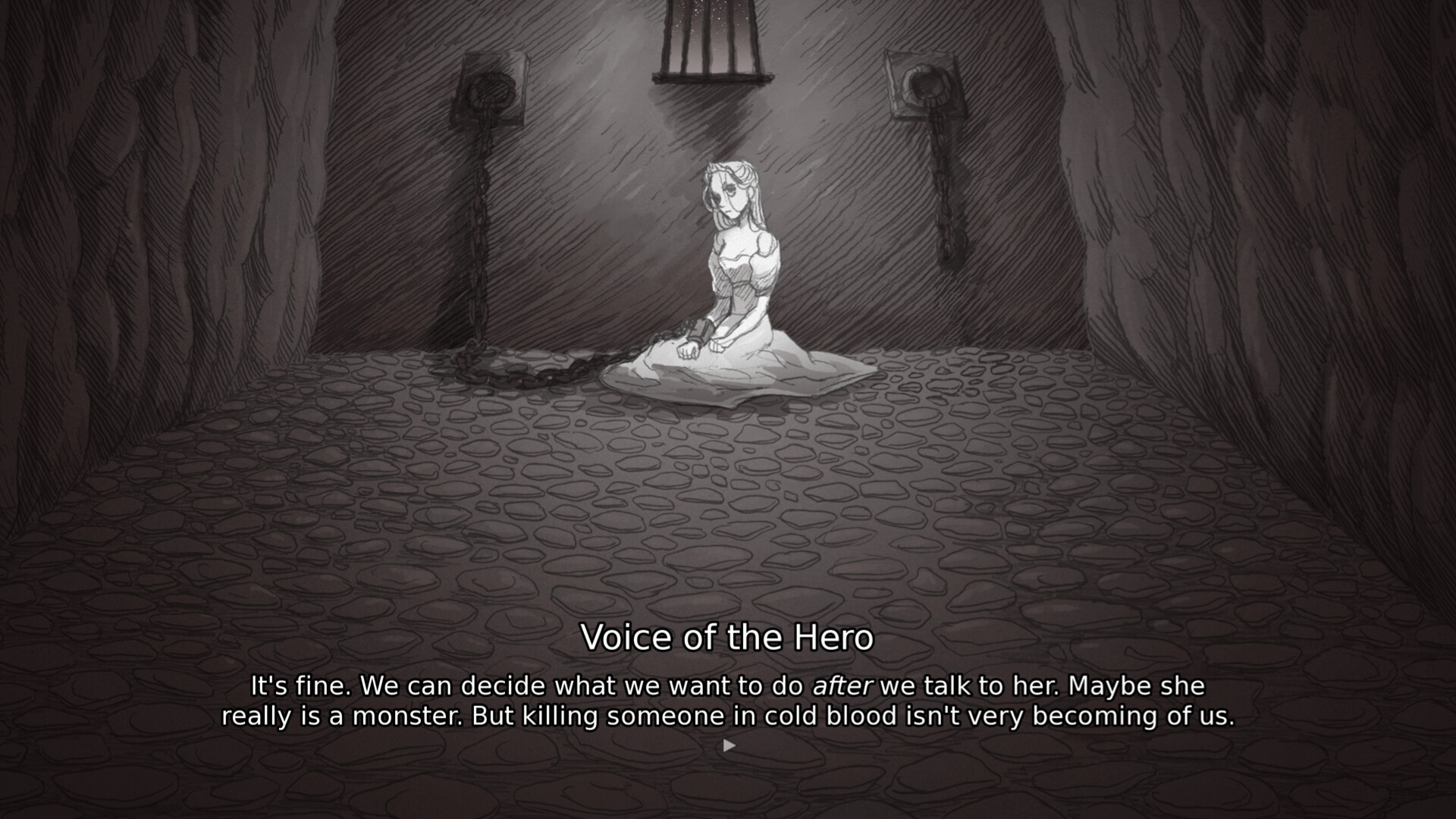
The game immediately touches on deep and complex topics, foremost among them the issue of free will: certainly, the dialogue and action options you are presented with are numerous, but by the end of the game, the path you take is predetermined. But is this predetermined because, in our subconscious, we have already made a decision, or because the narrator of what happens to us has already decided what must occur? But we go further still, ranging from the nature of existence to the question of personal identity, as the hero’s personality fractures across the various chapters that make up the game, acquiring distinct traits, sometimes contradictory, which will guide our actions—or at least attempt to do so.
Be careful, this does not mean our choices have no consequences at all — quite the opposite — but there are certain paths that must be followed to allow the story and the game to unfold in all their facets. Explaining this without saying more is complex, but anyone who decides to play Slay the Princess will understand. In any case, the repetition of certain sequences may lead to a slight sense of repetition, easily overcome thanks to the option to skip dialogues already heard until the next input required from the player.
What if...
Slay the Princess is a visual novel horror unlike any other. But what truly scares is not so much the story, which nonetheless leans heavily into psychological horror with a few gore elements, as the seemingly infinite number of possible paths available and their potential consequences and mutations. It terrifies to feel lost and ignorant (in the literal sense) in the face of a truth (or presumed truth) that is concealed for too long, and finally revealed only to leave us brooding during the closing credits. The developers push the player, given the game’s intrinsic nature, to explore the ramifications of every possible choice, traversing each branching point of the lush tree that constitutes the story’s full narrative.
We were talking about a minor glitch at the start, and in fact we noticed that the consequences of some choices appear incorrect, or at least logically implausible, but in a game so structurally complex, perhaps we shouldn’t have been surprised. And we certainly don’t doubt that the folks at Black Tabby will throw a punch in the coming weeks.
As for gameplay, this is quite limited: we’ll simply be listening, reading, clicking, laughing, crying — or all of these things at once. Almost like in a lyric work, the Narrator and the Voices in the protagonist’s head form a phenomenal chorus, sometimes illuminating, other times capable of planting even deeper doubts in the player, but never as much as She.
Her.
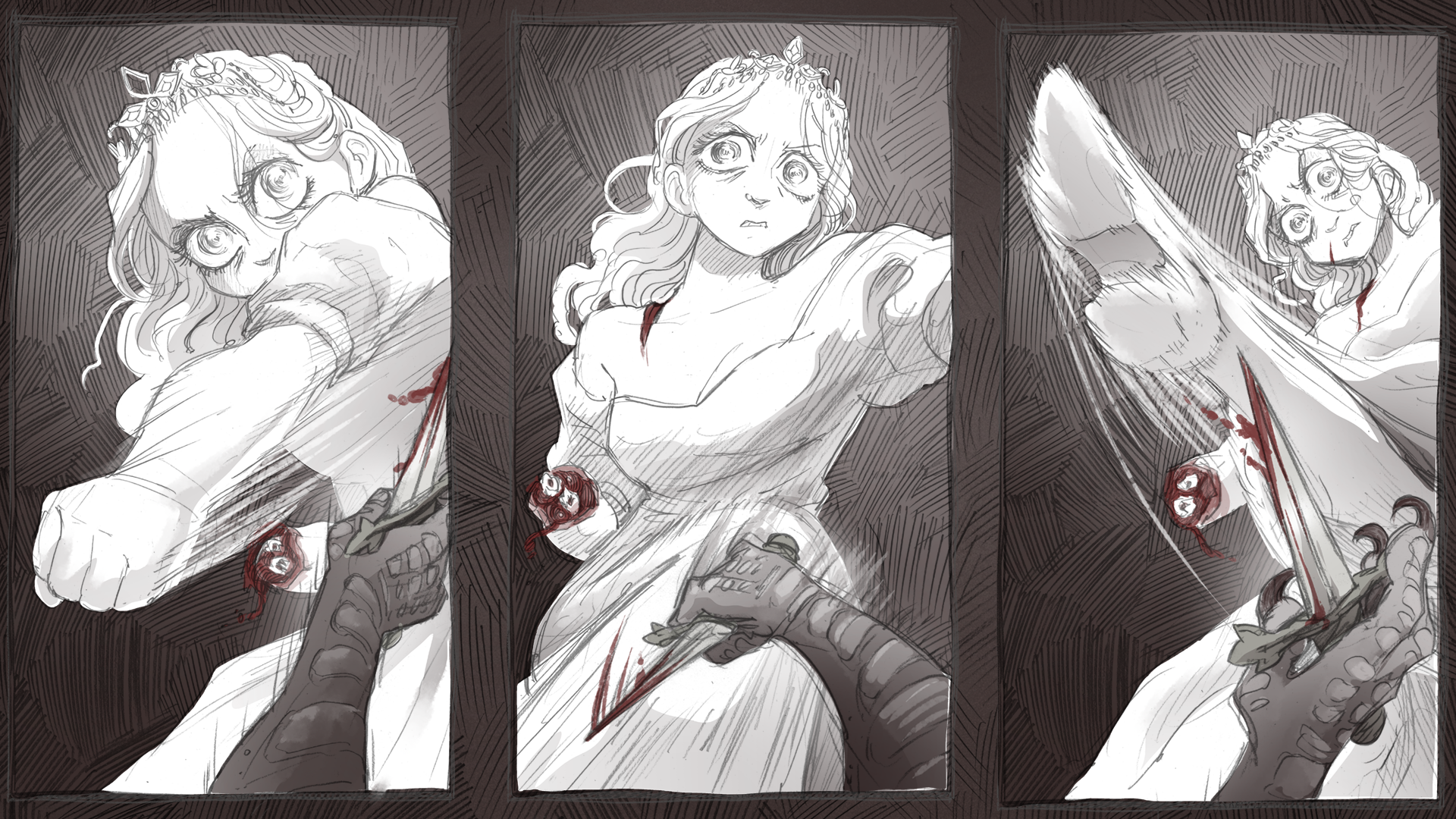
The Princess, in all her forms, brilliantly portrayed by Nichole Goodnight. Odi et Amo, a source of love and misfortune, an enemy by circumstance, in circumstances quite singular. In this regard, my experience with Slay the Princess reminded me of Doki Doki Literature Club!, except that this time the aura of happiness and carefreeness intended to deceive us into believing the title’s innocence is not even visible through a telescope.
In any case, although there are no right or wrong choices (the game makes this clear from the outset), you will often find yourself dying at the hands of, you guessed it, the “docile” princess. But don’t worry. The game over is not programmed, and the game world is “reset”, though the protagonist’s and princess’s memories remain unchanged. You will therefore frequently find yourself in the terrifying situation of knowing you are heading toward a doomed fate, yet being unable to do otherwise. The terror arising from the inability to predict events, but especially from being unable to control them, is a constant (anxious siblings, raise your hand).
A "run" takes about 3-4 hours, but that means only having glimpsed the tip of the iceberg: with 11 possible endings and corresponding paths to reach them, there will be plenty of time to wander that poor forest trail to reach the cabin — at least for a generous twenty hours.
Artistically speaking
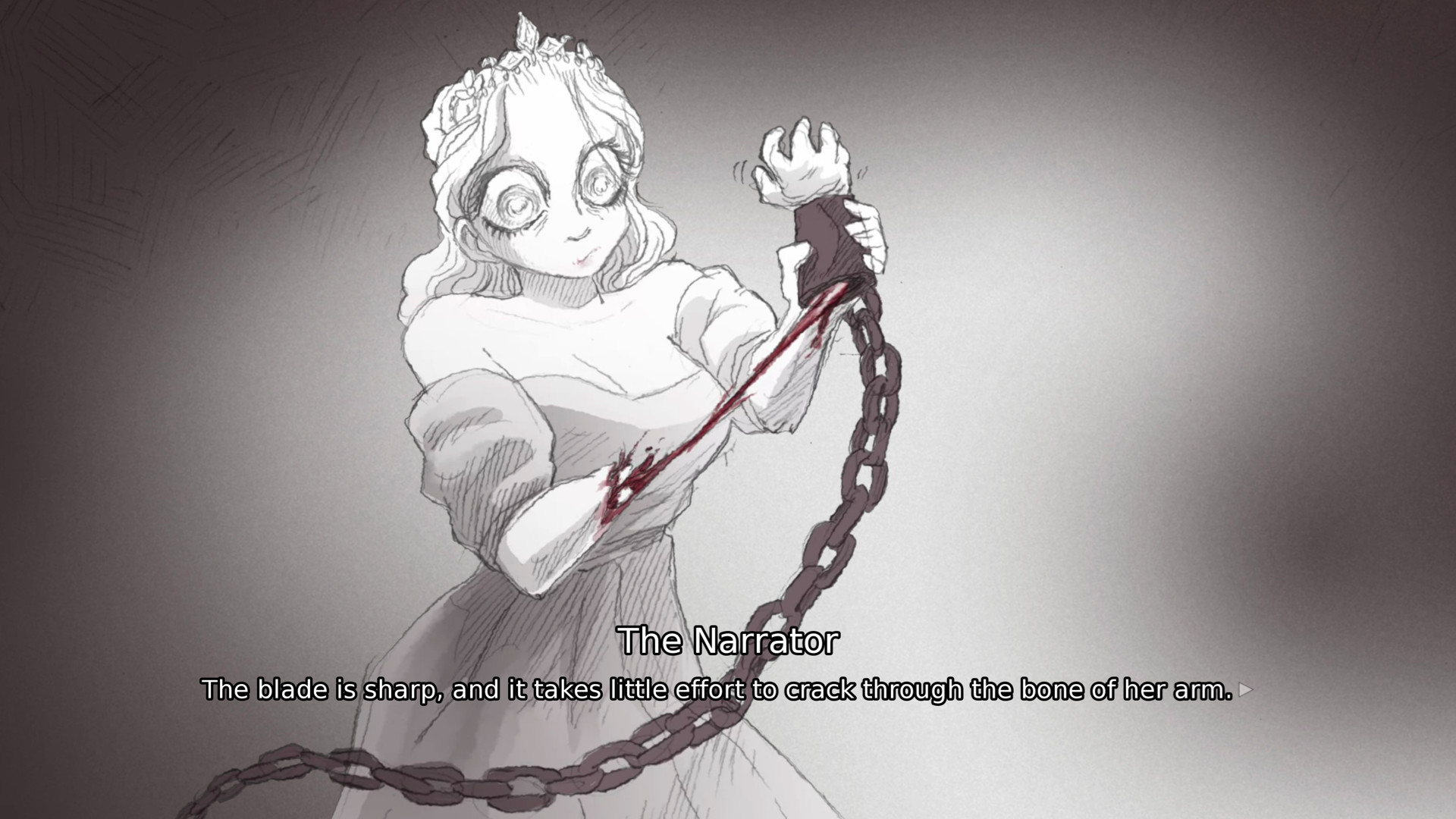
Artistically speaking... the game is a masterpiece, in every respect. From the hand-drawn tables by the brilliant Abby Howard in black and white, with red blood splatters that ignite the monitor pixels and seem to almost bleed onto the screen; to the mesmerising music, of a subtle but glorious beauty composed by Brandon Boone. Not to mention the script, with hundreds and hundreds of lines of coherent, characterised text, ranging from existential horror to mad comedy. And finally, the voice acting, with extraordinary performances by two actors who remind us that massive budgets and casts of dozens of actors are not necessary to create a quality product. Too bad for the absence of Italian localisation, a significant barrier for a title that relies on reading and above all understanding non-trivial or elementary dialogue.
You need passion, talent, love for what you do, and the rest follows.
In conclusion
I am guilty, Your Honour. I am guilty of not knowing about the existence of Slay the Princess until just over a week ago, but I hope this review, absolutely truthful and coming from the depths, may serve as a minimal reparation for my crime. The work of Black Tabby Games fully deserves to be among the games I recommend anyone try, even those who dislike horror, even those who hate visual novels, because Slay the Princess is all of this and nothing of this. It is a one-of-a-kind, a masterpiece, a triumph. And that concludes my review.
So we were... ah yes, we find ourselves along a path immersed in the forest...
About the Author