

In the land of Azuma, inspired by feudal Japan, nature reigns supreme, in peaceful balance with humanity. This harmony breaks when giant beasts, infused with ancient natural magic, begin to threaten the integrity of human settlements, controlling the elements of nature to their own pleasure and thereby putting human well-being at risk. They are the majestic and fearsome Kemono. The only ones capable of confronting them, to restore the balance, are the hunters who possess the seed of the Karakuri, which enables them to summon wooden structures bound by a "spiritual thread," allowing them to fight the Kemono on equal terms and free the population from their alarming presence.
These are the foundations of the new action-GDR from Omega Force, a development division of KOEI Tecmo, under the banner of EA Originals. Electronic Arts, thanks to the talented Japanese team, launches a challenge to Capcom and its 20-year-old brand Monster Hunter. An absolutely ambitious, perhaps almost arrogant, duel, but one that has certainly brought a fresh breeze into the genre now known as "monster hunter-like". Thanks to a key provided by the distributor, we’ve spent about twenty hours in the world of WILD HEARTS and, despite highs and lows, we can’t deny we’ve enjoyed ourselves overall.
This content is provided by YouTube. To view it, you must allow external content. Activation may result in data being shared with the third party.
An unnamed hunter
Perhaps the character we’ll portray — and which we can freely customise thanks to a very rich and detailed editor — possesses the power to manipulate Karakuri. Isn’t that an incredible coincidence? After this absolutely unpredictable coup de théâtre, the story of WILD HEARTS doesn’t offer much else in terms of narrative content. Our primary objective will be to bring the blacksmith Natsume and the eclectic Ujishige back to Minato, the city that will serve as the main hub of our adventure. To achieve this, we’ll need to clear the surrounding area of the Kemono that infest it — essentially functioning as a tutorial.
WILD HEARTS is not a true open world: it is instead divided into large, fairly expansive zones that we can explore at our own pace, either to hunt new prey to eliminate, or simply to gather natural resources or discover Tsukumo hidden (about these little creatures we will speak more later). Once this introductory section of the game is completed, we will unlock a specific Karakuri, the Rampino, which is essentially a zip-line allowing the trio to cross the only bridge connecting Minato to the area where we currently are, which was obviously destroyed by the fury of the Kemono. Upon entering Minato and overcoming the magnificent sight, we can immediately decide to continue with the main quest, following the seductive Suzuran into the new region, or we can pause to complete some of the requests from the city’s inhabitants, which often involve eliminating additional Kemono or collecting a certain number of ingredients or materials — which are then the side quests of the game.
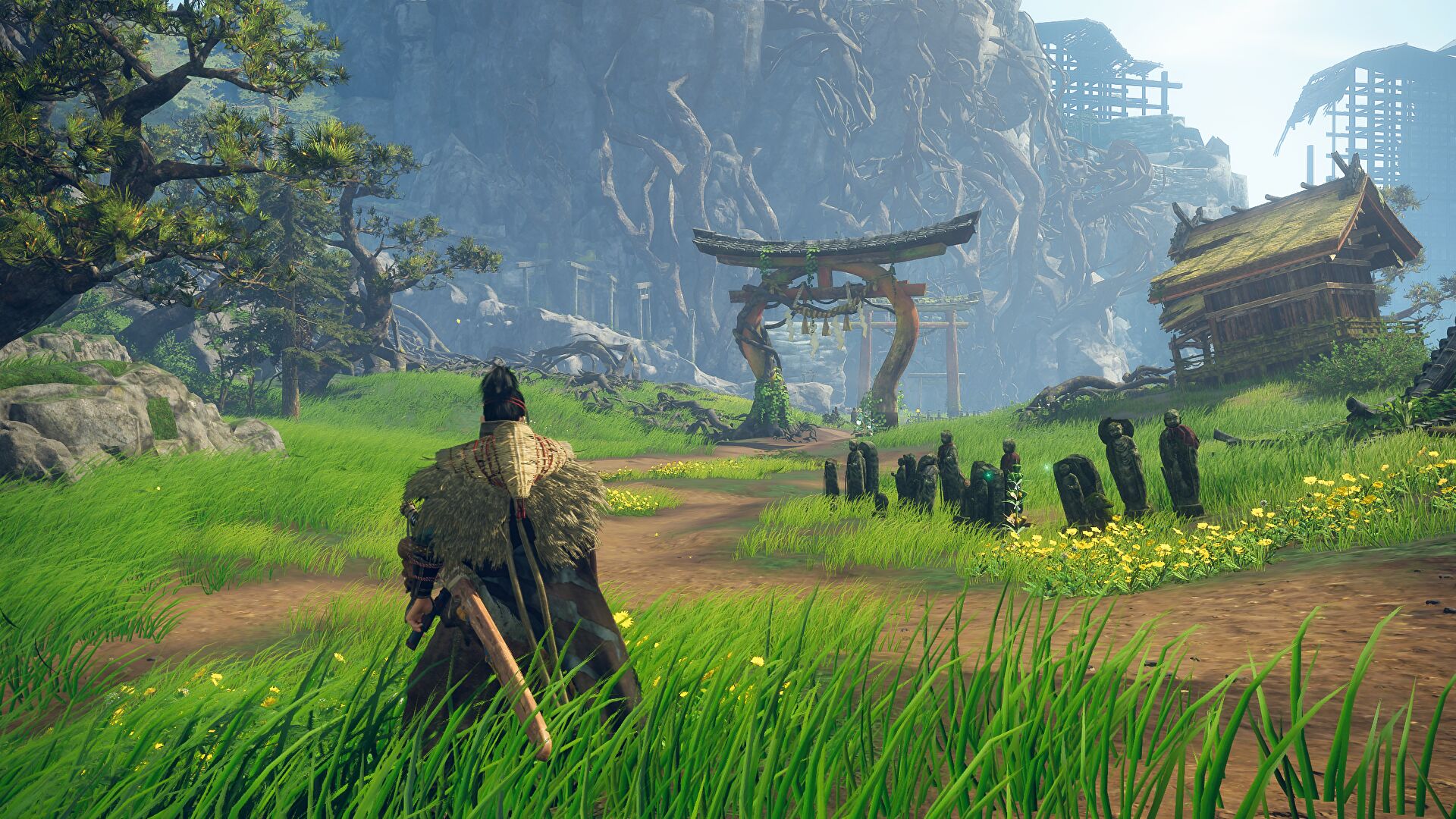
In short, despite the team’s efforts to delve deeper into the game’s narrative, perhaps in order to rise above Capcom’s “monstrous” competition, we cannot say we were particularly impressed by the main story of WILD HEARTS. What we did appreciate, however, was the attempt — successfully this time — to create a more “mature” title, taking itself more seriously and, despite being set in a fantasy world, deeply rooted in Japanese culture and history.
Enough with lounging, it’s time to hunt
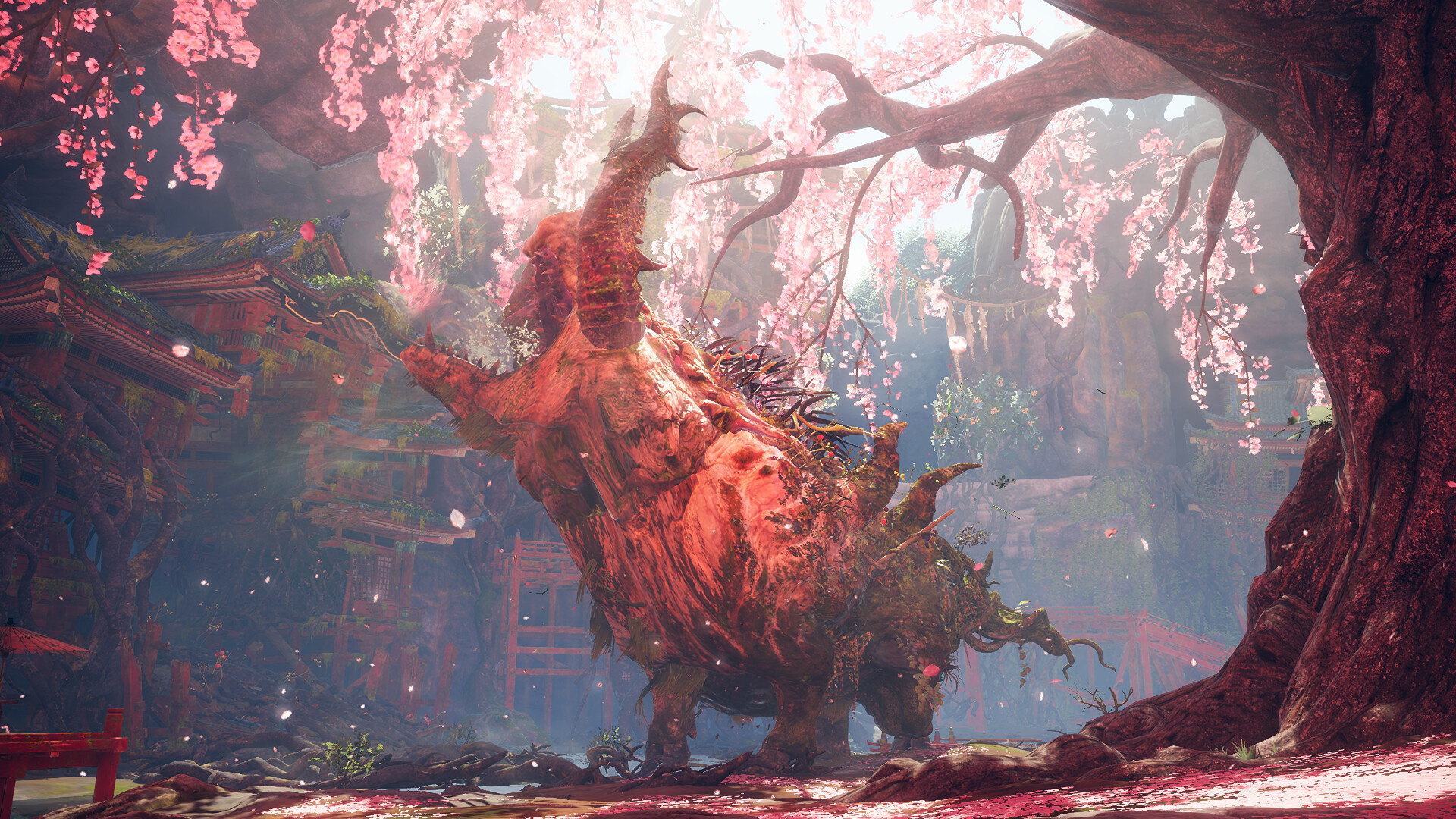
As we had already hinted, the main enemies that plague the lands surrounding Minato are the Kemono — dozens of enormous beasts, each with specific weaknesses and resistances, plus, of course, their own unique combat techniques: from the Zanna Reale, a wild boar capable of charging without mercy, crushing everything in its path, to the Flagello di Linfa, a type of squirrel that slows us down by hitting us with sticky resin, through the Becco d'Onice, a frenzied, lightning-fast rooster that won’t give us a single moment to breathe during the fight. The design of each Kemono is certainly interesting, though I must be honest — I’ve never been left speechless in front of one of them.
The team at Omega Force, already creators of Toukiden, have opted for a decidedly intense combat approach, making the Kemono true fury capable of inflicting serious damage on less attentive hunters. WILD HEARTS is not an action button-mashing, but demands careful study of the prey’s moveset, an understanding of its affinities and weaknesses (useful in this regard is the bestiary we’ll have at our disposal), and a thoughtful, consistent use of our weapon and the Karakuri base at our disposal, which, when combined, may in some cases serve as true, specific counters to the respective Kemono’s attacks.
As for the weapons, there are eight in total, although some will only become available by continuing the story. Initially, we can choose between a Katana, a Hammer, the Nodachi (a spear), the Bow and the Wagasa (a combat umbrella). Each weapon has its own distinctive moveset, and Omega Force has truly done an excellent job in making the combat style associated with each one feel unique and specific. Of course, they don’t reach the level of complexity and depth found at Capcom, but, and this is a big caveat, to function optimally, some of these weapons require a solid understanding and mastery of the right Karakuri, adding another layer of depth and freshness to the gameplay.
It seems fairly clear the difficulty gap between weapons for "beginners" such as the bow and more technical and complex ones like the Nodachi or the Wagasa. Unfortunately, some of these initial weapons perform best when combined with Karakuri, which unlock only much later — a balancing issue Omega should have paid more attention to.
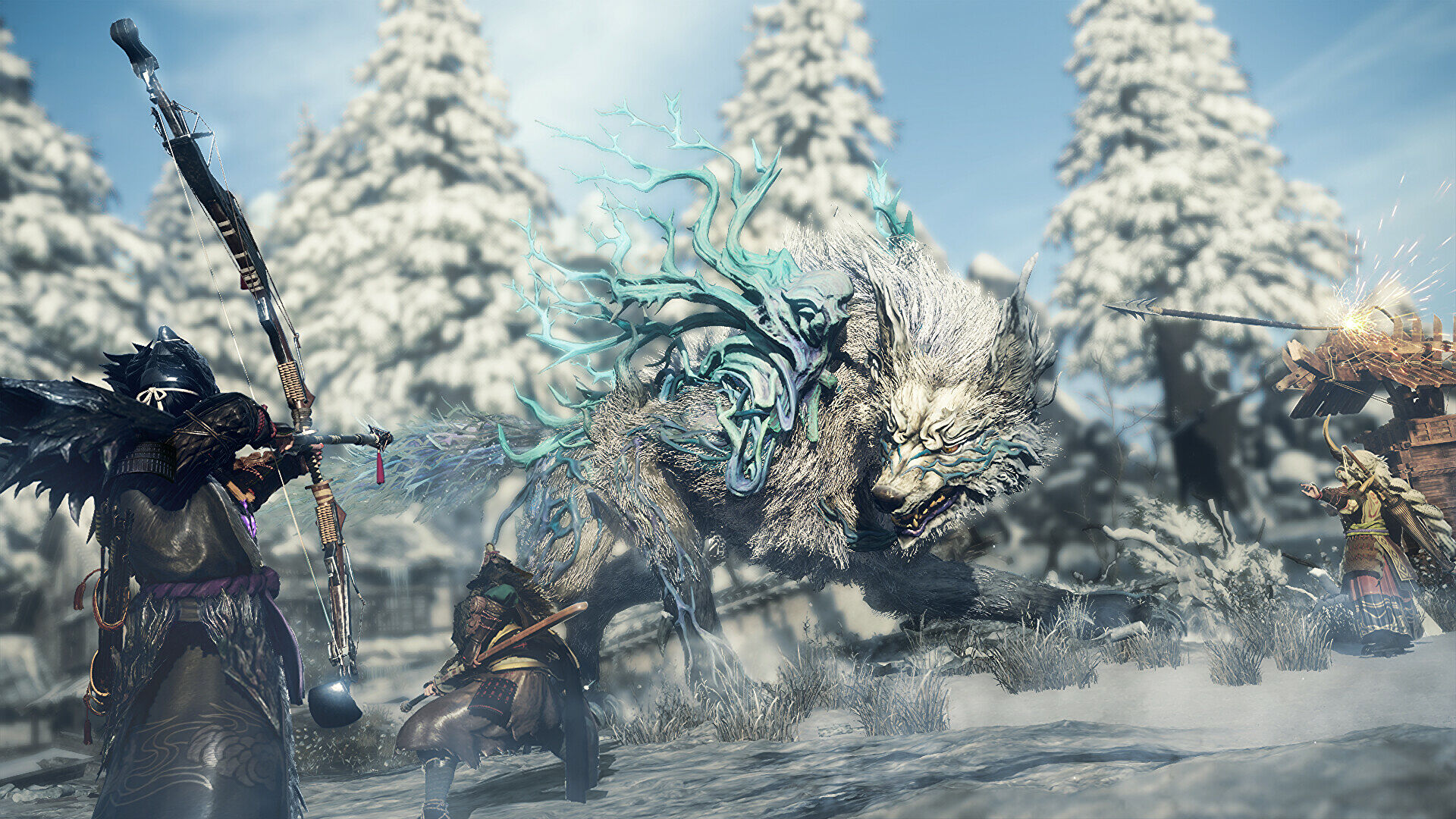
The hunt, for the most part, is fairly conventional: you locate the prey, either by foot exploring the map or by using a special Karakuri that acts as an observation tower, you engage it until it flees, you pursue it, you engage it again, and so on until one of the two contenders is knocked out. Highly appreciated is the fact that, once the prey is defeated, we must deliver the final blow to complete the mission and obtain the loot, and in doing so, we whisper our apologies to the dying Kemono, since after all, its death is merely a restoration of the natural balance that had been lost with its existence.
We briefly tried also the multiplayer experience, easily accessible thanks to portals scattered around the map; it can be summed up as: fun increases, challenge (sometimes drastically) decreases. Hunting with friends (up to three hunters simultaneously) is certainly more fun than doing it alone, but unfortunately, this comes at the cost of losing much of the high level of challenge Omega crafted for the experience. Probably, the online component’s balance still needs a bit of tweaking.
Karakuri, the true protagonists of the game
The gameplay element that has proven to be the true game-changer of WILD HEARTS is undoubtedly Omega Force’s brilliant invention of the Karakuri. Almost inspired by Fortnite (and I swear, it’s not a curse word), the Japanese team wanted to allow the player to alter the game world or quickly build structures that would give them a tactical advantage over the opponent. There are four types: the Tsukumo, the basic Karakuri, the combined Karakuri, and the Dragon Karakuri.
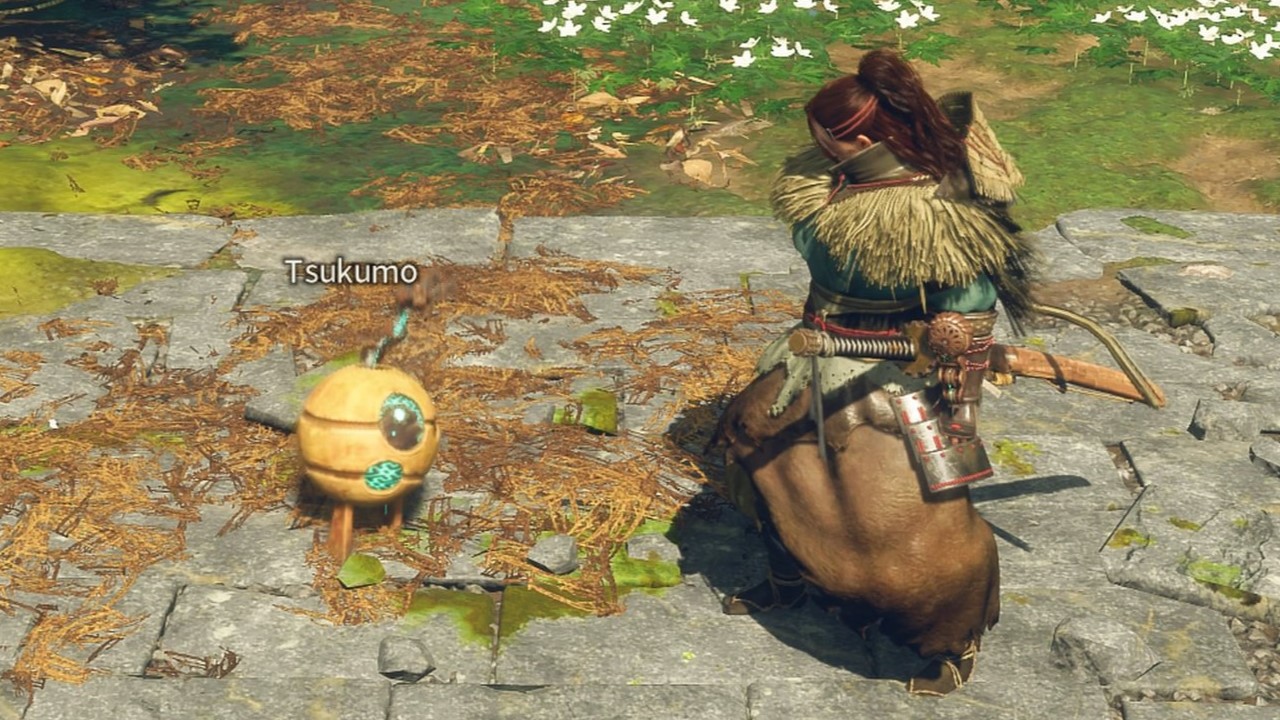
Let’s start with the first, the most important, our companion through a thousand battles, our spherical Tsukumo. This Karakuri distinguishes itself from all others because it is nothing more than a companion that will accompany us during battles and will be a fundamental ally in solo hunts, drawing the Kemono’s attention if we need time to recover from a stun or heal, emitting steam to karakurar us himself (I admit this was terrible), or supplying us with the “spiritual thread,” the material necessary to build Karakuri. And don’t think it’s just a support companion, eh! Tsukumo is also capable of attacking the Kemono by hurling whatever happens to be within reach at them... but it has no arms, just a sphere, you say? Esticaaaaa...
Hidden throughout the various macro-regions are many Tsukumo that we can become friends with: in this way, they will ensure us useful materials to enhance the offensive, defensive, and support capabilities of our personal Tsukumo when we rest by the fire.
Then there are the base Karakuri, six in total but only four can be equipped simultaneously — ranging from the basic cassa to the pedana a molla, from the torcia to the corda arpionata. Combining these base Karakuri yields far more powerful combined Karakuri, such as the Baluardo, a wall capable of halting Kemono charges and pushing them back, or the Balestra a Ripetizione, for neutralising the threat of flying Kemono. In short, discovering and mastering the most efficient and effective use of each Karakuri surpasses the attention given to refining your skill with the weapon you’ve chosen — but it’s clear this was precisely the developers’ intention.
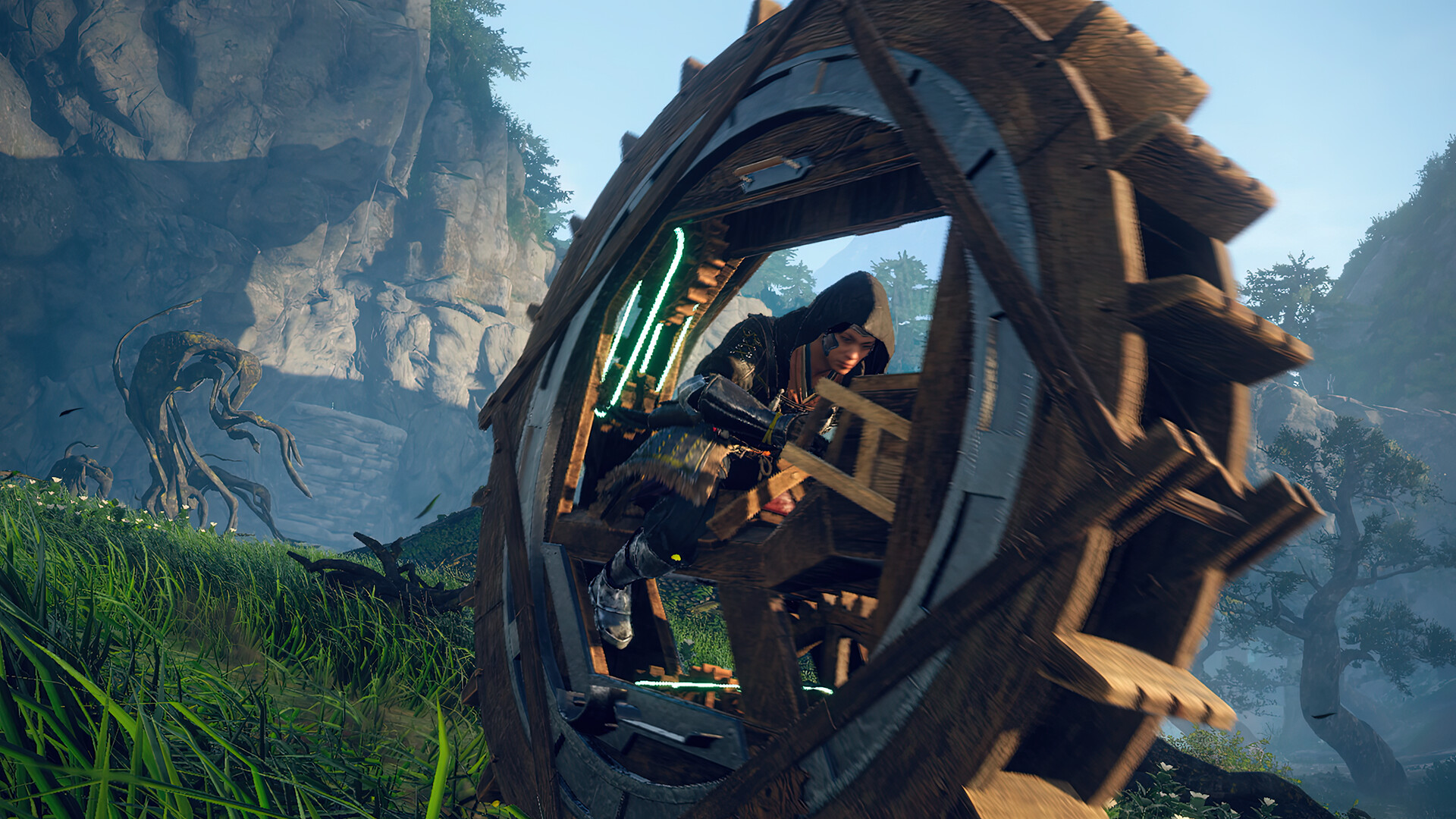
Finally, we have the Dragon Mechanisms, which will not be particularly important in combat but will play a key role in navigation and “furnishing” the various large areas that make up the game world. Among these types of Mechanisms, for example, there is the Rampino, mentioned at the beginning, which allows us to cover long distances, especially if there is a height difference between them; the Tenda da Caccia, which will serve as a respawn and teleportation point that we can place at our convenience; the Vortice d'Aria, which will allow us, like a large fan, to float and reach map areas otherwise unreachable. And then the Ruota Mobile, which will function as an ancient motorcycle for quick movement, the Fucina da Campo to upgrade weapons and gear without having to return to Minato, the Dispensa e l'Essiccatoio for food... in short, it is truly possible to turn the game map into our hunting ground, of course while respecting the quantities of Mechanisms that can be placed, as dictated by the Fonti del Drago, which will, however, become increasingly potent, allowing us to further enrich each area with Mechanisms.
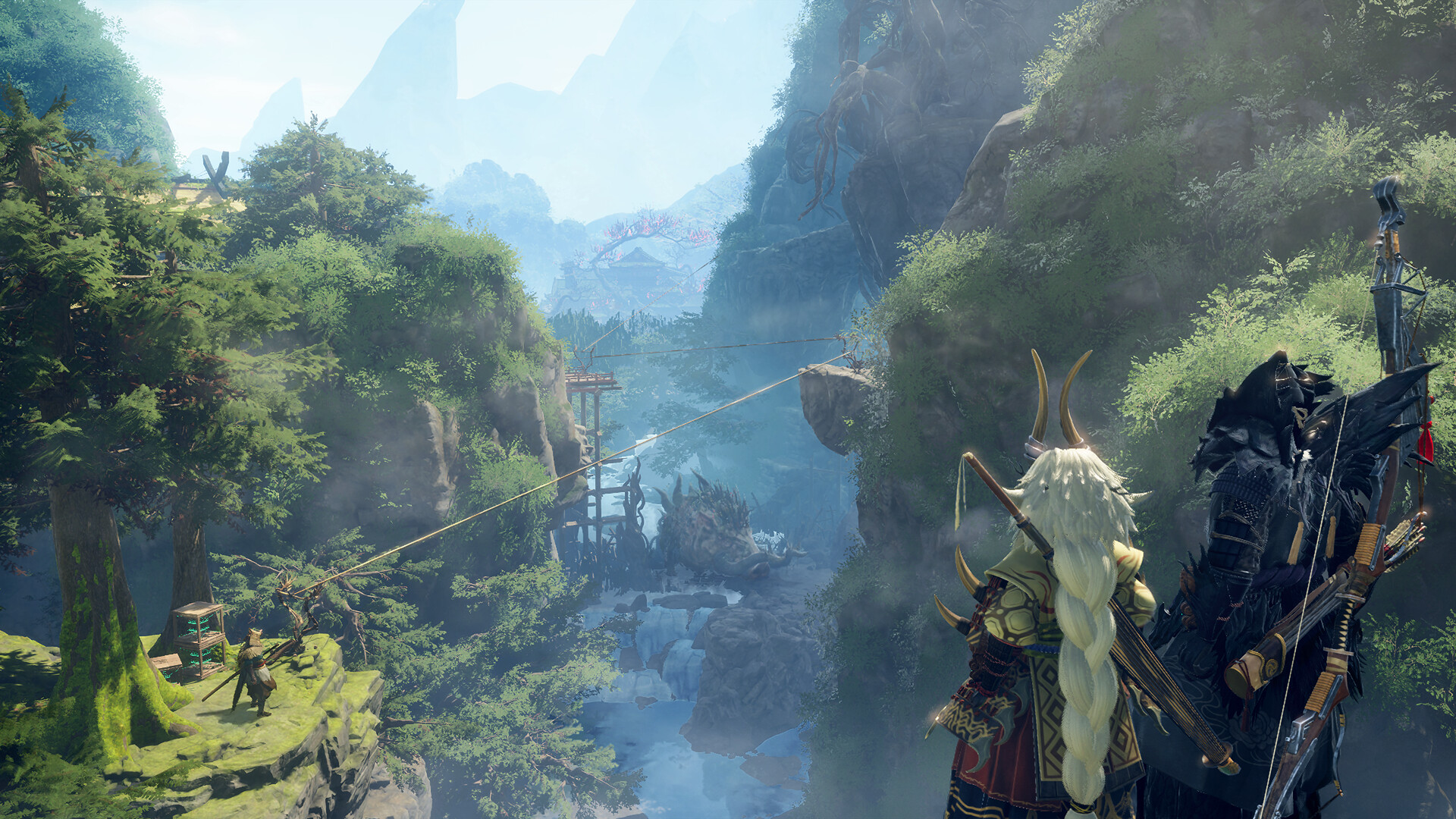
And the features of all this are infinite, because by placing Rampini and Vortici we can create shortcuts to reach Kemono more quickly during escape, by placing Drying Chambers and Storage Units we’ll always have food available to boost ourselves before a fight: studying the layout of every macroarea and subsequently using Karakuri to smooth out their flaws represents a game within the game that I truly, truly appreciated.
Technically speaking
We tested WILD HEARTS on the following setup:
AMD Ryzen 7 3700x @ 3.60 GHz
Gigabyte RTX AORUS Master 3080 Ti 12Gb
Corsair Vengeance RGB RT 32GB DDR4 3600MHz
LG 34GN850 Monitor at 3440x1440 (21:9)
I don’t know much about it, but my setup, though not cutting-edge, doesn’t seem that terrible. Here’s the thing: terrible is the right adjective to describe the technical gameplay experience on WILD HEARTS. And it’s a real shame, because the game, on its own, works fine across all areas, but dealing with stuttering, frame rates that never exceed 45fps regardless of settings, various bugs, and a couple of crashes… it’s hard to grasp, right?
And there’s some criticism to be had about the camera control, which at certain moments — especially with the bulkier Kemono — genuinely makes you want to hurl up. Unfortunately, really, because artistically the title is extremely strong, in the design of the monsters, armor, and environments, but everything unfortunately takes a back seat to such poor optimisation. The developers have released several patches that have somewhat improved the situation, but I believe that, rather than focusing on adding new Kemono to hunt, there’s still a need to work significantly on the title’s performance.
In conclusion
Electronic Arts launches a challenge glove to Capcom with a production that, although struggles (and rightly so) to compete with a twenty-year-old brand, introduces genuinely interesting gameplay ideas and absolutely doesn’t underperform in its niche (no longer quite so niche) of hunting games. A title that leans more on maturity than on humour, offering a less intricate combat system than its counterpart, but a challenge level that by no means deserves to be underestimated. Brilliant the introduction of the Karakuri mechanic, which gives the player almost limitless gameplay possibilities both during combat and during exploration. Everything is very good if not for the extremely low level of optimization of the title, which really goes against a game that, for everything else, left the player with very little to complain about. But not everything is lost — you have to roll up your sleeves and fix everything, patch after patch...
About the Author