
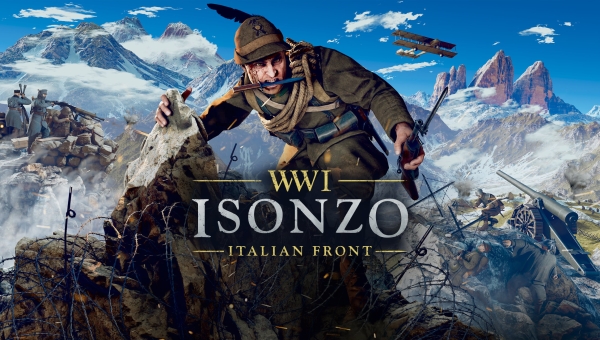
After taking us to the Western front in Verdun, and to the Eastern front in Tannenberg, the developers of Blackmill Games and M2H expand the WW1 Games Series with Isonzo, a chapter set on the Italian front, where the Regio Esercito and the Austro-Hungarian Army fought fierce mountain battles between 1916 and 1918. The immense emotional and non-political connection we feel to the real events that took place in northern Italy during the First World War demands a deep respect for what was an appalling slaughter that has left a heavy mark on general culture. Our grandparents fought and gave their lives on the front, and despite more than a century having passed since the Great War, places like the Piave, Grappa, Montello, Asiago, Gorizia, Caporetto, Pasubio, Stelvio, Adamello are almost revered and have become part of the DNA of those who still live in those environments. We had been waiting for a long time for an FPS title capable of capturing our attention, and Isonzo called us to arms with such urgency. At KotaWorld, we answered the call to arms by turning on our PCs and shouting with all our might, “Signorsì!”
This content is provided by YouTube. To view it, you must allow external content. Activation may result in data being shared with the third party.
Year of our Lord 1916, Gorizia
The release date, 13 settembre 2022, coincidentally reminds us of what happened in September 1916, when the seventh and eighth battles began on the Isonzo. Isonzo draws directly from these battles and launches with exactly 6 maps (Dolomiti, Cengio, Fior, Carso, Sabotino, Gorizia). We found in the map creation — particularly inspired and faithful to the original locations — one of Isonzo’s key strengths. The developers’ attention to detail is clearly evident, undoubtedly aided by on-site inspections conducted by the team during development and careful study of historical maps and period documents. The gameplay progresses from fighting at the base of the Tre Cime di Lavaredo, to the rocky outcrops of the Carso, through the woods of Monte Fior and the ruined alleys of Gorizia. The main, and currently sole, gameplay mode is Offensiva, a mode that recalls Battlefield’s Rush, yet succeeds where EA’s blockbuster failed to faithfully reproduce the trench warfare typical of the First World War.
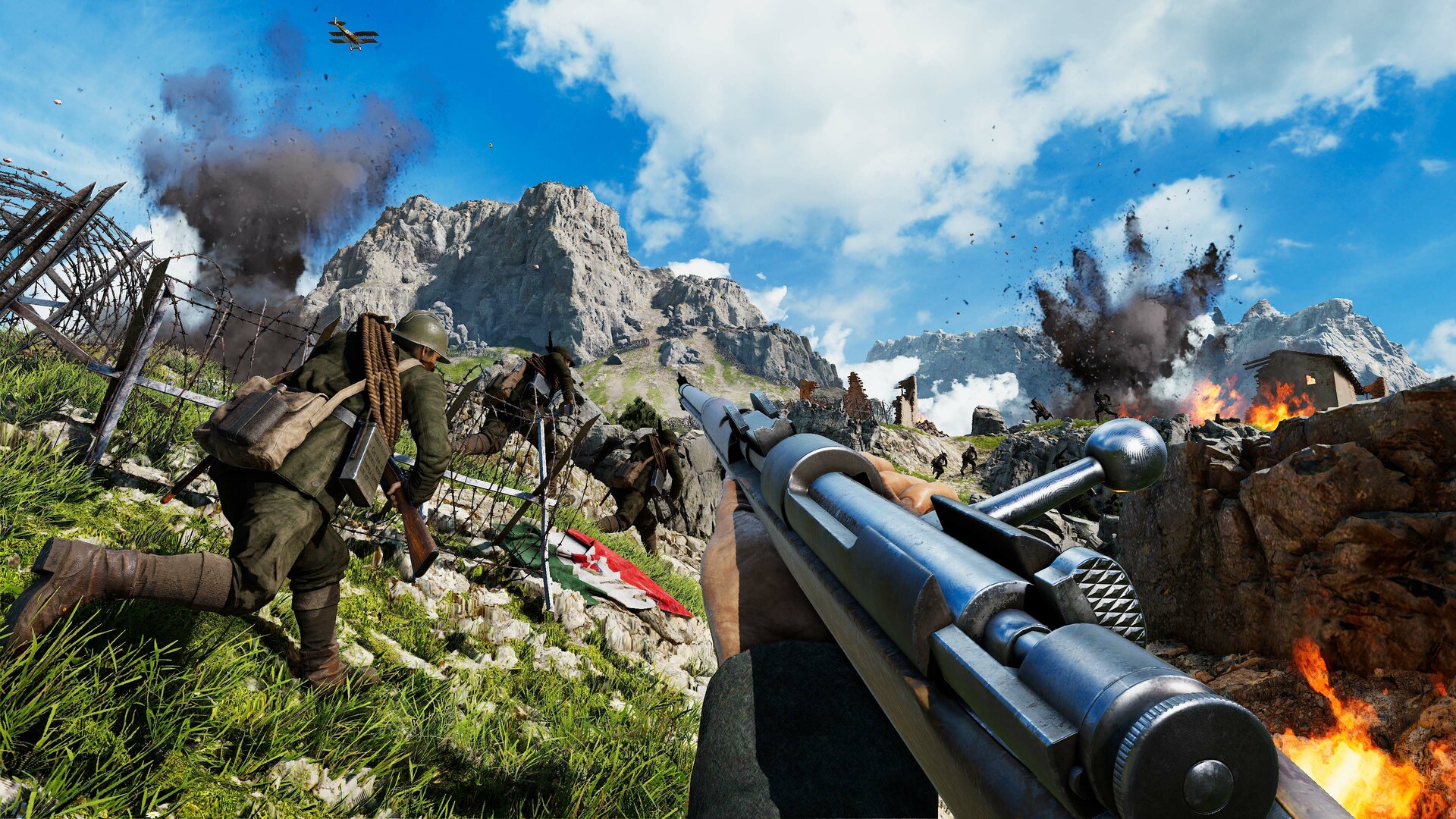
The two factions, each composed of 24 players, divided into squads of four soldiers, must fight to capture and defend critical positions, in order to advance on the offensive or repel the enemy. It’s a very dynamic mode that sees the battlefront shift continuously, with constant advances and retreats by both sides (and forgive me the rhyme). The line between life and death is truly thin: in most cases, a single shot is enough to end our lives or those of our enemies, reminding us sadly of the fragility of life in Ungarettiana memoria. In the event that “physical” players are missing, the game will replace them with bots, whose AI quality is quite erratic, ranging from murderous fury to the brink of aim-hacking, to truly stupid digital entities stuck far from the front and thus effectively penalizing the team that hosts them.
The sizes of the various maps, compact but rich in detail, ensure that you always feel immersed in the sensation of being in the thick of the action, a feeling that titles like Hell Let Loose, by nature, or the latest and most disastrous Battlefield 2042, due to blatant development errors, do not always manage to achieve. Yet, the action severely punishes individual initiatives but rewards teamwork and caution, with squad coordination made particularly difficult by a communication system that fundamentally relies on communication through in-game text chat only. It’s also a pity that there is no option to form groups before entering the match, forcing players to manually join their friends’ matches, often encountering full servers. These are, however, easily fixable issues with future updates.

Welcome to the front, soldier
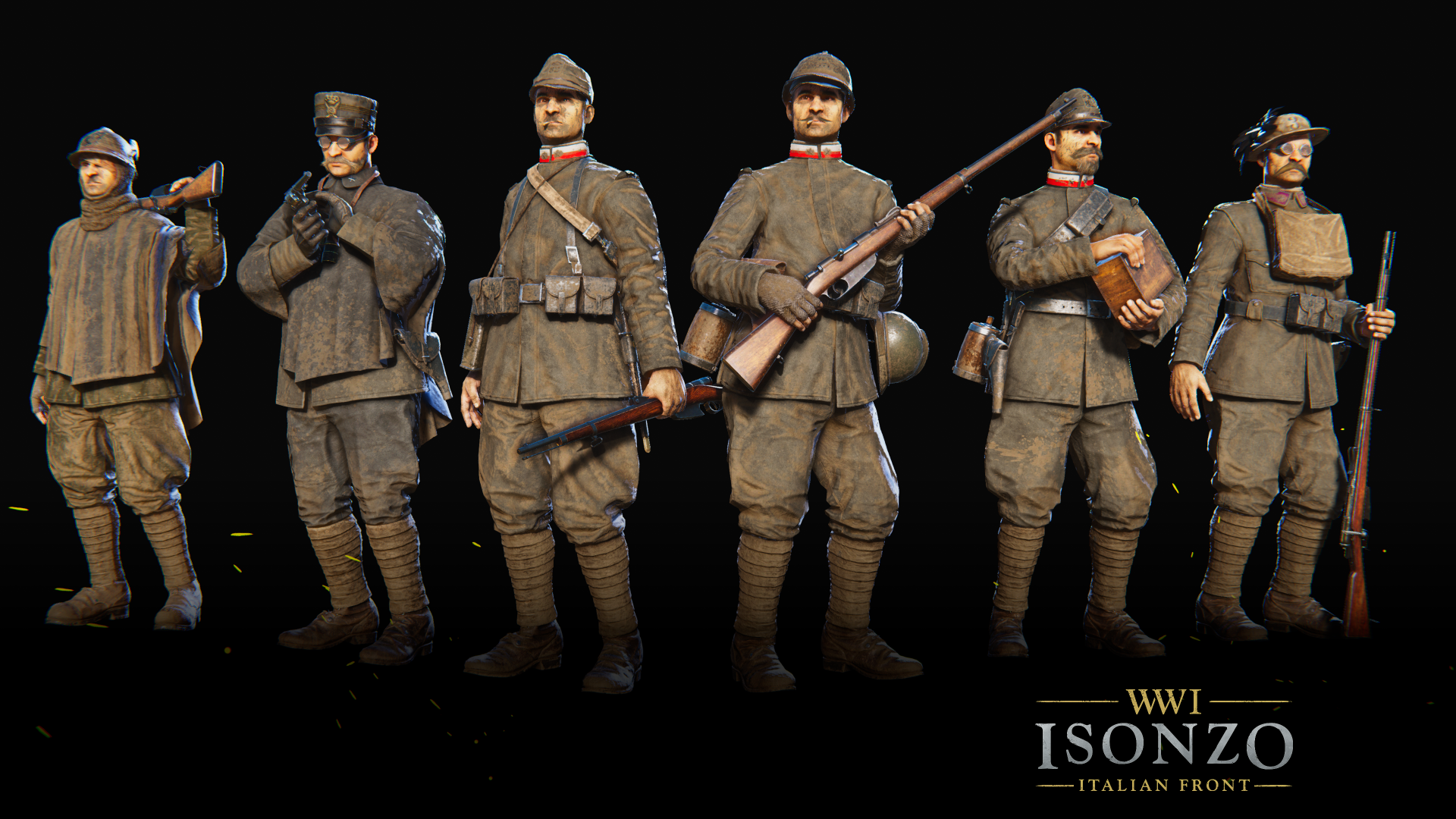
Attention to detail doesn’t stop at maps alone but ventures, with a certain artistic flair certainly not simulationist, into the uniforms and weapons of the two sides: Regio Esercito Italiano and Impero Austro-Ungarico. The presence of a possibly modest number of rifles and weapons, unlockable via a progression system we’ll explain shortly, is phenomenally successful in an egalitarian interpretation that compels all players to be “armed equally”. This perfectly balanced yet simple equilibrium between players therefore requires that the tactical-combat capabilities of each individual participant in the engagement can influence the entire course of the entire battle.
Once you’ve joined an offensive, you can enlist in one of the six classes currently available in the game, each with a precise battlefield role: if the Sniper is tasked with the unpleasant duty of resupplying teammates with ammunition, the engineer will be responsible for reinforcing defensive positions with barricades, deploying barbed wire to halt the enemy advance, or setting up fixed machine gun positions to decimate enemy lines. The Assaulters, the famed Arditi, can get drunk from their water bottles before launching into attack, to feel less fatigued and stay on their feet longer; the equally celebrated Alpine units act as scouts thanks to their binoculars, aiding the Snipers in the rear. Finally, perhaps the most important class is that of the Officers, who will have the delicate tactical role of directing the battle’s course by issuing orders to various squads and supporting them via the deployment of artillery, aerial bombardments, and the release of mustard gas clouds.
We greatly appreciated the team’s decision to impose clear limits on the number of units available for each role (there can be only four snipers per formation, with only one equipped with a telescopic scope, as well as only two officers, and so on), in order to always achieve optimal balance between forces on the field and to compel each player to choose the most necessary role depending on the circumstances. The class progression system, however, is less balanced, as players will unlock new weapons and abilities as they use a specific class and complete certain challenges. Players who invest more time in the game will therefore end up with automatic or semi-automatic weapons capable of far surpassing the manual repeating rifles of newcomers, already at a disadvantage due to lesser familiarity with the game and its mechanics. In this regard, something beyond a simple explanatory video could have been included to introduce newcomers to the brutality and chaos of the Isonzo battle, perhaps with more in-depth tutorials. In fact, Isonzo is a highly niche game, and once its core fanbase has been built, it will rarely see major shifts in its playerbase composition.

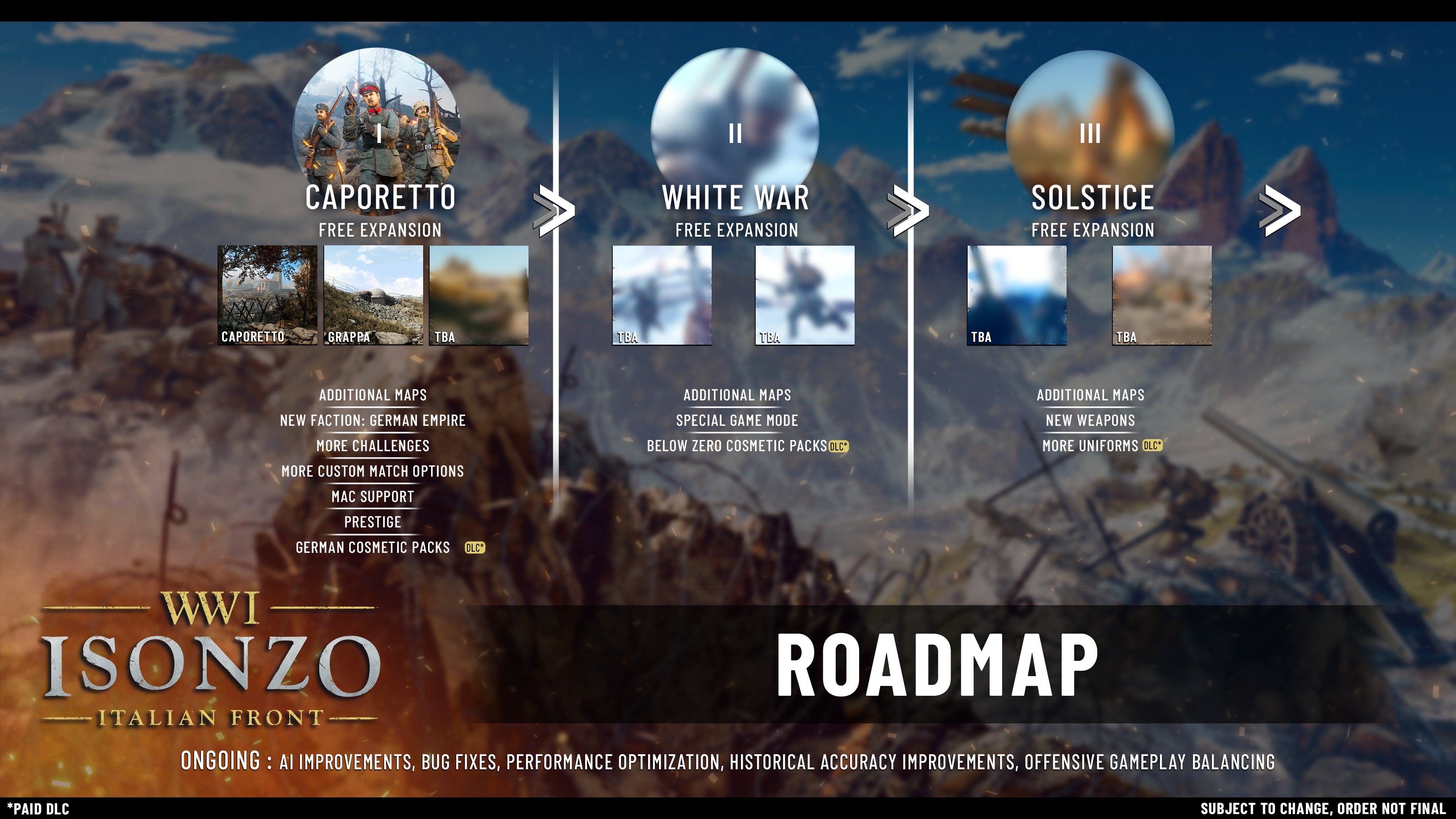
As you progress through the levels, players will be able to unlock aesthetic customisations for personalise their soldier, such as helmets, camouflage patterns and modern beard and moustache styles. Unfortunately, most of the skins are sold via DLC at an additional cost, but if this helps support the developers and fuels the development of an already quite interesting roadmap, we don’t see why we should honestly shout about scandal, especially given the budget price at which the game is sold (29,99€ at the time of review).
Technically speaking
The review was carried out in collaboration with the good old platoon buddy Eughenos. We tested Isonzo on the following setup:
AMD Ryzen 7 3700x @ 3.60 GHz
Gigabyte RTX AORUS Master 3080 Ti 12Gb
Corsair Vengeance RGB RT 32GB DDR4 3600MHz
Resolution 3440x1440 (21:9)
Having already tried the title during the Alpha, we were pleasantly impressed by the technical improvements the team has managed to achieve, especially regarding optimization, which maintains a frame rate mostly stable around 70-80fps even at maximum settings. Clarify, the graphics quality is certainly not what we can expect from an AAA title, but the attention to detail and the evident care shown for their title by Blackmill Games and M2H is clear, and we were decidedly pleased to sacrifice part of the visual aspect for a smooth, bug-free gameplay experience, aside from a few bugs the team is promptly addressing. The situation remains different for console versions, which suffer from more limited graphical settings and significant frame drops, but since we were unable to test those versions firsthand, we cannot make a judgment.
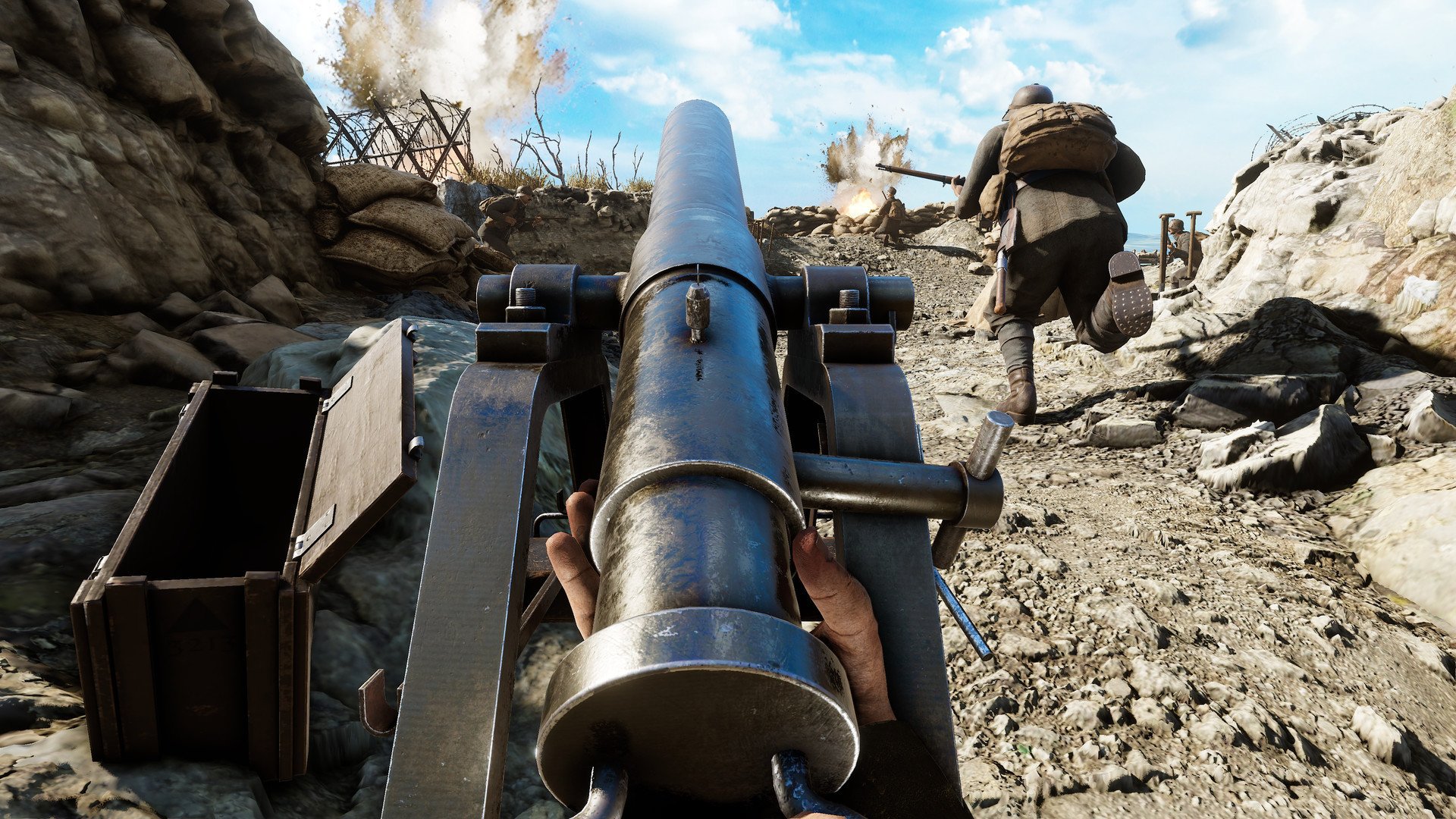
Good but not exceptional in the audio department, with weapon and explosion sound design that perhaps represents a step back compared to the previous iterations of the WW1 Games Series, and with the soldiers’ voice lines that, over time, feel a bit too intrusive and repetitive. Excellent work, however, on the soundtrack, fully inspired by the music of the era and featuring revised versions of the respective national anthems truly worth hearing.
In conclusion
Isonzo, with great respect and attention to detail, reimagines the First World War fought precisely in the Trentino and Northern Italy in a commendable work. An FPS that already at launch presents itself as decidedly stable, robust, and above all thoughtfully designed with great intelligence. The developers’ evident attention to detail — both large and small — within the graphical/environmental, musical, and historical aspects immediately struck us, leading us to spend many hours of the past few days pushing back the invader at the front. In our view, Isonzo represents a definite step forward compared to the previous iterations of the WW1 Games Series. Despite understanding its niche nature, we cannot help but recommend it even to the most sceptical or less familiar with the genre, confident that behind a completely disarming and chaotic first impression, many hours of fun may be hidden — a perfect oxymoron with the true horrors that occurred on those peaks and valleys, which still bear the marks of the atrocities they witnessed.
About the Author