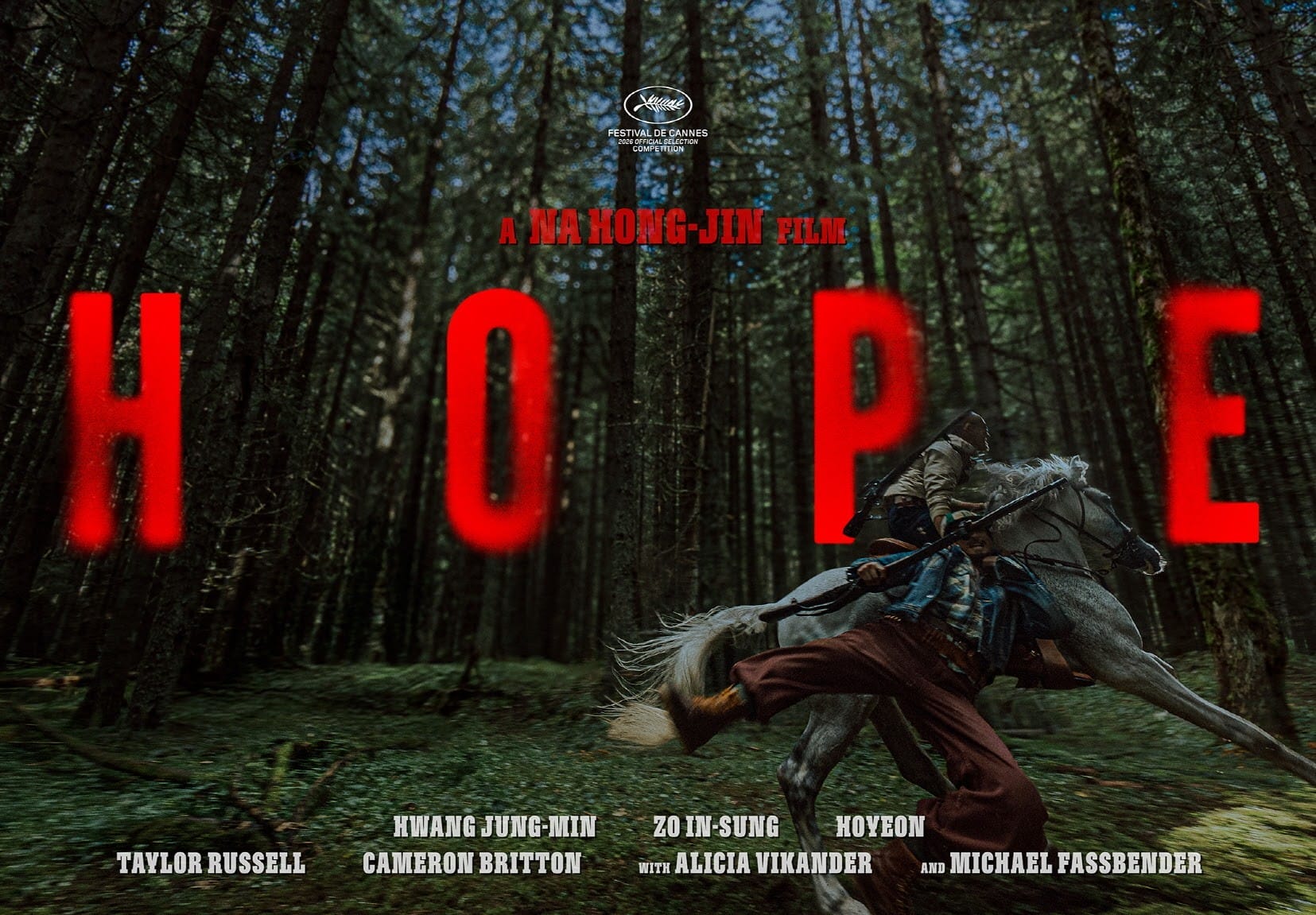
I haven’t yet read external reviews of this film, but I believe the confused state it left me in is the norm after viewing. The film is called Hope, hope, and honestly, I’m unsure whether the hope of seeing a good film was dashed or confirmed. Calling Hope “particular” would be reductive, and I’m speaking even to the most seasoned cinephiles.
The story
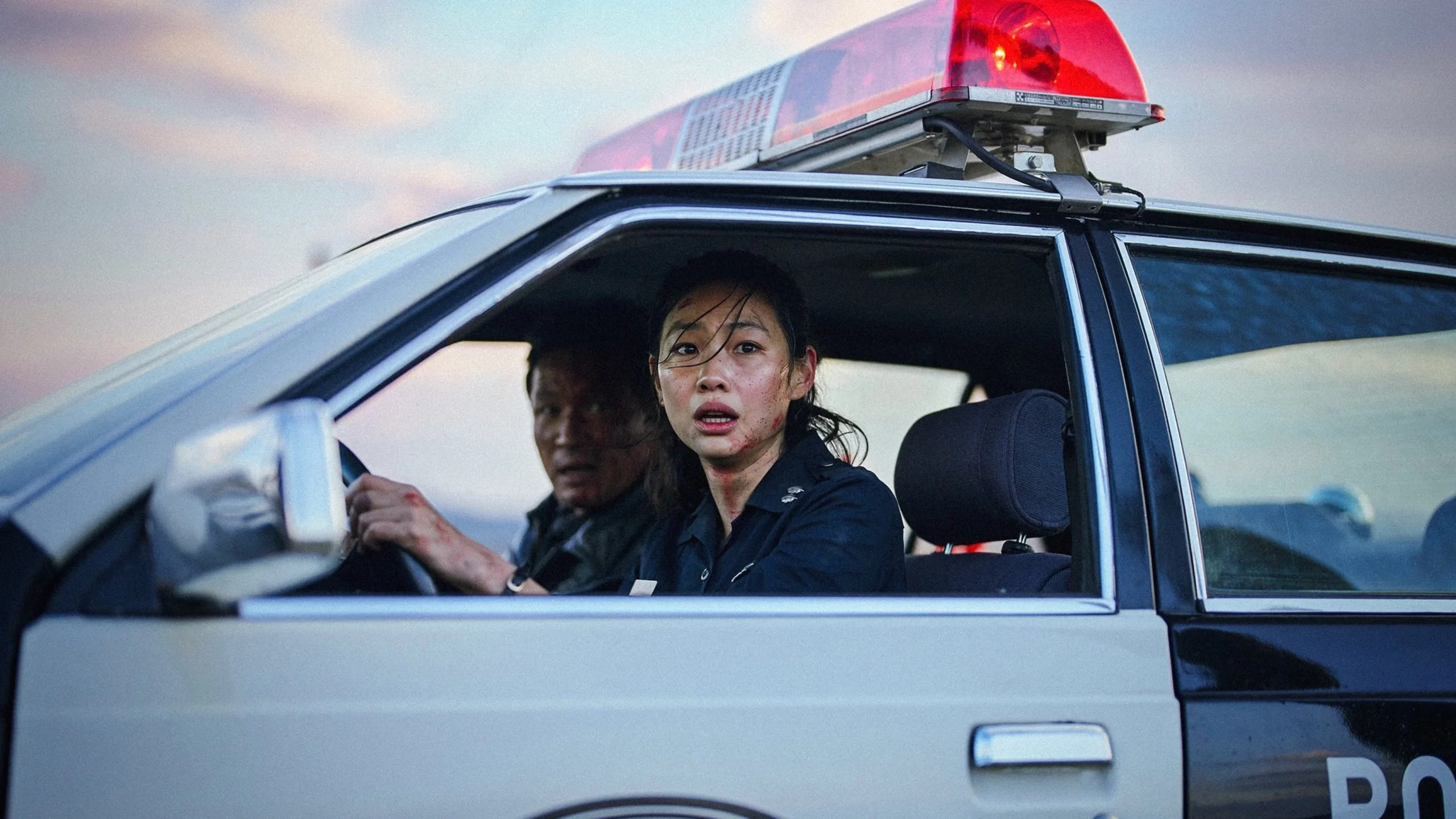
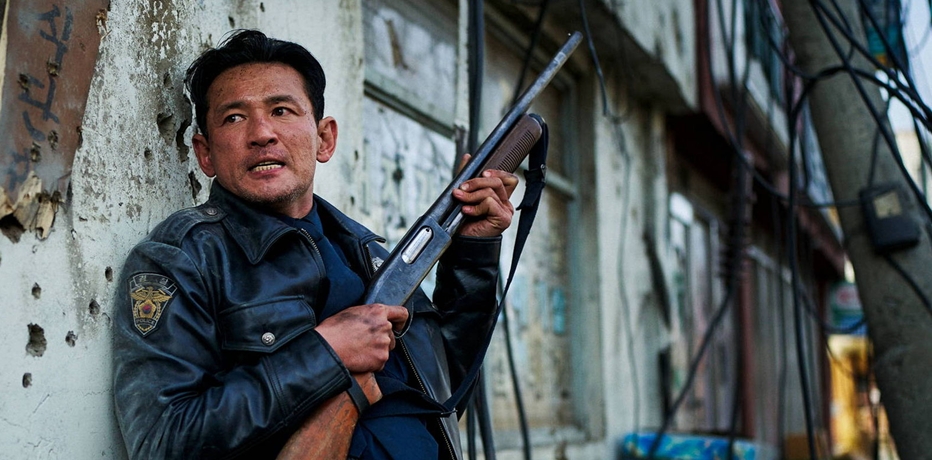
The film tells the story of an alien invasion in a small town in the Republic of Korea, the director’s homeland. We’re in Hope Harbor, a tiny seaside village, and everything begins with the discovery of a mutilated cow’s carcass, on which the local police chief, Ko Bum-seok, is called to investigate. In the first part, we follow the protagonist officer (Hwang Jung-min, delivering a solid performance) as he tries to understand what is seeding chaos and massacres in his community. We see him oscillate between extreme courage and cowardice, with the latter appearing to slightly prevail over the former. In this first phase of the film, as viewers, like the protagonist, we are unaware of the actual threat, and until it is revealed to us, we are led to believe the film may play on the famous concept of invisible evil.
Here the director seems to be highlighting the complete lack of control by the authorities over what surrounds them: citizens respect the protagonist in his role as a public official, but are perfectly capable of arranging themselves and at least attempting to defend themselves alone. Curious and indicative, moreover, is that all the female figures appear more agile and tougher than he.
Well, this superficial discussion about the weak male and the inadequacy of institutions disappears entirely in the second half. The protagonist has his revenge scenes, but they are not justified by any real character development, and the film settles into pure action and the clash between man and alien. The premises built up so far lose all weight. The scenes remain interesting, and some are decidedly entertaining. At times the film seems to pay homage to Tarantino: directly, with the recreation of the famous low-angle shot from Bastardi senza gloria, and indirectly, with a violence (here sci-fi) that verges on the comic.
Photography, visual effects and sound
Technically, the film doesn’t suffer from major flaws: the direction is focused, the cinematography is good but not exceptional. Hong Kyung-pyo’s signature, already working alongside the director in The Wailing. I expected the visual style typical of Korean cinema, which, on its own, usually suffices to get me to the cinema; here, however, it’s clear the film was conceived to transcend national boundaries, as evidenced by the record-breaking budget and a cast blending Korean and Western faces, including Michael Fassbender and Alicia Vikander. Curiously, it’s the Western actors who play the aliens: a choice that might suggest a political reading, but the film doesn’t seem to intend to explore it further.
As for the aliens, rendered in CGI, I remain in the middle: in some scenes they are perfectly integrated into the environment and appear to have been crafted with care, while in others the disconnect from the background is quite noticeable.
The music is by Michael Abels (Get Out, Nope) and may be one of the film’s most successful elements: a powerful orchestral score, almost of a bygone era, that well accompanies the tension of the first part. The soundscape is very intense and keeps the adrenaline high, though in the second half it occasionally risks becoming tiresome.
Criticism
The real limit is the editing. The film runs for two hours and forty minutes, yet the space devoted to the aliens’ story is minimal, and by the end, one understands very little. The suspicion is that the answers are pushed to a next chapter: the ending leaves the door open, and the rumours of a sequel seem to confirm it.
Behind the scenes
Before the conclusions, let’s try to put the film in context. Hope is the most expensive film in Korean cinema history (the figure is over 50 billion won), a record for Korea but still far below the budgets of American blockbusters, and this in part explains the limitations of the CGI. It is also the first film by Na Hong-jin to enter the Competition at the Cannes Film Festival, where it was presented in global premiere, and arrives ten years after his last work, The Wailing. In the cast, besides Hwang Jung-min, we find Zo In-sung and Hoyeon (already seen in Squid Game). As one can infer, it was definitely a film eagerly anticipated.
Interesting too is the work behind it: roughly eight years of development, shot at Haenam, on the southern coast of Korea, and, according to the director himself, over 400 shots featuring creatures. The action scenes with the actors were filmed as much as possible in real life, and this may explain why the most physically intense moments turn out to be the most successful. Unusual also is the choice to show the aliens in full daylight, when cinema usually hides them in the dark (also to save money): a bold choice, which nevertheless seems to partly explain the disconnect with the background I mentioned earlier.
In conclusion
In essence, Hope is a film I recommend for two hours and forty minutes of good entertainment, but it remains distant from that Korean cinema capable of uniting entertainment and depth, to which the director seemed to aspire in the first part.
About the Author