
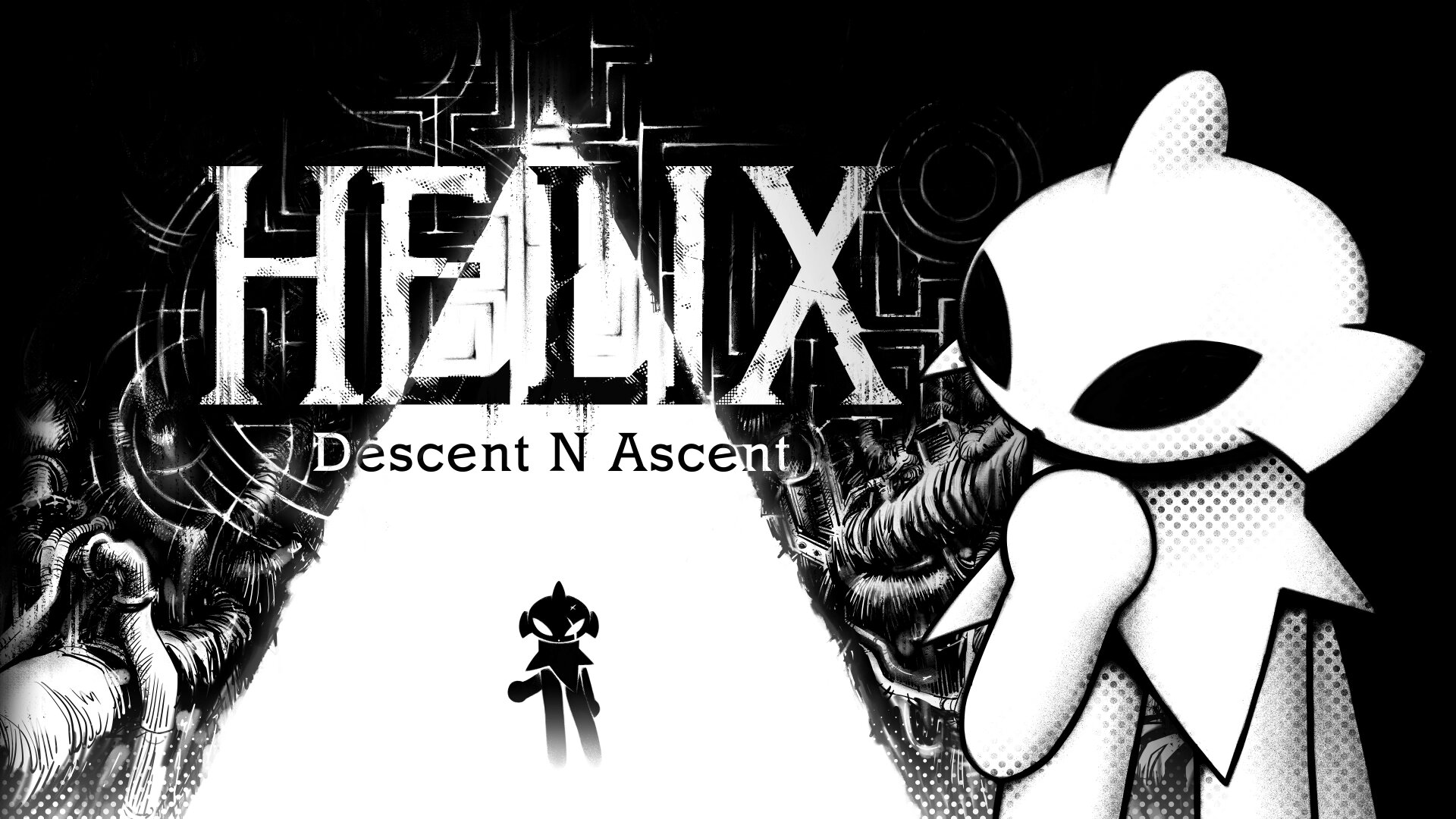
Helix: Descent N Ascent It looks like a puzzle game elegant, totally in black and white, able to seduce at first sight with aaesthetics which recalls the black and white indie comics of the 1980s, the 90's manga and the 70's Franco-Belgian comic book. But behind that refined patina there is a much darker experience and ♪ of how much the monochrome lets intuition.
This content is provided by Steam. To view it, you must allow external content. Activation may result in data being shared with the third party.
When freedom becomes lost
There's not one word in the whole game. No dialogue, no explicit narrative frame, no voice to guide you. The protagonist literally comes from a seed that falls to the ground. From that moment on, you only have to understand where you are, what you have to do and why. There is a tutorial, of course, but it is so blurred in its boundaries that it is natural to wonder whether it is really ever finished or whether, in reality, the whole game is a tutorial that never ends.
The basic idea is fascinating on the card, or leave the player the maximum freedom of exploration, decipher, mistake and start over but as in every puzzle game that you respect, the key to solving the puzzle must remain hidden without ever losing completely. It must be left a thread, however thin, that allows the intuition to work. Too often here the solution comes by chance, or after "aligned planets" you didn't even know about existence. I glifi and cryptic languages scattered around the game world require a time of understanding that I would call honestly frustrating, more than stimulating.

History: duality, aliens and urban ruins
The plot remains deliberately wrapped in mystery, and in a certain sense lies: the game builds from the beginning a duality net between black and whitebetween you and a doppelgänger that pursues you throughout the adventure, identical to you but always in contrast — ally or enemy, it is never clear. The world of Helix is a forgotten landa, halfway between suggestions aliens and an urban context dystopian and polluted, ruined. The thematic package promises a reflection on identity identity, solitude and human relations, intertwined with memories of a past existence.
The problem is that this promise struggles to transform itself into real narrative tension. What should push you forward in addition to pure curiosity? The collection of Collectables — scattered pages in illustrations, paintings, fragments of a story to be deciphered — is the only real engine that the game offers. It is a setting that works until the thrill of discovery remains alive, but that is consumed quickly when you understand that the "thing I'm looking for" never really changes: always and only material, always and only pieces to collect.

Gameplay: four powers, many ideas, a broken rhythm
Here. Helix shows its best side. The idea of a character progressively acquires powers to be combined in a creative way is clear and, above all in the first area, taught with intelligence: you start without skill, pushing objects and activating pressure levers, and then unlock the first real ability, to evoke blocks heavy to place on switches or launch in water to create a passage. You can keep two active at a time; the third makes the oldest disappear. From there onwards come a drone capable of slipping into the air ducts, claw that allows to attract objects or to hook to surfaces to swing over the gaps, one sphere that captures small creatures to carry where they serve, and — perhaps the most interesting power — the ability to move between white shape and that black, because certain platforms, certain objects and even whole paths exist only in one of the two colors.
Each skill arises from a pedestal marked by a glyph unique, decoration seemingly fine to itself in the first area but which becomes fundamental in the second, when the game begins to ask you to equip two powers at the same time and to let you choose freely what goal to deal with among the many available. This is where the experience really opens, and the combinations between powers return more than a moment "eureka" Genuine: throw the catch-creature ball on the drone to make it fly to an unreachable target, or kick a block only visible in one of the two chromatic forms to open a gap otherwise impossible.
But this is where the game loses the balance between freedom and guide. To understand that some mini-dungeon They demanded the exact combo of powers cost me a time that I consider excessive, and on at least two different occasions I found myself stuck in a blind alley — neither ramp nor blocks on the water allowed me to go back — for 15-20 good minutes, until I have to go out and return to the game to unlock the situation. A puzzle game can and must test, but should never force you to a Force reset for a sequence error.

There is then a problem of feedback: Once a dungeon has been resolved, the game does not communicate clearly that it has been completed. It would be enough a small note, a different color, an icon on the map — especially for those who, as often happens, play short sessions and spaced over time and struggle to remember what he has already faced and what not.
I'm not the only one who noticed these frictions. The lack of a clear trace of progress compels you to return several times in the same areas only to check if something is missing to collect, and the fact that changing the powers equipped asks to return physically tocentral hub each time ends up weighing a lot on the rhythm, especially in the longer sessions dedicated to full exploration. After passing many hours of play I imagined that, with some insight on quality of life and a more consistent system of clues in the advanced stages, the time needed to complete the adventure could have halved without losing anything of the challenge.

Even the Asian community, enthusiastic about the care with which the puzzles were designed — to the point of comparing the title to a small "metroidvania to Zelda" for the year — raised a rather serious problem and that I totally share: at the first recovery of the final collectible object of one of the macro-areas, the game resets all the dungeon of that area, forcing to remake paths already completed in order to reopen passages necessary to discover the hidden secrets. A defect that risks itself to ruin the entire experience of 100% completion.
To signal also the phases platform inside the arcade machines scattered around the world of play: small vertical challenges, themed with the dungeon to which they are connected, which act as a primary objective before being able to access the real dungeons, each with a normal variant and a decidedly more ostical. I'm probably the most " partold school" and direct of the package, a tribute declared to classic arcade platformer, and remain among the most simply enjoyable moments of all experience.

Graphics
I have no reservations on this front. The artistic direction, the structural and stylistic choice of black and white are absolutely clear: the contrast has a magnificent yield, so much to "explode" literally on OLED screens, as reported by other players. I have not experienced traumatic or dysfunctional experiences due to graphical glitch or slowdowns, even on the laptop I'm using in this summer period. U and menu are reduced to the bone, little explained but perfectly consistent with the minimalist philosophy of the game.

Audio
The soundtrack deserves a separate speech. It's atmospheric. Hypnotics. Almost obsessive. It was probably just the effect sought by developers. Personally, however, after a few hours I preferred to completely lower the volume. It is one of the rare times when I volunteer to silence the music of a video game. Not because it is wrong, but because, combined with the continuous trial process required by the puzzles, it ended up increasing that feeling spaesation and mental fatigue that accompanies much of the experience.

Conclusions
Helix: Descent N Ascent is one of those games that you immediately perceive as the fruit of a strong authoritarian vision. Original. Brave. Aesthetically magnificent. With some ideas of Gameplay Really brilliant. But precisely this will to leave total freedom to the player often ends up turning into his main limit.
The impression is that the development team deliberately eliminated any form of guidance to avoid compromising the sense of discovery. The result, however, is that too often you do not feel smart after solving a puzzle: you just feel lucky.
For this reason, today, I struggle to recommend it to everyone. I see it as a title destined for a niche very precise: the fans of puzzle game more ostic, those who find satisfaction in trying and retry dozens of solutions without any external help. For all others, a simple optional mode would be enough "Guided", with some contextual clue, better visual management of dungeon completed and some insights of quality of life — from the change of powers without having to return every timehub — to make the experience much more accessible without distorting the philosophy of the project.
Despite criticism, I do not consider Helix a failure. In fact: it is one of those games that deserve respect for the courage of their ideas. I will continue to play, because I want to understand the vision of developers. But, at least in the current state, it is a title that I admire much more than I really managed to catch.
About the Author

Biography
- Direttore di KotaWorld.itRecent Articles
- Box Knight Review PC: the office becomes a roguelite
- GTA VI will have an official 34-piece album: Travis Scott, Yung Lean and Keith Richards among the first artists
- Golden Swirl is available on Steam
- GTA 6, here are the most absurd fake news to date
- Acer a IFA 2026: all news between Predator Atlas 7, monitor 1000 Hz, Swift Blade 14, Vero 16, Aspire, Veriton AI and RTX Spark